
Absent vs absence is a common grammar question that confuses many English learners. These two words look similar, but they have different meanings and different jobs in a sentence. Using the wrong one can make your writing sound incorrect.
The good news is that the difference is easy to understand. Absent describes a person or thing that is not present. Absence is the noun that refers to the state or period of being away.
In this guide, you will learn the meaning of each word, simple grammar rules, real-life examples, common mistakes, and memory tricks. By the end, you will know exactly when to use absent and when to use absence in everyday English.
Quick Summary (Featured Snippet)
- Absent is usually an adjective.
- Absence is a noun.
- Absent means someone or something is not present.
- Absence means the state or period of being away.
- Use absent to describe people or things.
- Use absence to name the condition of not being present.
What Does “Absent” Mean?
Absent means not present in a place where someone or something is expected to be.
It usually works as an adjective.
Examples
- Sarah was absent from school today.
- My teacher was absent yesterday.
- He seemed mentally absent during the meeting.
- Two players were absent from practice.
- The manager remained absent for the conference.
Simple Definition
Absent = Not present.
What Does “Absence” Mean?
Absence means the state, condition, or period of not being present.
It is a noun.
Examples
- Her absence worried everyone.
- His long absence surprised his friends.
- The school recorded three days of absence.
- We noticed your absence at the meeting.
- The team struggled during the captain’s absence.
Simple Definition
Absence = The state of being away.
Absent vs Absence: Comparison Table
| Feature | Absent | Absence |
|---|---|---|
| Part of Speech | Adjective | Noun |
| Meaning | Not present | State of being away |
| Describes | A person or thing | A condition or period |
| Used After | Be verbs (is, was, were) | Articles and possessives |
| Example | She is absent. | Her absence surprised us. |
Absent vs Absence in Simple Words
Think about it this way.
- Absent describes someone.
- Absence names the situation.
Easy Example
✅ Tom is absent today.
✅ Tom’s absence surprised the teacher.
The first sentence describes Tom.
The second sentence talks about the situation.
Grammar Rules for Absent and Absence
Understanding grammar makes choosing the right word much easier.
Use “Absent” When
- Describing someone who is missing.
- Following linking verbs like is, was, or were.
- Talking about physical or mental presence.
Examples
- She is absent today.
- They were absent yesterday.
- His attention was absent.
Use “Absence” When
- Naming the condition of being away.
- Talking about a period of time.
- Referring to attendance records.
Examples
- His absence lasted two weeks.
- We explained her absence.
- The absence of evidence is important.
Real-Life Examples of Absent vs Absence
School
Correct:
- Emma was absent today.
- Emma’s absence was recorded.
Incorrect:
- Emma was absence today.
- Emma’s absent was recorded.
Work
Correct:
- John was absent from work.
- John’s absence affected the project.
Home
Correct:
- Dad is absent this weekend.
- Dad’s absence feels strange.
During Sports
Correct:
- Three players were absent.
- Their absence weakened the team.
Common Mistakes People Make
Many English learners mix these words because they look alike.
Mistake 1
❌ She is absence today.
✅ She is absent today.
Mistake 2
❌ His absent worried everyone.
✅ His absence worried everyone.
Mistake 3
❌ The teacher marked my absent.
✅ The teacher marked my absence.
Mistake 4
❌ Their absence from class were expected.
✅ Their absence from class was expected.
How to Remember the Difference
These simple tricks help many learners.
Trick 1
Absent describes.
Absence names.
Trick 2
If you can replace the word with missing, use absent.
Example:
She is missing.
She is absent.
Trick 3
If you need a thing or condition, use absence.
Example:
His absence lasted two days.
When Should You Use Absent?
Use absent when describing a person or thing that is not present.
Examples:
- My friend is absent today.
- Several students were absent.
- The manager remained absent.
- Interest was absent during the lecture.
- He looked absent-minded.
When Should You Use Absence?
Use absence when talking about the state of being away.
Examples:
- Her absence caused delays.
- We noticed your absence.
- His absence was unexpected.
- The absence lasted a week.
- Their absence affected the results.
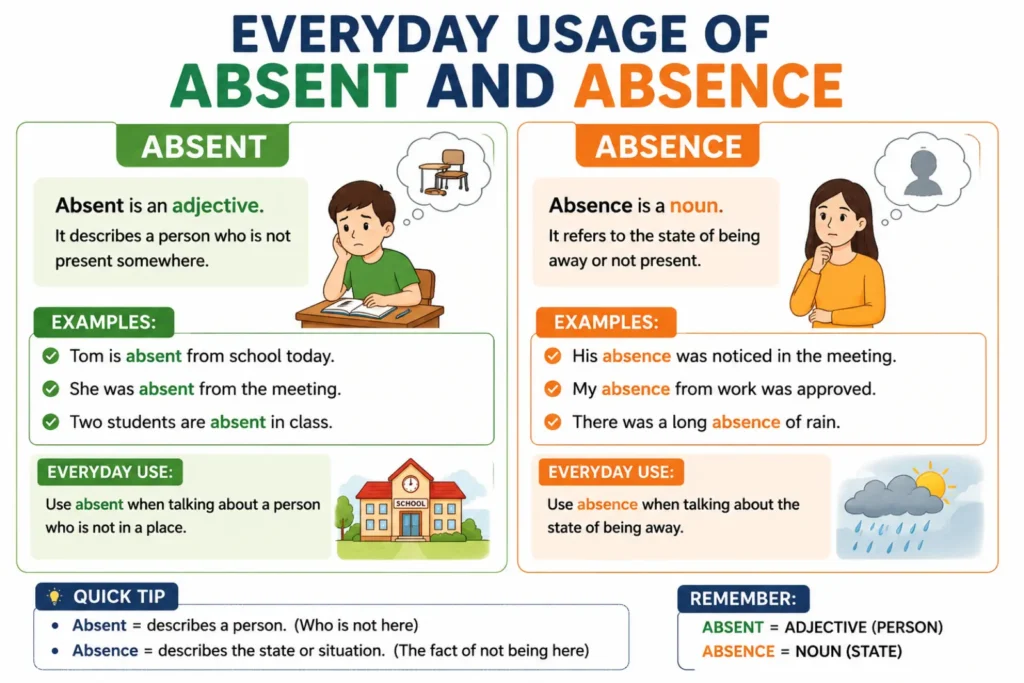
Everyday Usage of Absent and Absence
You will hear these words in many situations.
School
- absent student
- school absence
- absence record
Office
- absent employee
- leave of absence
- absence policy
Medical
- absent reflex
- prolonged absence
- temporary absence
Sports
- absent player
- captain’s absence
Synonyms and Related Words
Absent
- Missing
- Away
- Gone
- Unavailable
- Missing from
- Not present
Absence
- Nonattendance
- Lack
- Unavailability
- Vacancy
- Missing period
- Leave
LSI Keywords
- absent meaning
- absence meaning
- absent definition
- absence definition
- absent in a sentence
- absence in a sentence
- absent grammar
- difference between absent and absence
- absent vs absence examples
- absent or absence
- attendance words
- English grammar guide
Real-Life Scenario
Imagine your teacher asks why Ali did not attend class.
Correct:
Ali was absent yesterday.
Later, the teacher writes in the attendance book:
Ali’s absence has been recorded.
The first sentence describes Ali.
The second sentence describes the event.
Expert Insight
Grammar experts recommend learning the part of speech before memorizing similar words.
When you know whether a word is a noun or an adjective, choosing the correct one becomes much easier.
Many grammar mistakes happen because writers focus on spelling instead of sentence structure.
A simple grammar check before publishing can improve both clarity and professionalism.
FAQs:
Is absent a noun or an adjective?
Absent is mainly an adjective. It describes someone who is not present.
Is absence a noun?
Yes. Absence is a noun that refers to the state of being away.
Which is correct: absent from school or absence from school?
Both are correct.
- He was absent from school.
- His absence from school was excused.
Can absent be used as a verb?
Yes, but it is uncommon.
Example:
- He absented himself from the meeting.
What is the difference between absent and absence?
Absent describes someone who is not present.
Absence names the condition of being away.
Is “leave of absence” correct?
Yes.
“Leave of absence” is the standard English expression for approved time away from work or school.
Can I say “I am absence today”?
No.
Correct:
I am absent today.
Which word is used in attendance records?
Usually absence is recorded, while a student is marked absent.
Featured Snippet Answer
What is the difference between absent and absence?
Absent is an adjective that describes a person or thing that is not present. Absence is a noun that refers to the condition or period of being away. For example, “She is absent today,” but “Her absence was noticed.”
Internal Linking Suggestions
To improve your site’s SEO, consider linking this article to:
- Difference Between Affect and Effect
- Then vs Than Explained
- Lose vs Loose
- Their vs There vs They’re
- Principal vs Principle
- Who’s vs Whose
- Everyday vs Every Day
- Advice vs Advise
Conclusion
Understanding absent vs absence is much easier once you know their grammar roles. Absent is an adjective that describes someone or something that is not present. Absence is a noun that refers to the condition or period of being away. Although these words are closely related, they serve different purposes in a sentence. Using the correct word makes your writing clearer and more professional. Practice with real-life examples, remember the simple grammar rule, and review the comparison table whenever you feel unsure. With regular practice, choosing between absent and absence will become natural, helping you write and speak English with greater confidence.

Michael Reed is a language content writer and word comparison researcher based in the United States. He studied English Language and Communication and focuses on grammar, spelling differences, and word usage. His work helps readers understand confusing English words through clear comparisons and practical explanations. Michael creates simple, reader-friendly content designed to improve everyday language skills.