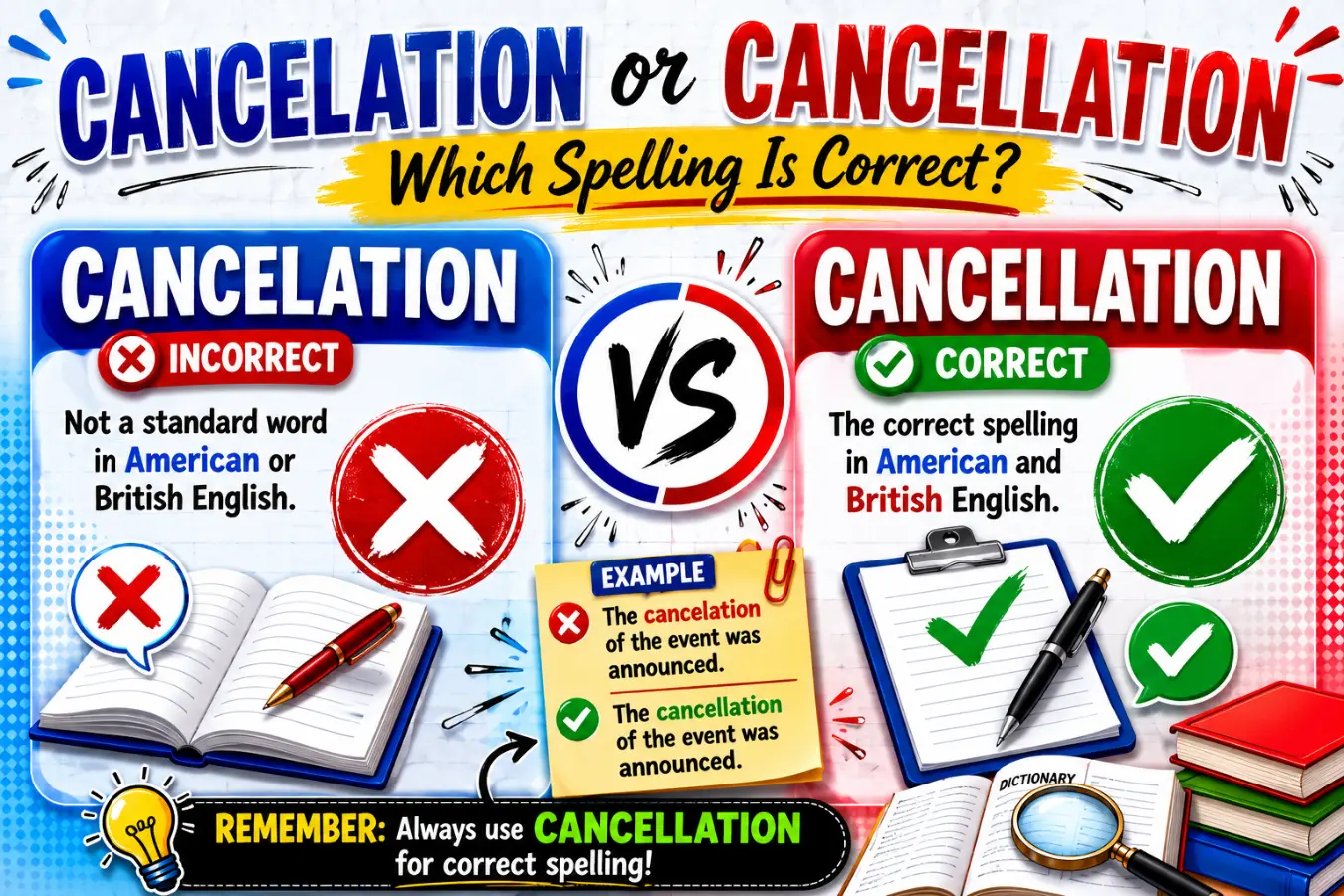
Cancelation or cancellation is a common spelling question that confuses many writers. Both words look similar, but only one is widely accepted in modern English.
If you write emails, reports, blogs, or school papers, you may wonder which spelling to use. The answer depends on the type of English and the style guide you follow.
Many people accidentally use the wrong version. As a result, their writing may appear less professional. Fortunately, the difference is easy to understand.
In this guide, you’ll learn the meaning of both spellings, discover which one is preferred, see real-life examples, and avoid common mistakes. By the end, you’ll know exactly when to use cancelation and when to use cancellation.
Quick Summary Box
Featured Snippet Answer
- Cancellation is the standard and most widely accepted spelling.
- Cancelation is an alternative spelling but is much less common.
- Most dictionaries, style guides, and businesses prefer cancellation.
- Use cancellation in formal writing, academic work, and professional communication.
- Both words mean the act of canceling something.
What Does Cancellation Mean?
Cancellation means the act of stopping, ending, or calling off something that was planned.
Examples include:
- Flight cancellation
- Event cancellation
- Subscription cancellation
- Appointment cancellation
The word comes from the verb cancel, which means to stop or withdraw something.
Simple Definition
Cancellation = the act of canceling something.
Cancelation or Cancellation: Which Is Correct?
The correct and preferred spelling is cancellation.
While cancelation appears in some dictionaries, it is considered a less common variant.
Most professional writers, editors, teachers, and businesses use cancellation.
Quick Answer
✅ Cancellation — Preferred spelling
⚠️ Cancelation — Rare alternative spelling
Cancelation vs Cancellation Comparison Table
| Feature | Cancelation | Cancellation |
|---|---|---|
| Meaning | Act of canceling | Act of canceling |
| Correct? | Technically acceptable | Yes |
| Common Usage | Rare | Very common |
| Preferred by Style Guides | No | Yes |
| Used in Business Writing | Rarely | Frequently |
| Used in Academic Writing | Rarely | Yes |
| Recommended Choice | Not usually | Yes |
Why Does Cancellation Have Two L’s?
Many English words double a consonant before adding a suffix.
Examples:
| Base Word | New Word |
|---|---|
| Cancel | Cancellation |
| Admit | Admission |
| Commit | Commitment |
| Permit | Permission |
The doubled “l” follows common English spelling patterns.
That is why cancellation became the dominant spelling.
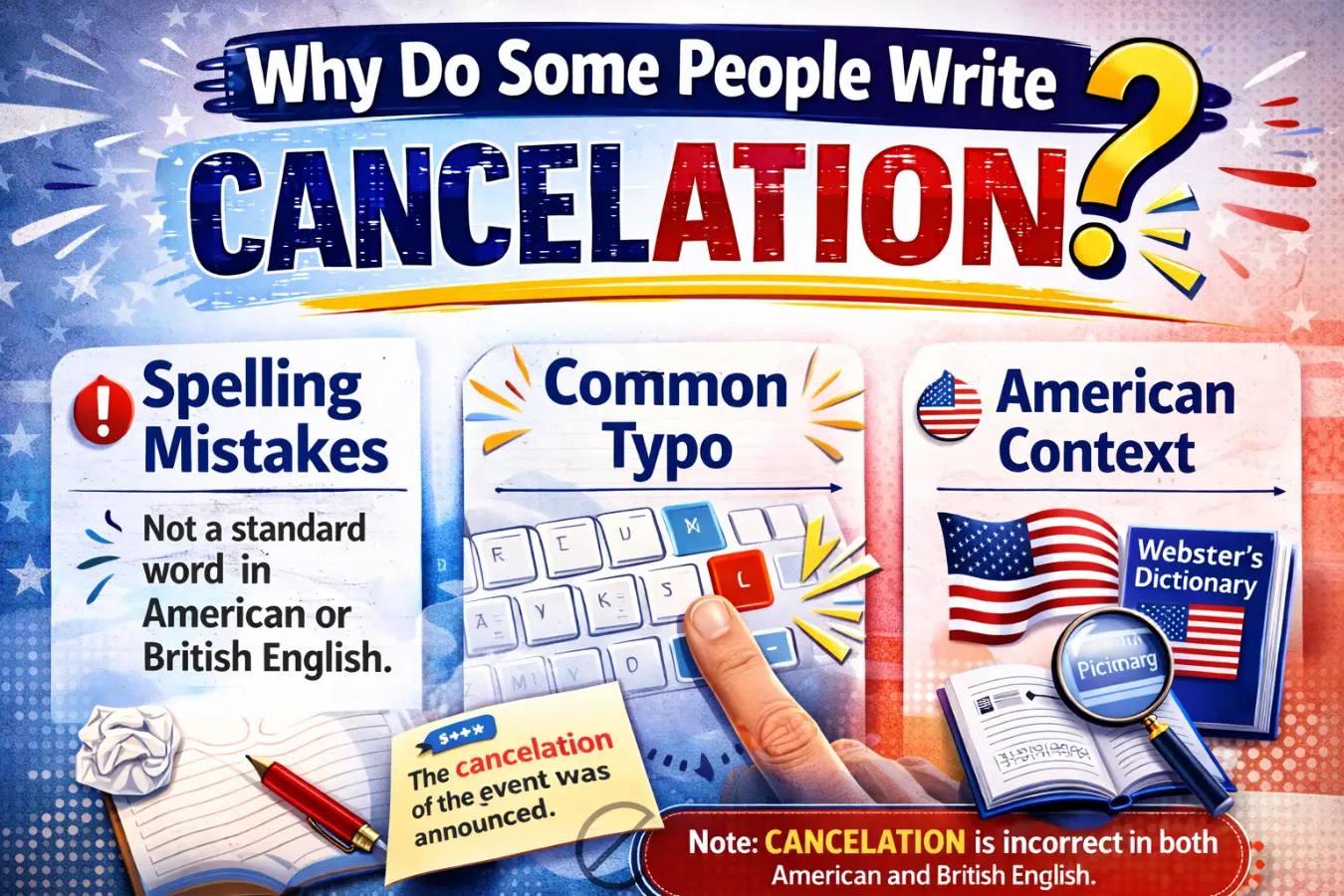
Why Do Some People Write Cancelation?
People often write cancelation because the base word cancel contains only one “l.”
They assume the noun should follow the same pattern.
For example:
- Cancel → Cancelation
This seems logical. However, standard English evolved differently, making cancellation the preferred spelling.
Cancellation in American English vs British English
Interestingly, both American and British English strongly favor cancellation.
Unlike some spelling differences such as:
- Color vs Colour
- Organize vs Organise
There is no major regional split here.
Both language varieties generally prefer:
✅ Cancellation
Not:
❌ Cancelation
Real-Life Examples of Cancellation
Here are common situations where the word appears.
Travel
- The airline announced a flight cancellation.
Healthcare
- The clinic sent a cancellation notice.
Education
- School cancellation occurred due to bad weather.
Entertainment
- Fans were disappointed by the concert cancellation.
Business
- The company issued a cancellation refund.
Example Sentences Using Cancellation
These examples show proper usage.
- The cancellation fee was higher than expected.
- We received a cancellation email this morning.
- Her appointment cancellation surprised the staff.
- The event cancellation affected hundreds of guests.
- Subscription cancellation can be completed online.
Is Cancelation Ever Correct?
Yes, but it is uncommon.
Some dictionaries list cancelation as a secondary spelling.
However, most publishers, editors, and organizations avoid it.
If you want your writing to look professional, choose:
Cancellation
This choice prevents confusion and aligns with modern usage.
Common Mistakes People Make
Mistake 1: Using Cancelation in Formal Writing
Many writers use the shorter spelling in business documents.
Better choice:
✅ Cancellation
Mistake 2: Mixing Spellings
Example:
- The cancellation policy explains all cancelation requests.
Choose one spelling and stay consistent.
Mistake 3: Assuming Shorter Means Correct
Shorter spellings are not always preferred.
Professional writing usually favors cancellation.
Easy Trick to Remember the Correct Spelling
Use this simple memory tip:
Double L = Official Choice
Think:
Cancel → Cancellation
The extra “l” appears before adding “-ation.”
Whenever you write emails, reports, or articles, remember:
Two L’s are safer than one.
Usage in Daily Life
You may see cancellation in many places.
Online Shopping
- Order cancellation
Streaming Services
- Subscription cancellation
Banking
- Card cancellation
Travel
- Ticket cancellation
Events
- Reservation cancellation
Because it appears so often, learning the correct spelling improves everyday writing.
Synonyms of Cancellation
These words have similar meanings.
- Termination
- Withdrawal
- Revocation
- Discontinuation
- Annulment
- Abandonment
- Suspension
- Rescission
- Repeal
- Nullification
Related LSI Keywords
- cancel spelling
- cancellation meaning
- cancellation definition
- cancelation vs cancellation
- correct spelling of cancellation
- cancellation examples
- cancellation policy
- booking cancellation
- service cancellation
- appointment cancellation
Why Correct Spelling Matters
Correct spelling builds trust.
Readers often judge professionalism by writing quality.
Using cancellation helps:
- Improve credibility
- Avoid confusion
- Meet style guide standards
- Create polished content
- Strengthen business communication
Even a small spelling error can affect first impressions.
Expert Insights
Language experts and editors overwhelmingly recommend cancellation.
Major dictionaries and writing guides list it as the primary spelling.
Professional organizations use it in:
- Contracts
- Policies
- Customer service documents
- Academic publications
- Government forms
For SEO content, business communication, and professional writing, cancellation remains the safest choice.
Expert Tip
When in doubt, use cancellation with two “l” letters.
You will match the spelling used by most native English writers.
FAQs
Is cancellation or cancelation correct?
Both exist, but cancellation is the preferred and standard spelling.
Why is cancellation spelled with two L’s?
English spelling conventions commonly double consonants before certain suffixes.
Is cancelation wrong?
Not completely. It is an accepted variant but is much less common.
Which spelling should I use in professional writing?
Use cancellation in all professional, academic, and business writing.
Do Americans use cancellation?
Yes. American English strongly prefers cancellation.
Do British writers use cancellation?
Yes. British English also favors cancellation.
Which spelling appears more often online?
Cancellation appears far more frequently across websites, books, and publications.
How can I remember the correct spelling?
Remember: official writing uses two L’s — cancellation.
Internal Linking Suggestions
To strengthen SEO, link this article to:
- Common English spelling mistakes
- Cancel vs cancelled
- American vs British spelling differences
- Grammar rules for doubled consonants
- Frequently confused English words
Conclusion
The debate over cancelation or cancellation has a simple answer. While both spellings exist, cancellation is the standard and preferred form in modern English. It appears in dictionaries, business documents, academic writing, and everyday communication. Although cancelation is sometimes accepted as a variant spelling, it remains uncommon and may look incorrect to many readers.
If you want clear, professional, and polished writing, use cancellation with two “l” letters. This spelling matches current usage and helps avoid confusion. The next time you write about a flight, appointment, event, or subscription ending, choose cancellation with confidence.

James Carter is a comparison writer and research specialist with over 10 years of experience in digital publishing. With a background in business communication and consumer research, he creates detailed comparison articles, buying guides, and reviews that help readers make informed decisions with confidence. “Every comparison should help readers make better decisions. My goal is to turn complex information into clear, practical guidance that people can trust.” — James Carter