
Consigner or consignor is a common question for anyone dealing with shipping, logistics, legal documents, or business contracts. Both words appear online, but only one is widely accepted in professional English. Choosing the correct spelling helps you write clearly and avoid costly mistakes in business communication.
Many people see both spellings in forms, websites, and documents. This creates confusion. Fortunately, the difference is simple to understand. Once you know the meaning, you can use the correct word with confidence.
In this guide, you’ll learn the definition, correct spelling, examples, grammar rules, common mistakes, and practical tips. You’ll also see a comparison table, FAQs, and expert advice to help you remember the right choice.
Quick Summary
- Consignor is the standard and correct English spelling.
- A consignor is the person or company that ships goods.
- Consigner is a less common spelling and is usually considered incorrect in modern business English.
- Shipping, logistics, and legal documents almost always use consignor.
- Remember: Consignor sends the shipment.
Featured Snippet Answer
Consignor is the correct and widely accepted spelling. A consignor is the person or business that sends goods to another person or company, known as the consignee. While consigner appears occasionally, professional dictionaries and shipping industries prefer consignor.
What Does Consignor Mean?
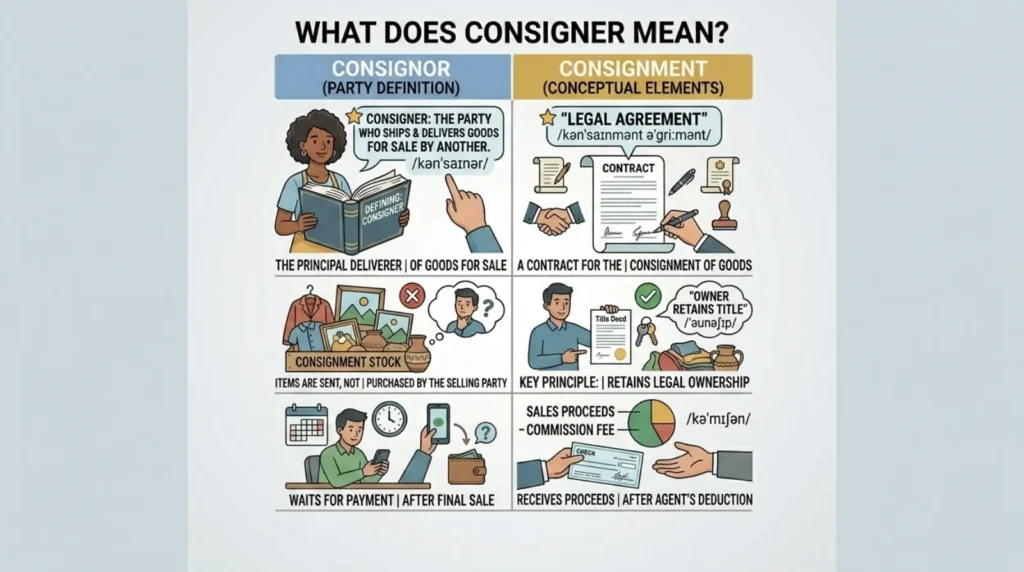
A consignor is the owner or sender of goods.
The consignor gives products to a carrier for delivery or sends them to a consignee for sale or storage.
Simple Definition
Consignor = The sender of goods.
The consignor may be:
- A manufacturer
- A wholesaler
- An exporter
- An online seller
- A business shipping products
What Does Consigner Mean?
A consigner is sometimes used by English speakers because it seems logical.
However, it is not the preferred spelling in shipping, legal writing, or commercial English.
Some older texts or regional sources may use consigner, but professional organizations almost always choose consignor.
In modern English:
- ✅ Consignor = Correct
- ⚠️ Consigner = Rare or nonstandard
Consigner or Consignor: Key Differences
| Feature | Consignor | Consigner |
|---|---|---|
| Standard English | ✅ Yes | ❌ Rare |
| Shipping industry | ✅ Used | ❌ Rarely used |
| Legal documents | ✅ Preferred | ❌ Avoid |
| Business contracts | ✅ Correct | ❌ Not recommended |
| Dictionaries | ✅ Listed | Sometimes listed as variant |
| Professional writing | ✅ Best choice | ❌ Usually avoided |
Why Is “Consignor” the Correct Spelling?
English forms many agent nouns with -or.
Examples include:
- creator
- donor
- lessor
- grantor
- vendor
- debtor
Similarly,
- consign → consignor
Business English adopted consignor as the standard spelling many years ago.
That is why you see it in:
- Bills of lading
- Shipping documents
- Export papers
- Customs forms
- Freight agreements
Real-Life Examples of Consignor
Here are common situations where consignor appears.
Example 1
A furniture company ships tables to a retailer.
The furniture company is the consignor.
Example 2
A farmer sends fresh apples to a supermarket.
The farmer is the consignor.
Example 3
An online store ships electronics to customers.
The online store acts as the consignor.
Example 4
An exporter sends clothing overseas.
The exporter becomes the consignor.
Example 5
A manufacturer ships car parts to distributors.
The manufacturer is the consignor.
Consignor vs Consignee
People often confuse these two terms.
| Term | Meaning |
|---|---|
| Consignor | Sends the goods |
| Consignee | Receives the goods |
Easy Trick
Consignor = Origin
Consignee = End destination
How to Use Consignor in Sentences
Here are correct examples.
- The consignor prepared the shipment.
- The consignor completed the customs paperwork.
- The carrier contacted the consignor.
- Every consignor must label dangerous goods correctly.
- The consignor paid the shipping charges.
Common Mistakes People Make
Many writers confuse these words.
Mistake 1
❌ The consigner shipped the package.
✅ The consignor shipped the package.
Mistake 2
Using consignor and consignee interchangeably.
Remember:
- Consignor sends.
- Consignee receives.
Mistake 3
Copying outdated documents that use consigner.
Modern business English prefers consignor.
Mistake 4
Assuming both spellings are equally common.
They are not.
Professional writing strongly favors consignor.
Tips to Remember the Correct Spelling
Learning one memory trick makes this easy.
Tip 1
Think:
Consignor sends goods.
Tip 2
Whenever you fill out shipping documents, choose consignor.
Tip 3
Read professional logistics forms.
You’ll almost always see consignor.
Tip 4
If you’re writing for work, avoid consigner.
Consignor in Daily Life
You do not need to work in shipping to hear this word.
Here are everyday examples.
Online Shopping
A seller shipping products becomes the consignor.
Small Business
A bakery sending cakes to stores acts as the consignor.
International Trade
Export companies become consignors.
Warehouse Distribution
Manufacturers shipping products to warehouses are consignors.
Retail Supply Chains
Suppliers often serve as consignors.
Synonyms and Related Terms
Related words include:
- Sender
- Shipper
- Exporter
- Supplier
- Owner of goods
- Freight sender
- Dispatcher
- Merchant
- Distributor
- Vendor
LSI Keywords
- consignor meaning
- consignor definition
- consignor vs consignee
- shipping terms
- logistics vocabulary
- freight terminology
- export documents
- bill of lading
- shipping sender
- transportation terms
- business English vocabulary
- cargo shipping terms
Grammar Rule Behind Consignor
English sometimes creates nouns using -or instead of -er.
Examples include:
| Verb | Noun |
|---|---|
| donate | donor |
| inspect | inspector |
| grant | grantor |
| vend | vendor |
| consign | consignor |
This is why consignor became the accepted business term.

Expert Insights
Professional communication depends on accurate terminology.
Using consignor shows that you understand modern business English and logistics vocabulary.
Small spelling mistakes can create confusion in contracts and shipping documents.
Businesses, exporters, freight companies, customs officers, and logistics professionals consistently use consignor because it follows accepted industry standards.
If you write about shipping, trade, or transportation, always use consignor unless quoting an older source.
FAQs
Is consignor or consigner correct?
Consignor is the correct and preferred spelling.
What is a consignor?
A consignor is the person or company that sends goods to another party.
Is consigner a real word?
Some dictionaries list it as a variant, but it is uncommon and rarely used in professional English.
Who receives goods from the consignor?
The consignee receives the goods.
Is consignor used in legal documents?
Yes. Legal contracts and shipping documents usually use consignor.
Can I use consigner in business writing?
It is better to avoid it. Use consignor for professional writing.
What is the difference between consignor and consignee?
The consignor sends goods, while the consignee receives them.
Internal Linking Suggestions
To improve SEO and user engagement, consider linking this article to related content such as:
- Consignor vs Consignee Explained
- Bill of Lading Meaning
- Shipper vs Carrier
- Freight Terms Every Business Should Know
- Common Shipping Vocabulary
- Export Documentation Guide
- Logistics Terms for Beginners
Conclusion
Understanding consigner or consignor is easier than it first appears. Although both spellings can occasionally be found, consignor is the accepted and preferred term in modern English. It refers to the person or business that sends goods to another party. The spelling consigner is uncommon and should generally be avoided in professional writing, shipping documents, and legal contracts.
Using the correct term improves clarity, builds credibility, and helps you communicate more effectively in business settings. Whether you work in logistics, international trade, e-commerce, or simply want accurate English, choosing consignor is the safest option. Remember one simple rule: the consignor sends the shipment, and the consignee receives it.

Michael Reed is a language content writer and word comparison researcher based in the United States. He studied English Language and Communication and focuses on grammar, spelling differences, and word usage. His work helps readers understand confusing English words through clear comparisons and practical explanations. Michael creates simple, reader-friendly content designed to improve everyday language skills.