
Laid up or layed up is a common question for English learners and native speakers alike. Many people wonder which spelling is correct. The answer is simple, but the grammar behind it can feel confusing.
English verbs often change form in unexpected ways. That is why many people write layed up by mistake. However, only one form is accepted in standard English.
This guide explains the difference in easy words. You will learn the correct spelling, see real-life examples, avoid common mistakes, and remember the rule with simple tricks. By the end, you will know exactly when to use laid up and why layed up is incorrect.
Quick Summary Box
- Correct phrase: Laid up
- Incorrect phrase: Layed up
- “Laid” is the past tense and past participle of lay
- “Layed” is not a standard English word
- Laid up usually means someone is sick, injured, or unable to do normal activities
- Example: She has been laid up with the flu for a week.
What Does “Laid Up” Mean?
Laid up is an idiom in English. It means someone cannot work or do normal activities because they are sick or injured.
It can also describe something that is not currently in use.
Examples
- John is laid up with a broken leg.
- My grandmother was laid up after surgery.
- The boat is laid up for the winter.
- She stayed laid up in bed for several days.
The phrase usually suggests that the condition lasts for some time.
Is “Layed Up” Correct?
No.
Layed up is not correct in standard English.
Many people create this spelling because they think every past tense ends in -ed. However, the verb lay is irregular.
Correct
- He was laid up after the accident.
- They were laid up with food poisoning.
Incorrect
- ❌ He was layed up after the accident.
- ❌ She has been layed up all week.
Always choose laid up.
Why Is “Laid” Correct?
The confusion comes from irregular verbs.
Here are the forms of lay.
| Verb Form | Word |
|---|---|
| Base Verb | Lay |
| Past Tense | Laid |
| Past Participle | Laid |
| Present Participle | Laying |
Notice that layed never appears.
Example
Present:
- I lay the book on the table.
Past:
- I laid the book on the table.
Present Perfect:
- I have laid the book on the table.
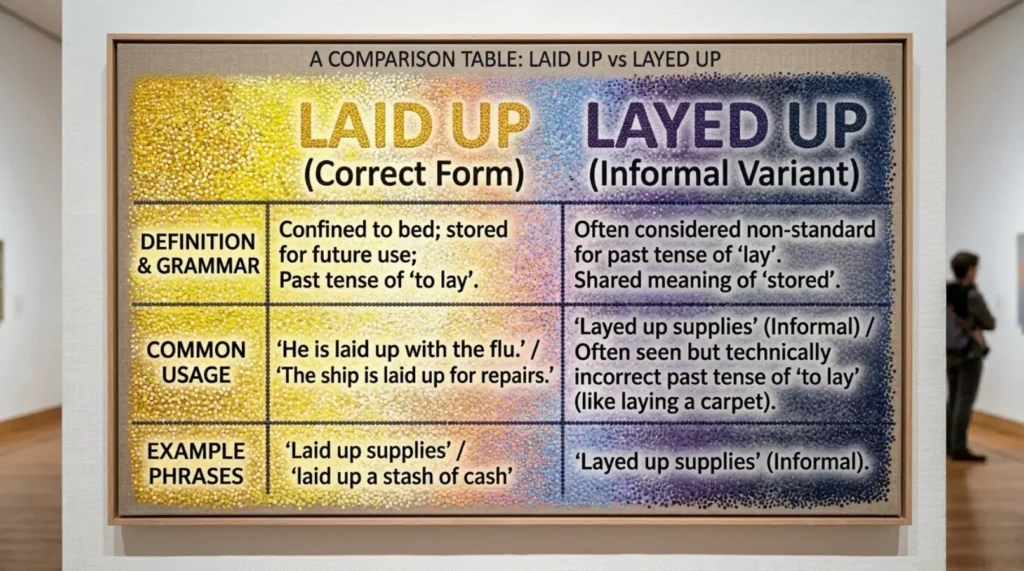
Laid Up vs Layed Up Comparison Table
| Feature | Laid Up | Layed Up |
|---|---|---|
| Correct English | ✅ Yes | ❌ No |
| Dictionary Word | Yes | No |
| Used by Native Speakers | Yes | No |
| Accepted in Writing | Yes | No |
| Recommended for Exams | Yes | No |
Winner: Always use laid up.
Real-Life Examples of “Laid Up”
Real examples help you remember grammar.
Illness
- Sarah has been laid up with the flu.
- Dad stayed laid up after heart surgery.
Injury
- Mike was laid up after breaking his ankle.
- She remained laid up for several weeks.
Vehicle or Equipment
- The ship is laid up until spring.
- Our old car has been laid up in the garage.
Sports
- The star player is laid up with a knee injury.
Why Do People Write “Layed Up”?
Several reasons explain this mistake.
1. They Add “-ed”
Many regular verbs form the past tense this way.
Examples:
- Walk → Walked
- Jump → Jumped
People expect:
- Lay → Layed
But English does not work that way here.
2. Irregular Verbs Are Confusing
Words like these often cause mistakes.
- Go → Went
- Eat → Ate
- Lay → Laid
3. Similar Pronunciation
Many learners hear laid and think it should be spelled layed.
Easy Trick to Remember the Correct Spelling
Remember this simple sentence:
You lay something down today. Yesterday, you laid it down.
Think of these examples.
Today:
- I lay the blanket on the bed.
Yesterday:
- I laid the blanket on the bed.
Never write layed.
Another memory trick:
Paid comes from pay.
Laid comes from lay.
Both change to -aid, not -ayed.
Using “Laid Up” in Daily Conversations
You will hear this phrase often in everyday English.
At Home
“I’m still laid up with a cold.”
At Work
“Our manager is laid Up after surgery.”
Talking About Family
“My uncle has been laid up for two weeks.”
Talking About Vehicles
“The motorcycle is Laid Up until the repairs are finished.”
Using this expression sounds natural and fluent.
Common Mistakes to Avoid
Many learners make these errors.
Mistake 1
❌ Layed up
✅ Laid up
Mistake 2
❌ He has layed in bed.
✅ He has lain in bed.
Mistake 3
Confusing lay and lie.
Lay needs an object.
Example:
- Lay the phone on the desk.
Lie does not.
Example:
- Lie on the sofa.
Synonyms and Related Words
These words have similar meanings depending on the sentence.
Synonyms
- Confined to bed
- Bedridden
- Recovering
- Resting
- Sick
- Injured
- Out of action
- Inactive
- Unable to work
- Recuperating
Related Search Terms
- laid up meaning
- laid up definition
- laid up in bed
- laid up with illness
- laid up with injury
- lay or laid grammar
- lay vs lie
- is layed a word
- laid meaning
- correct spelling of laid
Grammar Rule Behind “Laid”
Understanding the grammar makes the answer easy.
The verb lay means to put something somewhere.
Examples:
- Lay the keys on the table.
- Yesterday, I laid the keys there.
- I have laid the keys there already.
The verb lie means to rest.
Examples:
- I lie on the bed.
- Yesterday, I lay on the bed.
- I have lain on the bed all day.
This difference causes confusion because lay is both a present tense verb and the past tense of lie.

Expert Insights
Professional editors and grammar experts agree on one rule.
Use laid up in every formal and informal situation.
Major dictionaries recognize laid as the correct past form of lay.
Using the correct spelling improves your writing. It also makes your English look more professional. If you write layed up, readers may think it is a grammar mistake.
Good grammar builds trust. That matters for school, work, and online writing.
FAQs
Is “layed up” a real word?
No. Standard English does not recognize layed as the past tense of lay.
Which is correct: laid up or layed up?
Laid up is always correct.
What does “laid up” mean?
It means someone is sick, injured, or unable to do normal activities.
Can I say “I was layed up”?
No.
Say:
“I was laid up.”
Why do people spell it “layed”?
People often assume every past tense ends with -ed. However, lay is an irregular verb.
Is “Laid Up” formal?
Yes.
You can use it in both formal and informal English.
Can “laid up” describe vehicles?
Yes.
Example:
“The boat is Laid Up for the winter.”
How can I remember the correct spelling?
Remember this rule:
Pay → Paid
Lay → Laid
Neither becomes payed or layed in normal usage.
Featured Snippet Answer
Is it “laid up” or “layed up”?
The correct phrase is laid up. The word laid is the proper past tense and past participle of lay. The spelling layed up is incorrect in standard English. People use laid up to describe someone who is sick, injured, or unable to do normal activities.
Internal Linking Suggestions
To improve SEO and user engagement, link this article to related grammar topics such as:
- Lay vs Lie Explained
- Paid or Payed: Which Is Correct?
- Chose vs Choose
- Other or Others
- Youth or Youths
- Nosey vs Nosy
- Nil or Nill
- Consigner or Consignor
Conclusion
Choosing between laid up or layed up becomes easy once you know the grammar rule. Laid up is the only correct spelling in standard English. It refers to someone who is recovering from illness, healing from an injury, or temporarily unable to continue normal activities. Layed up is simply a common spelling mistake and should be avoided in both casual and professional writing.
Whenever you feel unsure, remember this simple pattern: pay becomes paid, and lay becomes laid. This quick trick helps you avoid one of the most common English spelling errors. By using laid up correctly, your writing will look clearer, more accurate, and more professional.

James Carter is a comparison writer and research specialist with over 10 years of experience in digital publishing. With a background in business communication and consumer research, he creates detailed comparison articles, buying guides, and reviews that help readers make informed decisions with confidence. “Every comparison should help readers make better decisions. My goal is to turn complex information into clear, practical guidance that people can trust.” — James Carter