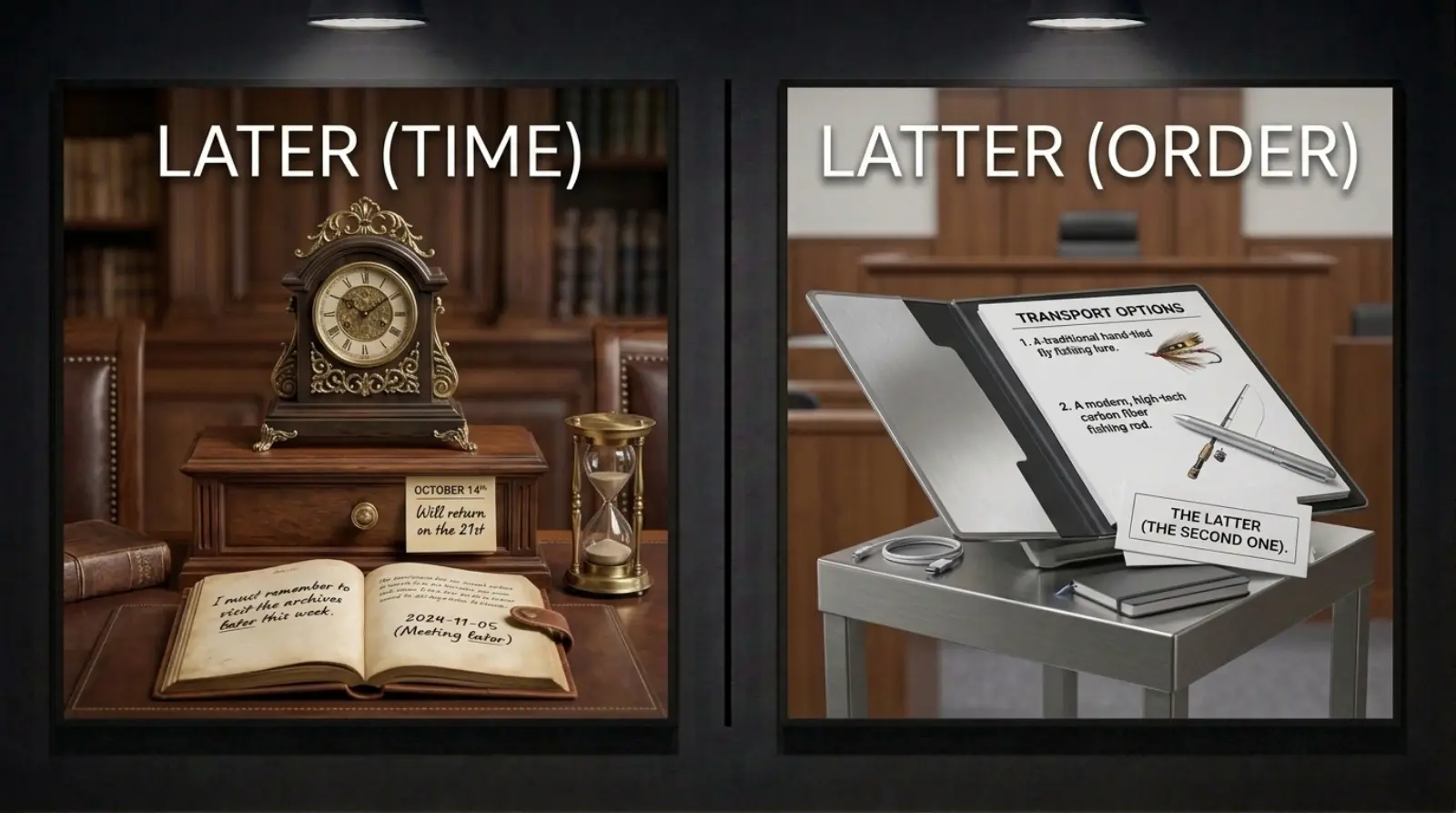
Later vs latter is a common grammar question for English learners and native speakers alike. These two words look similar, but they have different meanings. Using the wrong one can confuse your readers.
The good news is that the difference is easy to understand. Once you learn a simple trick, you will never mix them up again.
In this guide, you will learn what later and latter mean. You will also see comparison tables, real-life examples, common mistakes, and memory tips. By the end, you will know exactly when to use each word with confidence.
Quick Summary Box (Featured Snippet)
- Later means after a period of time.
- Latter means the second of two things mentioned.
- Use later for time.
- Use latter for choices or comparisons.
- Example: I’ll call you later.
- Example: Between tea and coffee, I prefer the latter.
What Does “Later” Mean?
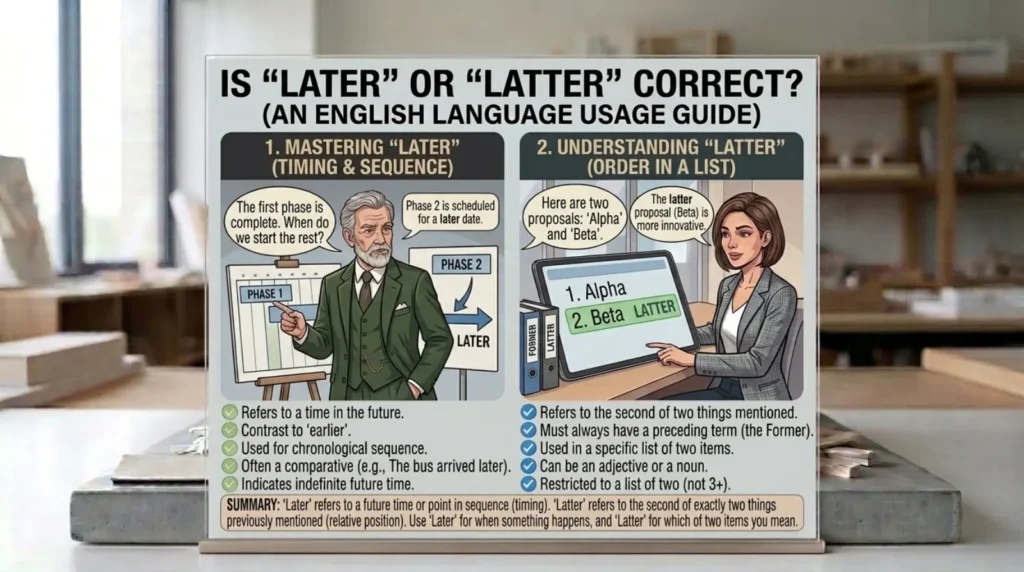
Later is an adverb or adjective that refers to time.
It means something happens after now or after another event.
Examples
- I will finish my homework later.
- See you later.
- We talked later that evening.
- She arrived later than expected.
- I’ll answer your email later today.
Key Idea
Whenever you talk about time, choose later.
What Does “Latter” Mean?
Latter is an adjective.
It means the second of two people, things, or ideas already mentioned.
Examples
- We visited London and Paris. I liked the latter more.
- You can travel by train or bus. The latter is cheaper.
- Tom and Jack played well. The latter scored twice.
- We discussed grammar and vocabulary. The latter was easier.
Key Idea
Whenever you refer to the second item in a pair, use latter.
Later vs Latter: Key Difference
| Feature | Later | Latter |
|---|---|---|
| Meaning | After some time | The second of two |
| Talks About | Time | Choice or comparison |
| Part of Speech | Adverb or adjective | Adjective |
| Opposite | Earlier | Former |
| Example | I’ll come later. | I prefer the latter. |
Later vs Latter in Simple Words
Think of these questions.
Ask yourself:
Are you talking about time?
Use later.
Example:
We will eat later.
Are you talking about the second option?
Use latter.
Example:
Between pizza and pasta, I chose the latter.
This simple question helps you choose the correct word every time.
Real-Life Examples of Later vs Latter
At School
Teacher:
“We have math first and science second.”
Student:
“I enjoy the latter.”
At Work
“I’ll send the report later.”
Shopping
“You can pay with cash or card.”
“I’ll use the latter.”
Friends
“I’ll call you later tonight.”
Reading Books
“I read two novels.”
“The latter was more exciting.”
Later vs Latter Comparison Table
| Sentence | Correct Word | Why? |
|---|---|---|
| I’ll see you ___ today. | Later | Refers to time |
| Between tea and coffee, I chose the ___. | Latter | Second choice |
| She arrived ___ than expected. | Later | Time |
| We watched two movies. The ___ was funny. | Latter | Second movie |
| Let’s finish this ___. | Later | Future time |
| We discussed grammar and writing. The ___ was harder. | Latter | Second topic |
Grammar Rules for Later and Latter
Use Later when:
- Talking about future time.
- Comparing events in time.
- Referring to something happening afterward.
Examples:
- I’ll do it later.
- Come back later.
- We met later that week.
Use Latter when:
- Comparing only two things.
- Referring to the second item.
- Pairing with former.
Examples:
- The former is cheaper.
- The latter is faster.
- I prefer the latter option.
Common Mistakes People Make
Mistake 1
❌ I’ll call you latter.
✅ I’ll call you later.
Reason:
You’re talking about time.
Mistake 2
❌ Between tea and coffee, I chose later.
✅ Between tea and coffee, I chose the latter.
Reason:
You’re choosing the second option.
Mistake 3
❌ The later option is better.
✅ The latter option is better.
Reason:
You mean the second choice.
Mistake 4
❌ See you latter!
✅ See you later!
Reason:
This expression always refers to future time.
Easy Trick to Remember Later vs Latter
Here’s a simple memory trick.
Later = Time
Think:
Later today
Later tonight
Later this week
All involve time.
Latter = Last Mentioned
The word latter begins with Lat.
Think:
Last Mentioned
It reminds you of the second item in a list.
Later vs Latter in Everyday Conversations
Conversation 1
A: Can you help me?
B: Sure. I’ll help you later.
Conversation 2
A: Do you want coffee or tea?
B: I’ll take the latter.
Conversation 3
A: Which phone do you like?
B: Between these two, I prefer the latter.
Conversation 4
A: Are you free now?
B: Not now. Maybe later.
Synonyms and Related Words
Synonyms of Later
- Afterwards
- Eventually
- Subsequently
- Soon
- Afterward
- Next
- Following
Related Words for Latter
- Second
- Last-mentioned
- Final of two
- Former and latter
- Second option
- Second choice
Later vs Latter in American and British English
Both American English and British English use later and latter in the same way.
There is no spelling difference.
The grammar rules stay the same.
Expert Tips for Using Later and Latter
- Remember that later always connects with time.
- Use latter only when two items appear.
- Avoid using latter for three or more choices.
- Read your sentence twice before choosing.
- Practice with everyday conversations.
These habits improve your grammar and make your writing clearer.
Featured Snippet: Later vs Latter
Later refers to a future time or something that happens afterward. Latter refers to the second of two people, things, or ideas already mentioned. Use later for time and latter for comparisons between two items.

FAQs:
Is it “see you later” or “see you latter”?
Use see you later because it refers to future time.
What does “the latter” mean?
It means the second of two things already mentioned.
Can “latter” refer to time?
No.
It refers to the second item in a pair, not time.
What is the opposite of “later”?
The opposite is earlier.
What is the opposite of “latter”?
The opposite is former.
Can I use “latter” for three choices?
No.
Use latter only when there are two choices.
Which word is more common?
Later appears more often in everyday conversation because people frequently discuss time.
How can I remember the difference?
Think:
- Later = Time
- Latter = Second choice
Related Keywords (LSI & Semantic Keywords)
- difference between later and latter
- later meaning
- latter meaning
- later vs latter examples
- latter definition
- later definition
- former and latter
- grammar mistakes
- English grammar tips
- commonly confused words
- later or latter
- latter in a sentence
- later in a sentence
Internal Linking Suggestions
You can internally link this article to related grammar topics, such as:
- Former vs Latter
- Then vs Than
- Affect vs Effect
- Farther vs Further
- Who’s vs Whose
- Everyday vs Every Day
- Stationary vs Stationery
- Lay vs Lie
Conclusion
Understanding later vs latter is easier than many people think. The key difference is simple. Later always relates to time, while latter refers to the second of two people, things, or ideas. Once you remember this rule, you can avoid a common grammar mistake and write with more confidence. Practice by reading examples and using both words in daily conversations. Over time, choosing the correct word will become natural. Whenever you are unsure, ask yourself one question: Am I talking about time or the second of two choices? If it is about time, use later. If it is about the second option, use latter. Following this simple rule will improve both your speaking and writing.

Michael Reed is a language content writer and word comparison researcher based in the United States. He studied English Language and Communication and focuses on grammar, spelling differences, and word usage. His work helps readers understand confusing English words through clear comparisons and practical explanations. Michael creates simple, reader-friendly content designed to improve everyday language skills.