
Lose vs loose is one of the most common grammar mistakes in English. Many people confuse these words because they look and sound similar. However, they have very different meanings.
Knowing the difference helps you write clearly. It also makes your emails, school work, and social media posts more professional.
In this guide, you will learn what lose and loose mean. You will also see easy examples, a comparison table, memory tricks, and common mistakes. By the end, you will never mix them up again.
Whether you are a student, writer, or English learner, this simple guide will help you use both words with confidence.
Quick Summary
Lose vs Loose at a Glance
- Lose means to no longer have something.
- Loose means not tight.
- Lose is a verb (action word).
- Loose is usually an adjective (describing word).
- Never write “I loose my keys.”
- Correct sentence: “I lose my keys.”
- Think: Lose = loss. Loose = not tight.
What Does “Lose” Mean?
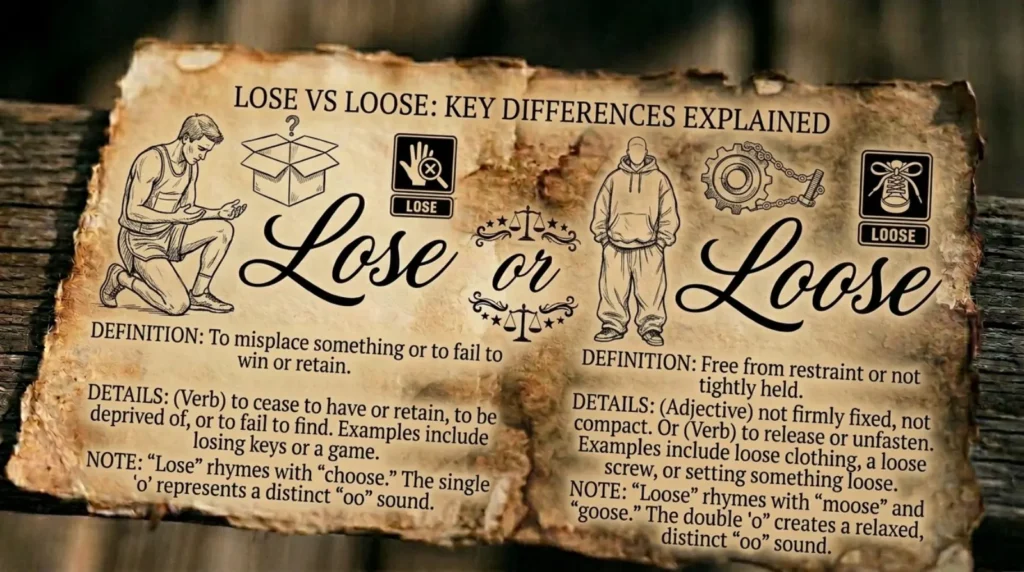
Lose means to stop having something or fail to keep it.
It is always used as a verb.
Simple Definition
Lose = to no longer have, win, or keep something.
Examples
- I don’t want to lose my wallet.
- She may lose the game.
- They lose money every year.
- Please don’t lose your ticket.
- We cannot lose hope.
What Does “Loose” Mean?
Loose means something is not tight, fixed, or secure.
It is usually an adjective.
Simple Definition
Loose = not tight or firmly attached.
Examples
- My shoes are loose.
- This shirt feels loose.
- The dog is loose in the park.
- A loose screw needs fixing.
- Her hair was loose.
Lose vs Loose: Key Differences
| Feature | Lose | Loose |
|---|---|---|
| Part of Speech | Verb | Adjective |
| Meaning | To no longer have something | Not tight |
| Pronunciation | /looz/ | /loos/ |
| Used For | Losing games, money, keys | Clothing, ropes, screws |
| Example | I may lose my phone. | My pants are loose. |
How to Remember the Difference
Here is an easy trick.
Remember This
Lose = Loss
Both words relate to missing something.
Example:
- Lose your wallet
- Lose a race
- Lose weight
Loose = Extra “O” = Extra Space
The extra O reminds you that something has more room.
Example:
- Loose shirt
- Loose knot
- Loose belt
This simple trick works every time.
Real-Life Examples of Lose vs Loose
Understanding real situations makes learning easier.
At School
✅ I don’t want to lose my homework.
❌ I don’t want to loose my homework.
At the Gym
✅ My shoes feel loose.
❌ My shoes feel lose.
During Sports
✅ Our team may lose the match.
❌ Our team may loose the match.
Shopping
✅ This jacket is too loose.
❌ This jacket is too lose.
Traveling
✅ Don’t lose your passport.
✅ My backpack straps are loose.
Lose vs Loose in Daily Conversations
People use these words every day.
Lose
- Don’t lose your phone.
- I hope we don’t lose.
- She doesn’t want to lose her job.
- You’ll lose time if you’re late.
Loose
- My watch is loose.
- Tie the loose rope.
- Your jeans look loose.
- Keep loose papers together.
Common Mistakes People Make
Many writers confuse these words because they sound alike.
Mistake 1
❌ I always loose my keys.
✅ I always lose my keys.
Mistake 2
❌ My pants are lose.
✅ My pants are loose.
Mistake 3
❌ Don’t loose hope.
✅ Don’t lose hope.
Mistake 4
❌ The screw is lose.
✅ The screw is loose.
Grammar Rule: Lose Is a Verb, Loose Is an Adjective
The easiest grammar rule is this:
Lose
Shows an action.
Examples:
- lose weight
- lose money
- lose control
- lose interest
Loose
Describes something.
Examples:
- loose clothing
- loose wire
- loose tooth
- loose hair
Synonyms and Related Words
Lose
- Misplace
- Drop
- Miss
- Surrender
- Forfeit
- Fail
- Give up
Loose
- Free
- Untied
- Relaxed
- Slack
- Unfastened
- Hanging
- Open
Related LSI Keywords
- lose meaning
- loose meaning
- lose or loose
- difference between lose and loose
- lose definition
- loose definition
- grammar mistakes
- English vocabulary
- commonly confused words
- spelling mistakes in English
- how to use lose
- how to use loose
Lose vs Loose Examples in Sentences
Lose
- Don’t lose your temper.
- We might lose the competition.
- I never want to lose this photo.
- She could lose her balance.
- They lose customers every month.
Loose
- The button is loose.
- I like loose clothing.
- His tooth became loose.
- The dog got loose.
- The lid feels loose.
When Should You Use Lose?
Use lose when talking about:
- Losing objects
- Losing games
- Losing money
- Losing time
- Losing weight
- Losing confidence
- Losing opportunities
Example:
“I don’t want to lose my chance.”
When Should You Use Loose?
Use loose when describing:
- Clothing
- Shoes
- Hair
- Belts
- Screws
- Knots
- Animals
- Teeth
Example:
“My shoelaces are loose.”

Expert Insight: Why This Difference Matters
Professional writing depends on correct word choice.
Using lose instead of loose shows strong grammar skills. It also helps readers understand your message without confusion.
Search engines reward clear, helpful content. Readers also trust websites with accurate grammar. Learning small differences like this improves your writing in school, work, and daily communication.
A simple spelling mistake can change the meaning of an entire sentence. That is why mastering lose vs loose is important for every English learner.
FAQs:
Is it lose or loose weight?
The correct phrase is lose weight.
What is the difference between lose and loose?
Lose means to no longer have something.
Loose means not tight.
Is loose a verb?
Usually no.
Loose is mainly an adjective.
Why do people confuse lose and loose?
They look similar and have similar pronunciation.
Is “I loose my keys” correct?
No.
The correct sentence is:
“I lose my keys.”
Can loose describe clothing?
Yes.
Example:
“This shirt is loose.”
How do I remember lose vs loose?
Remember:
Lose = Loss
Loose = Extra O = Extra Space
Which word is more common in grammar mistakes?
Both appear often, but confusing lose and loose is one of the most common English spelling mistakes.
Featured Snippet: Lose vs Loose
Lose means to no longer have something, fail to win, or misplace an item. It is a verb.
Loose means not tight, firmly attached, or secure. It is usually an adjective.
Example:
- Lose: Don’t lose your keys.
- Loose: My shoelaces are loose.
Internal Linking Suggestions
If you run a grammar or English learning website, consider linking this article to:
- Commonly Confused English Words
- Affect vs Effect
- Then vs Than
- Accept vs Except
- Their vs There vs They’re
- Everyday vs Every Day
- Advice vs Advise
- Breath vs Breathe
- Principal vs Principle
Conclusion
Understanding lose vs loose is easier than it first appears. The key difference is simple. Lose is a verb that means to no longer have something, while loose is an adjective that describes something that is not tight. Although these words look similar, using the correct one makes your writing clearer and more professional.
A helpful memory trick is to remember that lose relates to loss, while loose has an extra “o,” just like something has extra room when it is loose. Practice these words in everyday sentences, and the difference will soon become natural. Mastering this small grammar point can improve your English and help you avoid one of the most common spelling mistakes.

Emma Collins is a language writer and grammar enthusiast specializing in English vocabulary, spelling comparisons, and word usage guides. She creates easy-to-understand content that helps readers improve their writing, communication, and language skills with confidence.