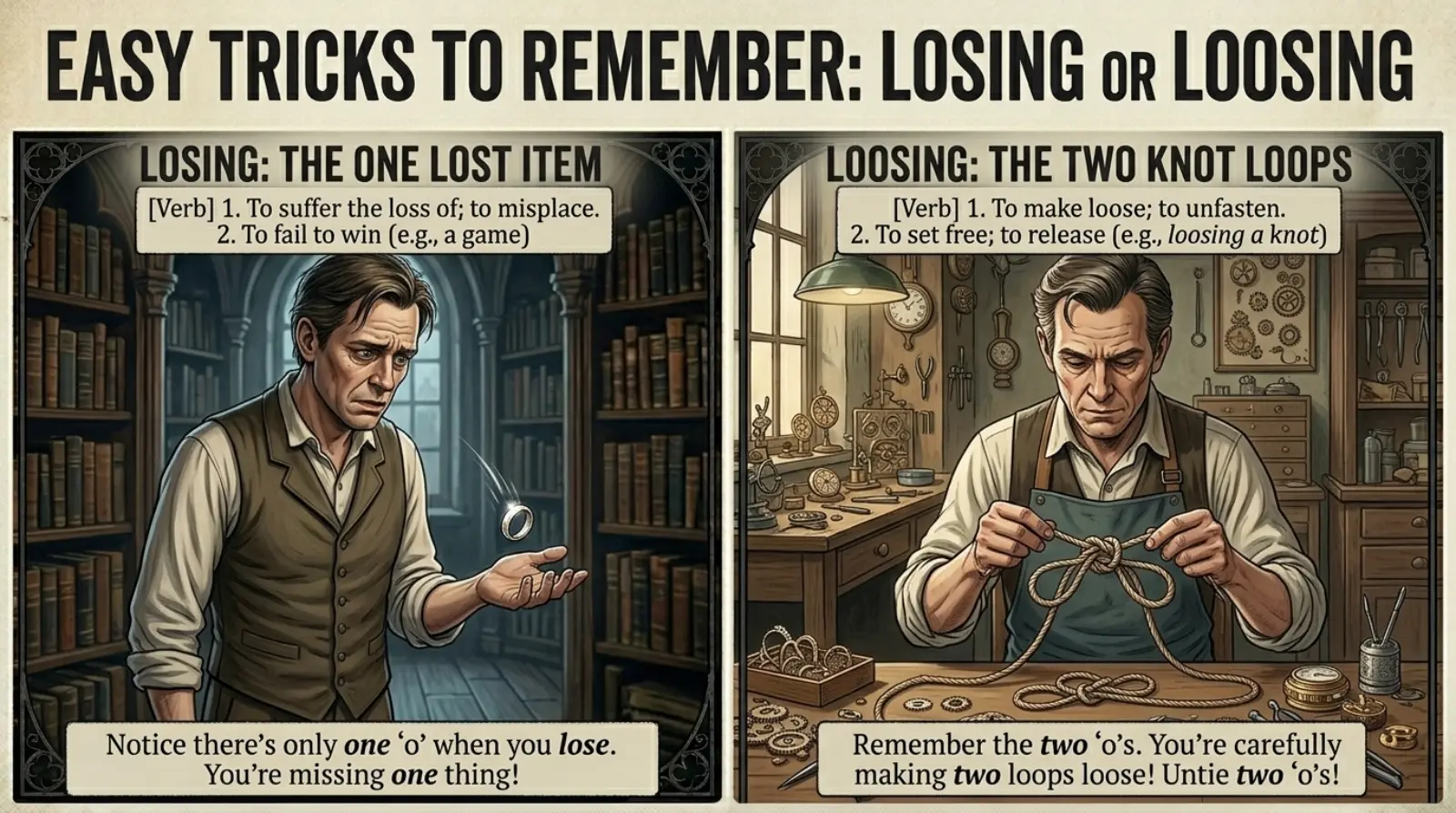
Losing or loosing is a common spelling question that confuses many English learners and native speakers alike. The two words look similar, but they have very different meanings.
Many people accidentally write loosing when they mean losing. This mistake appears in emails, social media posts, school assignments, and even business documents.
Understanding the difference is simple once you know what each word means. In this guide, you will learn the correct definitions, usage rules, examples, and easy memory tricks. By the end, you will never confuse these words again.
Let’s clear up the confusion between losing and loosing once and for all.
Quick Summary Box
- Losing means failing to win or no longer having something.
- Loosing means releasing, letting go, or making something loose.
- Losing is much more common in everyday English.
- Loosing is rarely used in modern conversation.
- Most spelling mistakes happen when people write loosing instead of losing.
- Remember: If it relates to winning or keeping something, use losing.
What Does Losing Mean?
Losing is the present participle of the verb lose.
It means:
- Not winning a game or competition
- Misplacing something
- Becoming less of something
- Failing to keep possession
Examples
- Our team is losing the match.
- I am losing my keys again.
- She is losing weight slowly.
- They are losing money on the project.
In most situations, people actually mean losing when they ask about “losing or loosing.”
What Does Loosing Mean?
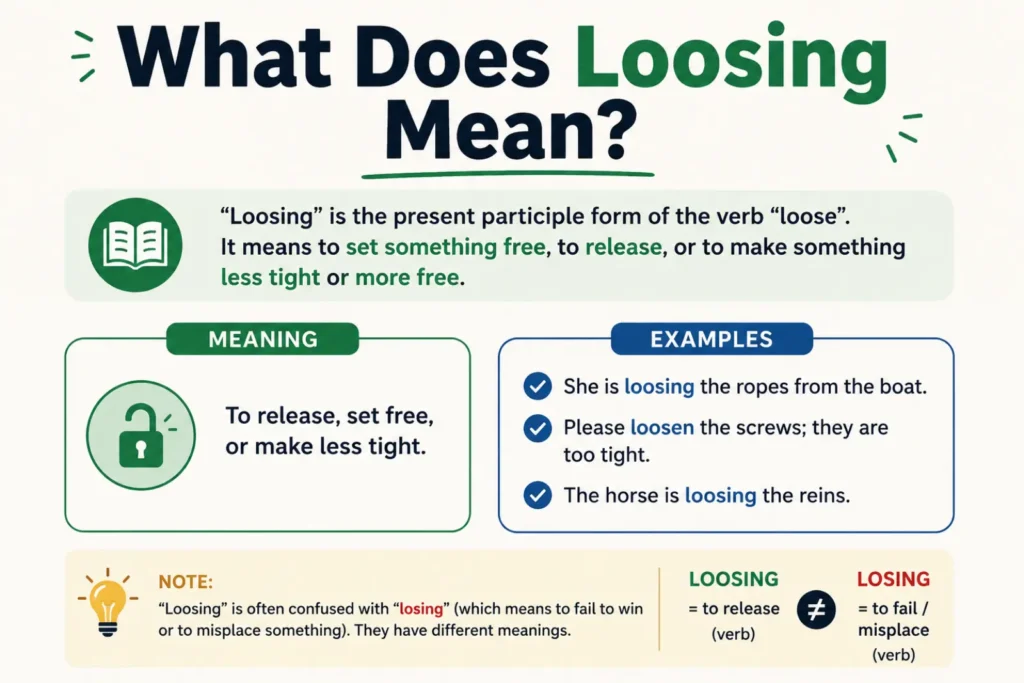
Loosing comes from the verb loose.
It means:
- Releasing something
- Letting something go
- Setting something free
- Making something less tight
Examples
- The hunter is loosing an arrow.
- They are loosing the ropes.
- The sailor is loosing the sails.
This word is uncommon in modern English.
Losing or Loosing: The Key Difference
The main difference is their meaning.
Losing relates to loss.
Loosing relates to release or loosening.
Many writers mistakenly use loosing because it looks similar to lose.
However, the correct spelling in most cases is losing.
Losing vs Loosing Comparison Table
| Feature | Losing | Loosing |
|---|---|---|
| Root Word | Lose | Loose |
| Meaning | Not winning or not keeping something | Releasing or setting free |
| Common Usage | Very common | Rare |
| Used in Sports | Yes | No |
| Used for Misplacing Items | Yes | No |
| Used for Releasing Arrows | No | Yes |
| Example | We are losing the game. | The archer is loosing an arrow. |
Why Do People Confuse Losing and Loosing?
Several reasons cause this mistake.
Similar Appearance
The words differ by only one letter.
Pronunciation Confusion
Some people assume the spelling should match the sound.
Typing Errors
Writers often add an extra “o” by mistake.
Autocorrect Issues
Some devices fail to catch the error in certain contexts.
Because of these reasons, “loosing” often appears when “losing” is intended.
Real-Life Examples of Losing
Here are common situations where losing is correct.
Sports
- The team is losing by two points.
- We are losing the championship match.
Personal Items
- I keep losing my phone.
- She is losing her glasses frequently.
Health
- He is losing weight after exercising.
- They are losing sleep because of stress.
Business
- The company is losing customers.
- We are losing money this year.
Real-Life Examples of Loosing
Here are examples where loosing is correct.
Archery
- The archer is loosing an arrow.
Sailing
- The crew is loosing the sails.
Releasing Animals
- They are loosing the birds into the wild.
Untying Ropes
- The workers are loosing the ropes.
These examples show why loosing appears much less often.
Common Mistakes People Make
Incorrect
- I am loosing my wallet.
- We are loosing the game.
- She is loosing weight.
Correct
- I am losing my wallet.
- We are losing the game.
- She is losing weight.
A simple rule helps:
If something is disappearing, use losing.
Easy Trick to Remember the Correct Spelling
Memory tricks can prevent future mistakes.
Trick #1: Lose Becomes Losing
- Lose → Losing
Notice that only one “o” remains.
Trick #2: Think About Winning
If the opposite is winning, use losing.
Example:
- Winning the game
- Losing the game
Trick #3: Loose Means Not Tight
If the meaning relates to releasing or making something less tight, use loosing.
How Losing Is Used in Everyday English
Most daily conversations use losing.
Examples include:
- Losing your keys
- Losing a race
- Losing weight
- Losing patience
- Losing focus
- Losing money
- Losing confidence
These phrases appear frequently in spoken and written English.
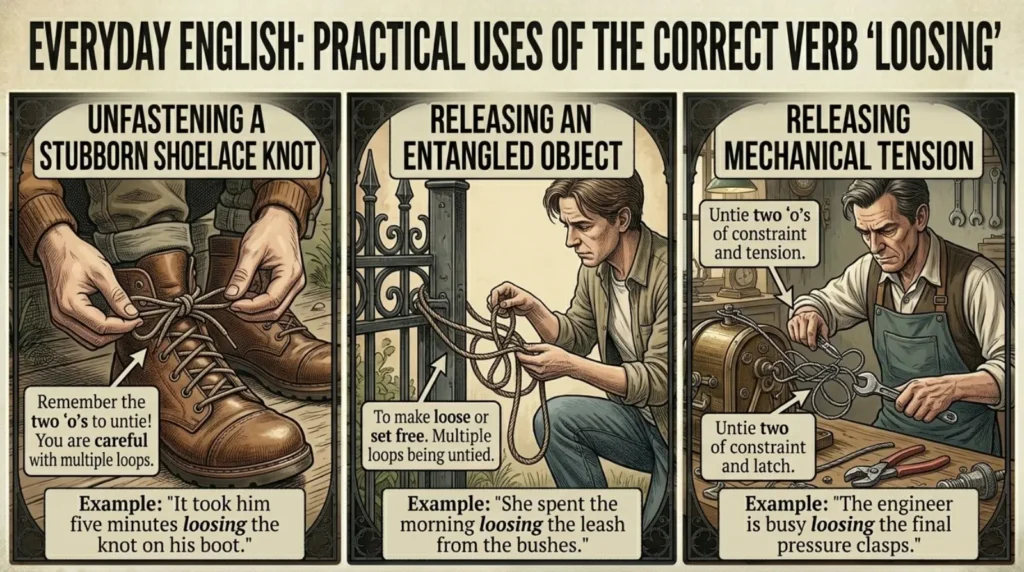
How Loosing Is Used in Everyday English
Modern English rarely uses loosing.
You may encounter it in:
- Historical writing
- Archery discussions
- Religious texts
- Literary works
- Sailing terminology
Outside these areas, you probably need losing.
Synonyms and Related Words
Losing
- Failing
- Misplacing
- Surrendering
- Forfeiting
- Missing
- Declining
Loosing
- Releasing
- Unleashing
- Freeing
- Letting go
- Untying
- Unfastening
Related Search Terms
- lose vs loose
- losing meaning
- loosing meaning
- lose or loose
- difference between losing and loosing
- common English spelling mistakes
- how to spell losing
Expert Insights: Why This Difference Matters
Correct spelling improves communication.
Readers notice spelling mistakes quickly. A simple error can affect credibility in emails, blogs, reports, and school assignments.
Writers who understand the difference between losing and loosing appear more professional.
Search engines also favor clear, accurate content. Using correct grammar improves user trust and readability.
For students, professionals, and content creators, mastering common word pairs strengthens writing skills.
Frequently Asked Questions
Is it losing or loosing weight?
The correct phrase is losing weight.
Is it losing or loosing a game?
The correct phrase is losing a game.
Is loosing a real word?
Yes. It means releasing or setting free.
Why do people spell losing as loosing?
Because the words look similar and sound somewhat alike.
Which word is more common?
Losing is far more common in modern English.
Can loosing mean losing?
No. They have different meanings.
How do I remember the difference?
If you mean not winning or not keeping something, use losing.
Is loosing an arrow correct?
Yes. Archers can be described as loosing an arrow.
Featured Snippet Answer
Losing or Loosing: Which Is Correct?
Losing means failing to win or no longer having something. Loosing means releasing, setting free, or making something loose. In everyday English, losing is usually the correct word. Most people mistakenly write loosing when they mean losing.
Internal Linking Suggestions
Consider linking this article to:
- Lose vs Loose
- Then vs Than
- Affect vs Effect
- Accept vs Except
- Principal vs Principle
- Common English Grammar Mistakes
- Frequently Misspelled Words in English
Conclusion
The confusion between losing or loosing is one of the most common spelling mistakes in English. Although the words look similar, their meanings are very different. Losing refers to not winning, misplacing something, or failing to keep it. Loosing means releasing or setting something free.
In everyday writing, you will almost always need losing. The word loosing appears mainly in special contexts such as archery, sailing, and historical writing.
A simple way to remember the difference is this: if something is disappearing or you are not winning, choose losing. If something is being released, choose loosing.
Mastering this distinction will make your writing clearer, more professional, and more accurate.

Michael Reed is a language content writer and word comparison researcher based in the United States. He studied English Language and Communication and focuses on grammar, spelling differences, and word usage. His work helps readers understand confusing English words through clear comparisons and practical explanations. Michael creates simple, reader-friendly content designed to improve everyday language skills.