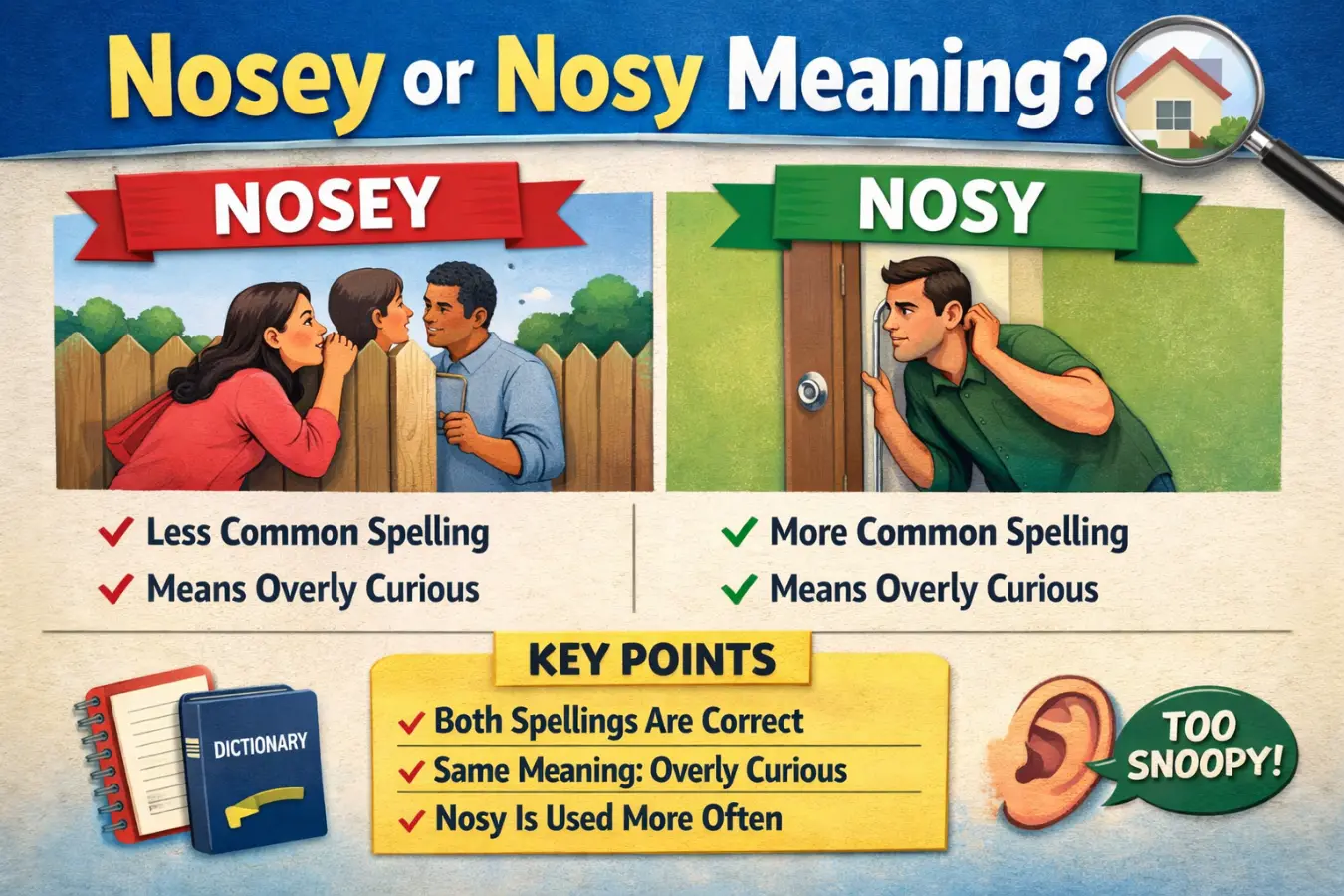
Nosey or nosy meaning is a common search because many people see both spellings and wonder which one is correct. The good news is that both words have the same meaning.
People use nosey and nosy to describe someone who asks too many questions. A nosy person often wants details about other people’s lives. They may listen to private conversations or seek information that does not concern them.
However, the spelling can confuse writers. Some dictionaries prefer one version over the other. Others accept both.
In this guide, you will learn the meaning of nosey and nosy, the difference between the spellings, real-life examples, common mistakes, and expert tips for using the word correctly.
Quick Summary Box
- Nosy and nosey have the same meaning.
- Both describe a person who is overly curious.
- A nosy person often asks personal questions.
- Nosy is the more common spelling today.
- Nosey is an accepted alternative spelling.
- The word usually has a negative meaning.
- Both forms appear in dictionaries.
What Is the Meaning of Nosey or Nosy?
The meaning of nosey or nosy is being too interested in other people’s private matters.
A nosy person may:
- Ask personal questions
- Listen to private conversations
- Read information that is not meant for them
- Want details about others’ lives
The word usually describes behavior that feels intrusive or annoying.
Simple Definition
Nosy (or nosey): Showing too much interest in things that do not concern you.
Is It Nosey or Nosy?
Both spellings are correct.
However, nosy is more common in modern English.
| Spelling | Correct? | Common Usage |
|---|---|---|
| Nosy | Yes | Most common |
| Nosey | Yes | Less common |
Many style guides and dictionaries prefer nosy because it appears more often in modern writing.
If you are writing for school, work, or a blog, nosy is usually the safer choice.
Why Are There Two Spellings?
The word comes from nose.
Historically, people connected curiosity with sticking one’s nose into someone else’s business.
Over time, two spellings developed:
- Nosey
- Nosy
Language changes naturally. As a result, both versions became accepted.
Today, most writers choose nosy, but nosey still appears in books and articles.
What Does a Nosy Person Do?
A nosy person often crosses personal boundaries.
Examples include:
- Asking about someone’s salary
- Reading another person’s messages
- Listening to private phone calls
- Questioning people about personal relationships
- Looking through private belongings
These actions can make others uncomfortable.
Nosey or Nosy in Simple Words
In simple terms, a nosy person wants information that is not their business.
Imagine a neighbor who always asks:
- Where are you going?
- How much did your house cost?
- Why did you leave your job?
Many people would consider that behavior nosy.
Real-Life Examples of Nosey or Nosy
Understanding real-life examples makes the meaning easier.
Example 1
Sarah asks her coworker about every detail of their personal life.
Sarah is nosy.
Example 2
A neighbor watches who visits your house every day.
That neighbor is nosey.
Example 3
Someone reads a private text message without permission.
That behavior is nosy.
Example 4
A friend keeps asking about your income.
Many people would call that nosy.
Nosey vs Nosy Comparison Table
| Feature | Nosey | Nosy |
|---|---|---|
| Meaning | Overly curious | Overly curious |
| Correct spelling | Yes | Yes |
| Modern usage | Less common | More common |
| Dictionary acceptance | Yes | Yes |
| Professional writing | Acceptable | Preferred |
| Pronunciation | Same | Same |
Key Takeaway
The meaning does not change. Only the spelling differs.
Common Mistakes People Make
Many writers make simple mistakes with these words.
Mistake 1: Thinking One Is Wrong
Many people believe nosey is incorrect.
It is not wrong. It is simply less common.
Mistake 2: Using It Positively
The word usually has a negative tone.
Calling someone nosy often sounds like criticism.
Mistake 3: Confusing Curiosity With Nosiness
Curiosity can be healthy.
Nosiness often involves unwanted interest in private matters.
Mistake 4: Switching Spellings Randomly
Choose one spelling and stay consistent throughout your writing.
Curiosity vs Nosiness
People often confuse these ideas.
| Curiosity | Nosiness |
|---|---|
| Healthy interest | Excessive interest |
| Learning-focused | Personal-focused |
| Respectful | Intrusive |
| Usually positive | Usually negative |
| Respects boundaries | Ignores boundaries |
Curiosity helps people learn.
Nosiness often invades privacy.
How to Use Nosy in Daily Life
You may hear this word in many situations.
At School
“Stop being nosy and focus on your work.”
At Work
“He asked everyone about their salaries. That’s nosy.”
At Home
“My little brother is nosy and always enters my room.”
In Friendships
“She keeps asking personal questions. She’s a bit nosy.”
Synonyms for Nosey or Nosy
Using synonyms can improve your writing.
Common synonyms include:
- Inquisitive
- Curious
- Intrusive
- Meddlesome
- Prying
- Snoopy
- Interfering
- Investigative
- Busybody
- Overcurious
Related Search Terms
- nosy meaning
- nosey meaning
- what does nosy mean
- what does nosey mean
- nosy person meaning
- nosey vs nosy
- curious vs nosy
- overly curious person
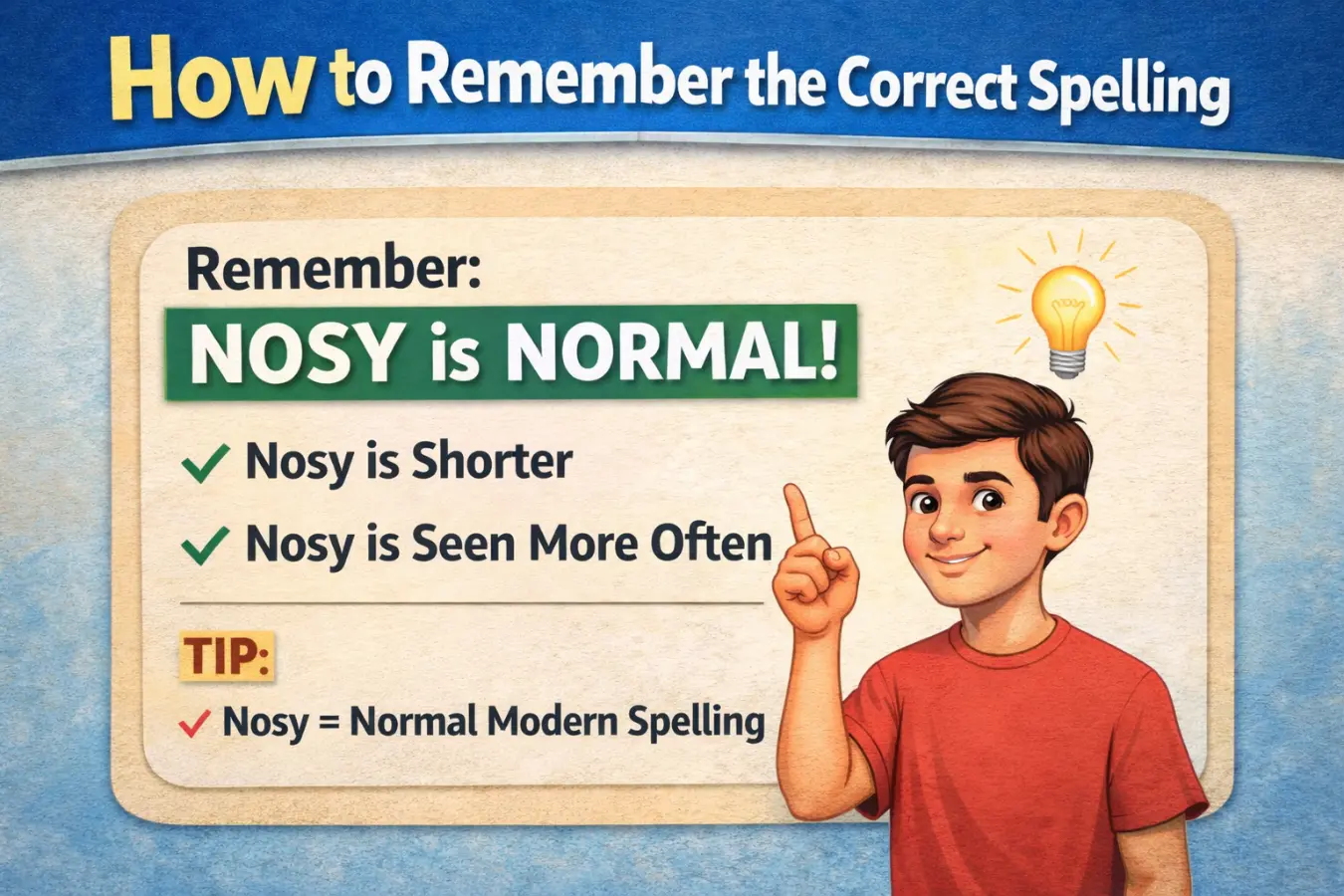
How to Remember the Correct Spelling
A simple trick can help.
Memory Tip
Think of the shorter and more popular version:
Nosy = Normal modern spelling
Because it appears more often online and in books, many writers choose nosy by default.
When in doubt, use nosy.
Expert Insights on the Meaning of Nosey or Nosy
Language experts generally agree that both spellings are acceptable.
However, modern dictionaries and style guides often favor nosy because it appears more frequently in current English.
Understanding the difference matters because word choice affects clarity and professionalism.
If you write blogs, articles, emails, or business content, using the preferred spelling helps maintain consistency.
Writers should also recognize the difference between healthy curiosity and intrusive behavior. Context determines whether the word sounds playful or critical.
Why Understanding This Word Matters
Knowing the correct meaning helps you:
- Communicate clearly
- Avoid spelling confusion
- Improve writing accuracy
- Understand social situations
- Use English more naturally
Small language details often create a stronger impression in professional writing.
FAQs
Is nosy or nosey correct?
Both are correct spellings. However, nosy is more common today.
What does nosy mean?
Nosy means showing too much interest in other people’s private matters.
What does nosey mean?
Nosey has the same meaning as nosy. The spelling is simply different.
Which spelling should I use?
Most writers prefer nosy because it is more common in modern English.
Is being nosy a bad thing?
Usually yes. The word often describes intrusive behavior.
Can nosy be used humorously?
Yes. Friends and family sometimes use it playfully.
What is the difference between curious and nosy?
Curious people seek knowledge respectfully. Nosy people often ignore privacy boundaries.
Is nosey used in American English?
Yes. Both American and British English recognize the spelling nosey.
Internal Linking Suggestions
If you run a grammar or language blog, link this article to:
- Nosey vs Nosy: Full Comparison Guide
- Curious vs Nosy Explained
- Commonly Confused English Words
- Grammar Rules for Everyday Writing
- British vs American English Spellings
Conclusion
Understanding nosey or nosy meaning is simple once you know the facts. Both words describe someone who shows too much interest in other people’s private affairs. The meanings are identical, and both spellings are accepted by dictionaries.
However, nosy is the spelling most writers prefer today. It appears more often in modern books, websites, and professional writing. While nosey remains correct, using nosy can help keep your writing consistent and current.
The key takeaway is easy to remember: both spellings mean the same thing, but nosy is the more common choice. Whether you are writing an article, email, or social media post, understanding this difference will help you communicate with confidence.

Michael Reed is a language content writer and word comparison researcher based in the United States. He studied English Language and Communication and focuses on grammar, spelling differences, and word usage. His work helps readers understand confusing English words through clear comparisons and practical explanations. Michael creates simple, reader-friendly content designed to improve everyday language skills.