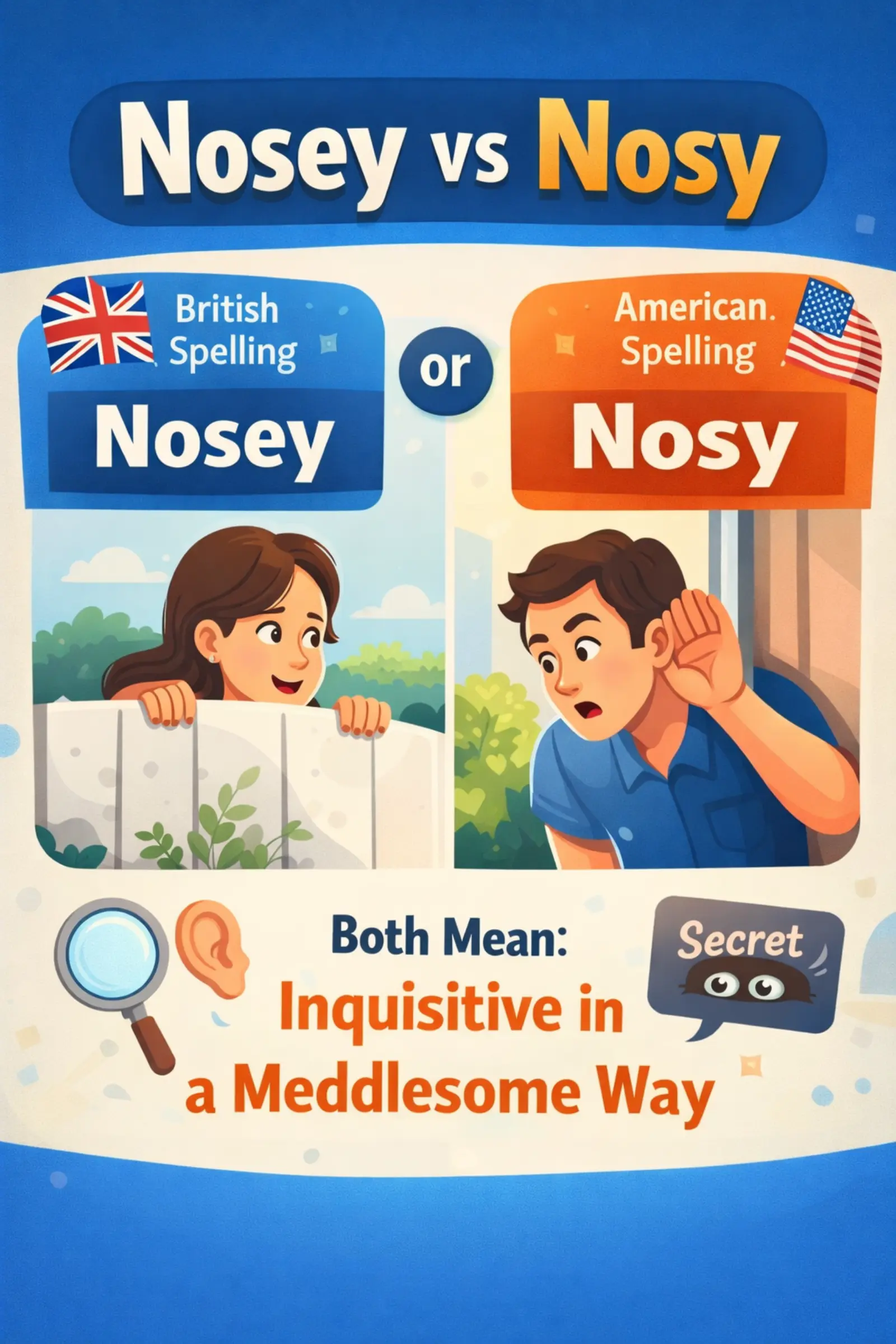
Nosey vs nosy is a common spelling question that confuses many English learners and native speakers. Both words describe someone who asks too many questions or gets involved in other people’s business. However, many people wonder if one spelling is more correct than the other.
The good news is that both spellings are accepted in English. Still, some dictionaries and style guides prefer one version over the other.
In this guide, you will learn the meaning of nosey and nosy, see examples, compare the two spellings, and discover which one works best in different situations. By the end, you will feel confident using the correct spelling in everyday writing.
Quick Summary Box
- Nosy and nosey have the same meaning.
- Both words describe a person who is overly curious.
- Nosy is the preferred spelling in most modern dictionaries.
- Nosey is an alternative spelling.
- Both are correct in American and British English.
- Use the spelling style that matches your audience or publication.
- The word often has a negative meaning.
What Does Nosy Mean?
The word nosy describes someone who wants to know too much about other people’s lives.
A nosy person may ask personal questions or interfere in private matters.
Examples
- My nosy neighbor always asks where I am going.
- Don’t be so nosy about my plans.
- The reporter seemed nosy during the interview.
In simple terms, a nosy person cannot resist learning information that does not concern them.
What Does Nosey Mean?
Nosey means exactly the same thing as nosy.
The extra “e” does not change the meaning.
Examples
- She can be nosey about her coworkers.
- Stop being nosey and let them talk privately.
- His nosey questions made everyone uncomfortable.
Most readers understand both spellings without any confusion.
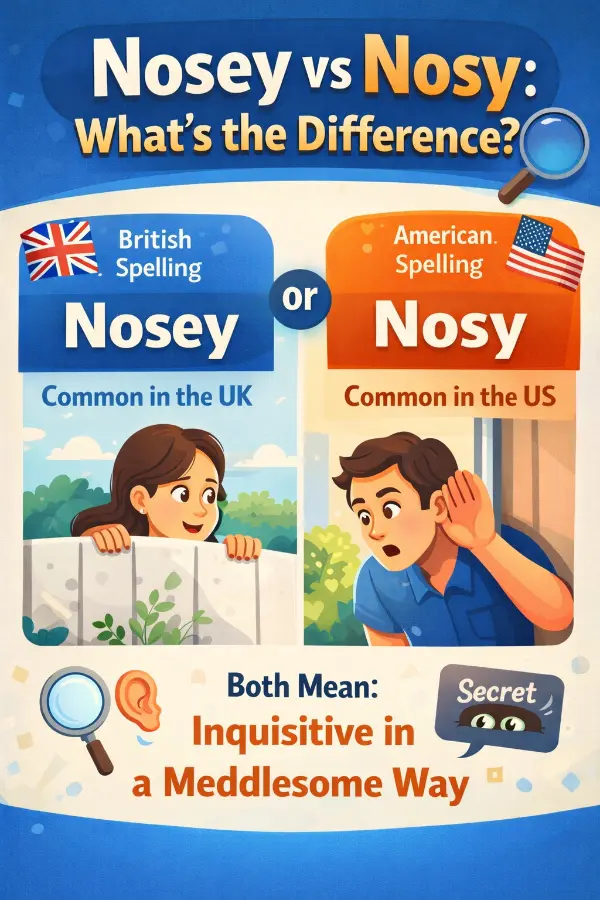
Nosey vs Nosy: What’s the Difference?
There is no difference in meaning between nosey and nosy.
The main difference is spelling preference.
Many modern dictionaries list nosy as the primary spelling. They often list nosey as a variant.
Quick Answer
Nosy is usually the preferred modern spelling, while nosey is an accepted alternative spelling.
Nosey vs Nosy Comparison Table
| Feature | Nosy | Nosey |
|---|---|---|
| Meaning | Overly curious | Overly curious |
| Correct Spelling | Yes | Yes |
| Dictionary Acceptance | Yes | Yes |
| Modern Preference | More common | Less common |
| Formal Writing | Preferred | Acceptable |
| Everyday Use | Very common | Common |
Why Are There Two Spellings?
English contains many words with more than one accepted spelling.
Language changes over time. Different regions and publishers often choose different spellings.
The word comes from the noun nose. Since curious people often “stick their nose” into other people’s business, the term developed over time.
Some writers kept the spelling closer to nose, creating nosey.
Others simplified it to nosy, which became the more popular version.
Which Spelling Is More Common?
Today, nosy appears more often in:
- News articles
- Educational websites
- Online publications
- Business writing
- Modern dictionaries
Many style guides recommend using nosy because it is more widely recognized.
If you must choose one spelling, nosy is usually the safest option.
Real-Life Examples of Nosy and Nosey
Example 1: Family Conversation
Nosy:
“Why are you checking my phone? You’re being nosy.”
Example 2: Neighborhood Situation
Nosey:
“Our nosey neighbor knows everything that happens on this street.”
Example 3: Workplace Example
Nosy:
“The new employee seemed nosy about everyone’s salaries.”
Example 4: School Example
Nosey:
“Some students become nosey when they hear gossip.”
In each example, the meaning stays the same.
When Should You Use Nosy?
Use nosy when:
- Writing blog posts
- Creating academic content
- Publishing professional articles
- Following modern style guides
- Writing for a broad audience
Example Sentences
- The journalist asked several nosy questions.
- My nosy cousin wants details about everything.
- People dislike coworkers who act nosy.
When Should You Use Nosey?
Use nosey when:
- Matching a publication’s style
- Following personal preference
- Quoting someone else’s writing
- Maintaining consistency in a document
Example Sentences
- Her nosey attitude annoyed the group.
- The nosey customer asked personal questions.
- Everyone knows the nosey neighbor next door.
Common Mistakes People Make
Many writers make these mistakes when using nosey and nosy.
Mistake 1: Thinking One Is Wrong
Many people believe nosey is incorrect.
This is not true.
Both spellings are accepted.
Mistake 2: Mixing Spellings
Avoid switching between nosy and nosey in the same article.
Choose one spelling and stay consistent.
Mistake 3: Confusing Meaning
Some people think the spellings have different meanings.
They do not.
Both words describe excessive curiosity.
Tips to Remember the Correct Spelling
Use these simple tricks.
Remember “Nosy” as the Modern Choice
Most dictionaries prefer nosy.
If unsure, choose nosy.
Think About Consistency
Pick one spelling and use it throughout your writing.
Check Style Guides
Some organizations may prefer a specific spelling.
Always follow their rules.
Synonyms for Nosy and Nosey
Using synonyms can improve your writing.
Common Synonyms
- Curious
- Inquisitive
- Meddlesome
- Interfering
- Snoopy
- Prying
- Intrusive
- Busybody
- Investigative
- Questioning
Example
Instead of saying:
“He is very nosy.”
You could say:
“He is very meddlesome.”
or
“He is a busybody.”
How Nosy Is Used in Everyday Life
People use this word frequently in casual conversation.
At Home
“My brother is nosy about my messages.”
At School
“The students became nosy after hearing a rumor.”
At Work
“Nosy coworkers often create uncomfortable situations.”
Online
“Some social media users can seem nosy about private lives.”
The word appears in many everyday situations where curiosity crosses personal boundaries.
Expert Insight: Why This Spelling Question Matters
Language consistency improves credibility.
When readers notice spelling changes, they may become distracted.
Professional writers often choose the spelling that major dictionaries favor.
Today, that spelling is usually nosy.
However, using nosey does not make your writing wrong.
The most important rule is consistency.
Strong writing focuses on clarity, accuracy, and audience expectations.
FAQs
Is nosy or nosey correct?
Both are correct spellings. However, nosy is more common in modern English.
Which spelling do dictionaries prefer?
Most modern dictionaries list nosy as the preferred spelling.
Is nosey old-fashioned?
Some writers consider nosey slightly less common today, but it remains acceptable.
Do nosy and nosey have different meanings?
No. They have exactly the same meaning.
Which spelling should I use in professional writing?
Use nosy because it is more widely accepted in formal and professional content.
Is nosy an insult?
It can be. The word often suggests that someone is too interested in private matters.
Can I use nosey in American English?
Yes. American English accepts both spellings.
Is nosy positive or negative?
It is usually negative because it describes unwanted curiosity.
Internal Linking Suggestions
You may link this article to related topics such as:
- Curious vs Inquisitive
- Their vs There vs They’re
- Advice vs Advise
- Affect vs Effect
- Then vs Than
- Toward vs Towards
- Everyday vs Every Day
Conclusion
The debate over nosey vs nosy is simpler than many people think. Both spellings are correct and carry the same meaning. They describe someone who shows too much interest in other people’s personal matters.
Even though both versions are acceptable, nosy has become the preferred spelling in most modern dictionaries, publications, and professional writing. That makes it the safest choice for blogs, articles, and business communication.
Still, if you use nosey, you are not making a mistake. The key is consistency. Choose one spelling and use it throughout your writing.
When in doubt, remember this simple rule: nosy is the more common modern spelling, while nosey remains a valid alternative.

James Carter is a comparison writer and research specialist with over 10 years of experience in digital publishing. With a background in business communication and consumer research, he creates detailed comparison articles, buying guides, and reviews that help readers make informed decisions with confidence. “Every comparison should help readers make better decisions. My goal is to turn complex information into clear, practical guidance that people can trust.” — James Carter