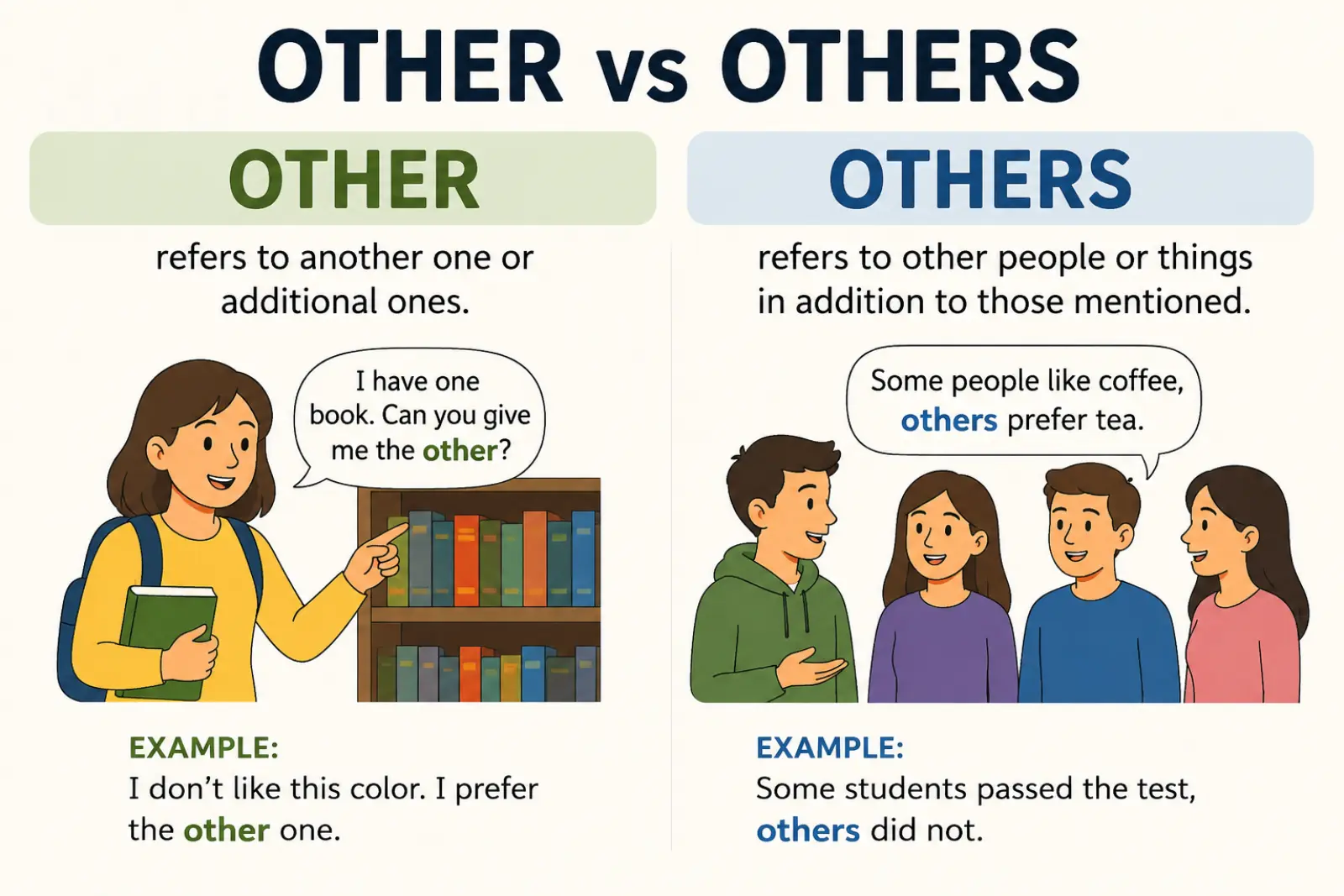
Other or others is a common grammar question that confuses many English learners. These two words look similar, but they do not work the same way.
Many people use other when they should use others, and vice versa. As a result, their sentences sound incorrect or unclear.
The good news is that the difference is easy to understand. Once you learn a few simple rules, you can use both words correctly every day.
In this guide, you will learn the meaning of other and others, see real-life examples, avoid common mistakes, and discover easy memory tips. By the end, you will know exactly when to use each word with confidence.
Quick Summary Box
Featured Snippet: Other vs Others
- Other refers to an additional person, thing, or group.
- Others means other people or things.
- Other usually comes before a noun.
- Others replaces a noun.
- Use other when a noun follows.
- Use others when no noun follows.
- Example: “I have other books.”
- Example: “I have books. Others are at home.”
What Does “Other” Mean?
Other means additional, different, or remaining.
It usually describes a noun.
Examples
- I need other shoes.
- Do you have other ideas?
- She visited other countries.
- We looked at other options.
In each sentence, other comes before a noun.
What Does “Others” Mean?
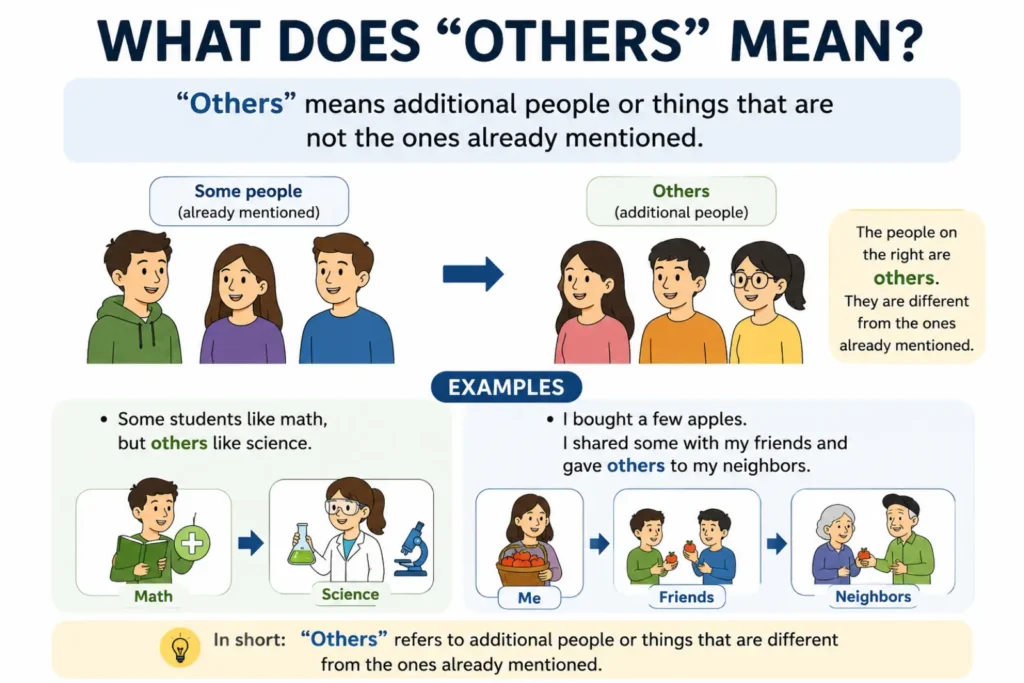
Others means other people or other things.
It acts as a pronoun. It replaces a noun that is already understood.
Examples
- Some students arrived early. Others came later.
- I like these cookies. Others are too sweet.
- Several books are on the shelf. Others are in storage.
Notice that others stands alone.
Other vs Others: Key Difference
The main difference is simple.
| Other | Others |
|---|---|
| Adjective or determiner | Pronoun |
| Comes before a noun | Replaces a noun |
| Cannot stand alone in most cases | Can stand alone |
| “Other books” | “Others” |
| Describes something | Refers to people or things already mentioned |
Example
✅ I want other shoes.
✅ I have many shoes. Others are in my closet.
❌ I want others shoes.
❌ I have many shoes. Other are in my closet.
When to Use “Other”
Use other when a noun follows it.
Examples
- I need other information.
- Let’s try other methods.
- She likes other colors.
- We visited other places.
Formula
Other + Noun
Examples:
- Other students
- Other books
- Other people
- Other ideas
When to Use “Others”
Use others when the noun is already known.
Examples
- Some people agreed. Others disagreed.
- These apples are fresh. Others are old.
- A few members stayed. Others left.
Formula
Others = Other + Noun (understood)
Example:
- Some students studied.
- Others studied later.
The word students is understood, so it is not repeated.
Real-Life Examples of Other and Others
School
- Do you have other pencils?
- Some students finished early. Others needed more time.
Work
- We explored other solutions.
- Some employees work remotely. Others work in the office.
Home
- I bought other groceries.
- These toys are broken. Others still work.
While Traveling
- We visited other cities.
- Some tourists stayed longer. Others returned home.
Common Mistakes People Make
Mistake 1: Using Others Before a Noun
❌ Others students arrived late.
✅ Other students arrived late.
Mistake 2: Using Other Alone Incorrectly
❌ Some books are new. Other are old.
✅ Some books are new. Others are old.
Mistake 3: Forgetting the Noun
❌ I need other.
✅ I need another one.
✅ I need other books.
Other, Others, Another, and The Other
Many learners confuse these words.
| Word | Meaning | Example |
|---|---|---|
| Other | Additional or different | Other books |
| Others | Other people or things | Others stayed home |
| Another | One more | Another cup of tea |
| The Other | The remaining one | The other shoe |
Examples
- I need another pen.
- Where is the other sock?
- Let’s discuss other topics.
- Some people agreed. Others did not.
Easy Trick to Remember the Difference
Try this simple rule:
Use “Other” + Noun
- Other books
- Other students
- Other ideas
Use “Others” Alone
- Others agreed.
- Others stayed.
- Others left.
Memory Tip
If a noun comes after the word, choose other.
If no noun comes after the word, choose others.
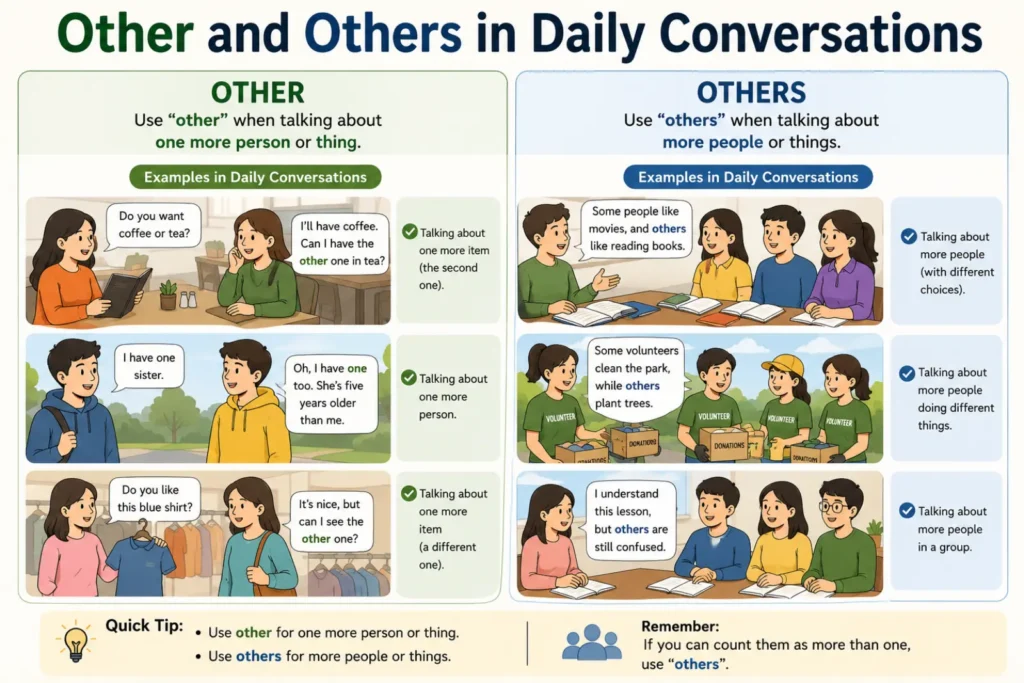
Other and Others in Daily Conversations
You hear these words every day.
Common Sentences
- Do you have any other questions?
- Some stores are closed. Others are open.
- We need other plans.
- Others may disagree.
- Let’s explore other options.
Using them correctly makes your English sound natural and professional.
Synonyms and Related Words
Other
- Different
- Additional
- Alternative
- Extra
- Remaining
Others
- The rest
- Remaining people
- Remaining things
- Additional people
Related Search Terms
- other vs others
- difference between other and others
- when to use other
- when to use others
- grammar rules for other and others
- other meaning in English
- others meaning in English
- English grammar examples
Why Understanding Other and Others Matters
Correct grammar improves communication.
Using the wrong word can confuse readers and listeners.
When you know the difference:
- Your writing becomes clearer.
- Your speaking sounds more natural.
- You avoid common grammar errors.
- You build confidence in English.
Even small grammar improvements can make a big difference.
Expert Insight
Language experts recommend learning words through patterns instead of memorizing rules alone.
For other and others, focus on one question:
Does a noun come after the word?
If yes, use other.
If no, use others.
This simple approach works in most situations and helps learners avoid mistakes quickly.
Professional writers also review sentences to make sure pronouns clearly refer to something already mentioned. This practice improves readability and clarity.
FAQs
1. What is the difference between other and others?
Other comes before a noun, while others replaces a noun.
2. Can I say “others people”?
No. Use other people instead.
3. Is “others” singular or plural?
Others is plural and refers to more than one person or thing.
4. Can “other” be used alone?
Sometimes, but it usually needs a noun after it.
5. Which is correct: “other students” or “others students”?
Other students is correct.
6. Can I use “others” for objects?
Yes. It can refer to people or things.
Example: Some books are here. Others are missing.
7. Is “other” an adjective?
Yes. It commonly functions as an adjective or determiner.
8. How can I remember the rule?
Use other before nouns and others without nouns.
Internal Linking Suggestions
You can internally link this article to:
- Another vs Other
- Their vs There vs They’re
- Affect vs Effect
- Then vs Than
- Who vs Whom
- Common English Grammar Mistakes
- Parts of Speech in English
Conclusion
Understanding other or others is easier than many people think. The key difference is simple. Use other before a noun and use others when the noun is already understood. This small grammar rule helps you write and speak more clearly.
Practice with everyday sentences and real-life examples. Soon, choosing between other and others will feel natural. Remember the easy trick: if a noun follows, use other. If no noun follows, use others.
Mastering this grammar point improves communication and boosts confidence. The next time you wonder about other or others, you will know exactly which word to choose.

Emma Collins is a language writer and grammar enthusiast specializing in English vocabulary, spelling comparisons, and word usage guides. She creates easy-to-understand content that helps readers improve their writing, communication, and language skills with confidence.