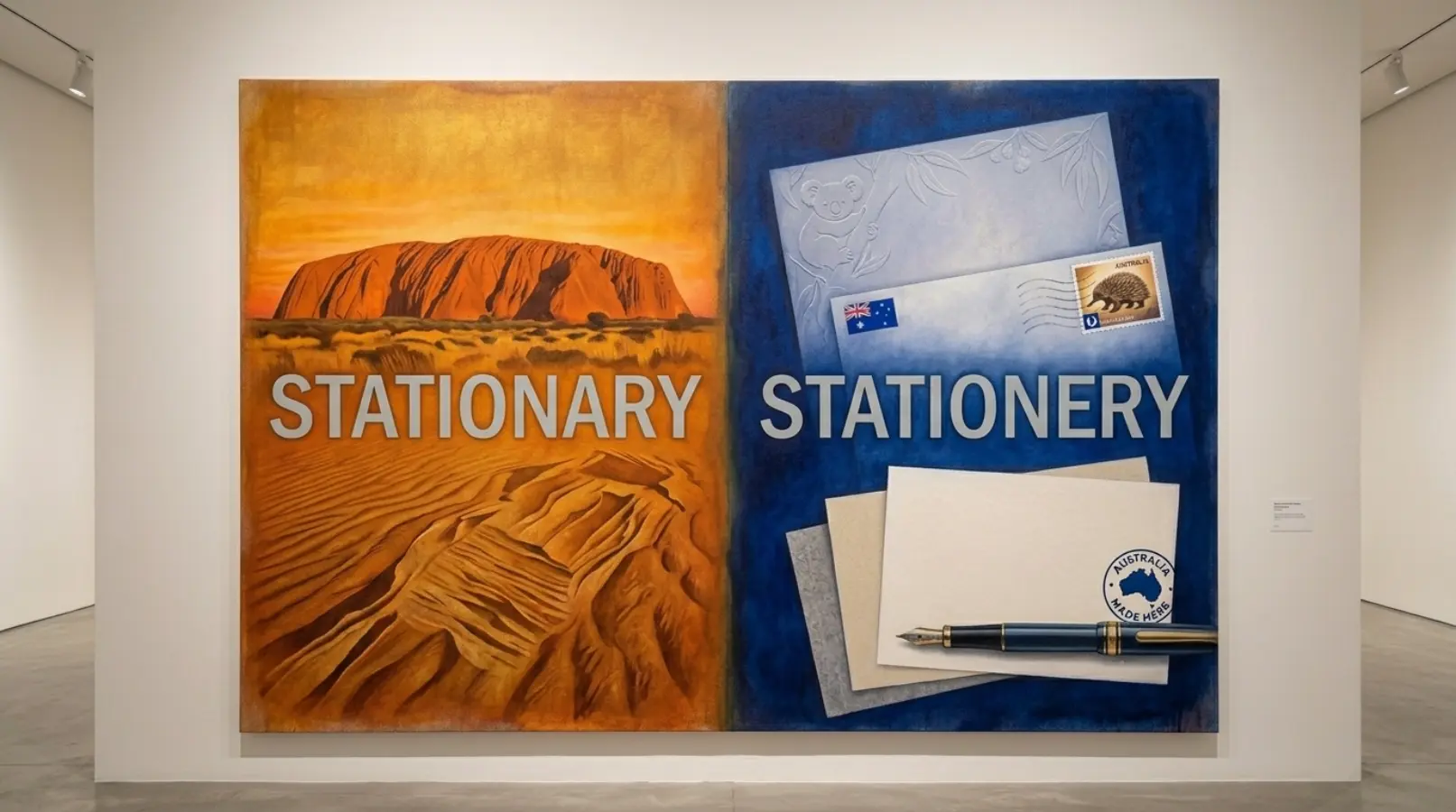
Stationary or stationery Australia is a common search because many people confuse these two similar words. They sound the same but have different meanings. Using the wrong spelling can make your writing look unprofessional. Luckily, the difference is easy to remember.
In Australian English, both words are correct, but they mean different things. Stationary describes something that does not move. Stationery refers to paper, pens, notebooks, envelopes, and office supplies.
This guide explains the difference in simple words. You will learn meanings, examples, memory tricks, common mistakes, and Australian usage. By the end, you will know exactly which spelling to use every time.
Quick Summary Box
- Stationary = not moving
- Stationery = writing materials and office supplies
- Both words are correct in Australian English.
- They sound the same but have different meanings.
- Remember: StationEry has an “E” for Envelopes.
- Use stationary for vehicles, objects, or people that stay still.
- Use stationery for pens, paper, notebooks, and office products.
What Does “Stationary” Mean?
Stationary is an adjective. It describes something that stays in one place.
Simple Definition
Something is stationary when it does not move.
Examples
- The car remained stationary at the traffic light.
- The train stayed stationary for ten minutes.
- The bicycle was stationary outside the shop.
- The camera stayed stationary during filming.
- The athlete remained stationary before the race began.
What Does “Stationery” Mean?
Stationery is a noun. It means writing materials and office supplies.
Simple Definition
Stationery includes paper products used for writing or printing.
Common Stationery Items
- Pens
- Pencils
- Notebooks
- Diaries
- Sticky notes
- Envelopes
- Printer paper
- Letterheads
- Greeting cards
- Business cards
Examples
- I bought new stationery for school.
- Our office ordered branded stationery.
- The teacher handed out stationery before the exam.
- She designs beautiful wedding stationery.
Stationary or Stationery Australia: What’s the Difference?
Although the words sound alike, they belong to different parts of speech.
| Feature | Stationary | Stationery |
|---|---|---|
| Part of Speech | Adjective | Noun |
| Meaning | Not moving | Writing materials |
| Used For | Cars, people, objects | Paper, pens, office supplies |
| Example | The bus remained stationary. | I bought school stationery. |
| Australian English | Correct | Correct |

Why Australians Confuse These Words
Many Australians mix these spellings because:
- They sound exactly the same.
- Only one letter changes.
- Spellcheck may not catch the mistake.
- Both words appear in business writing.
- Students often learn them late.
The pronunciation stays almost identical.
Stationary vs Stationery in Australian English
Australian English follows the same rules as British English.
Correct Australian Usage
1.✅ Office stationery
2.✅ School stationery
3.✅ Business stationery
4.✅ Wedding stationery
5.✅ Stationary vehicle
6.✅ Stationary equipment
There is no special Australian spelling difference.
Real-Life Examples
At School
Correct:
Don’t forget your stationery before class.
Incorrect:
Don’t forget your stationary before class.
At the Office
Correct:
The company ordered new branded stationery.
On the Road
Correct:
The truck remained stationary for several minutes.
During Sports
Correct:
Players stayed stationary until the whistle blew.
Shopping
Correct:
I need to buy stationery for university.
Common Mistakes Australians Make
Mistake 1
❌ I bought new stationary.
✅ I bought new stationery.
Mistake 2
❌ The car was stationery.
✅ The car was stationary.
Mistake 3
❌ Office stationary looks professional.
✅ Office stationery looks professional.
Mistake 4
❌ The bike remained stationery.
✅ The bike remained stationary.
Easy Memory Tricks
These tricks help you remember forever.
Trick 1
StationEry has an “E” for Envelopes.
Both words contain the letter E.
Trick 2
Paper has an E.
So does stationery.
Trick 3
If something moves—or doesn’t move—think stationary.
If you can write on it, think stationery.
When Should You Use “Stationary”?
Use stationary when describing something that stays still.
Examples:
- stationary bike
- stationary train
- stationary object
- stationary position
- stationary vehicle
- stationary camera
When Should You Use “Stationery”?
Use stationery whenever talking about writing supplies.
Examples:
- school stationery
- office stationery
- business stationery
- personalised stationery
- wedding stationery
- luxury stationery
- art stationery

Usage in Daily Australian Life
Australians use these words every day.
Schools
Students buy:
- exercise books
- pens
- rulers
- highlighters
These are all stationery.
Offices
Businesses use:
- company letterheads
- envelopes
- business cards
- notebooks
These belong to stationery.
Transport
Cars waiting at traffic lights remain stationary.
Construction
Heavy machines sometimes stay stationary during maintenance.
Synonyms and Related Words
Stationary
- Still
- Motionless
- Fixed
- Immobile
- Unmoving
- Static
Stationery
- Office supplies
- Writing supplies
- Paper goods
- School supplies
- Writing materials
- Office materials
Related Search Terms (LSI Keywords)
Use these naturally when discussing the topic:
- stationery Australia
- office stationery Australia
- school stationery
- stationery meaning
- stationary meaning
- stationary vs stationery
- stationery spelling
- Australian English spelling
- business stationery
- writing materials
- stationery supplies
- personalised stationery Australia
Expert Insights
Writers, teachers, and editors often see these words confused.
The mistake looks small, but it changes the meaning completely.
Businesses should also use the correct spelling on:
- websites
- brochures
- invoices
- business cards
- marketing materials
Correct spelling improves trust and professionalism.
Students can also earn better marks by using the correct word.
Featured Snippet: Stationary vs Stationery
| Word | Meaning |
|---|---|
| Stationary | Not moving or staying in one place |
| Stationery | Paper, pens, notebooks, and office supplies |
Remember:
StationEry has an E for Envelopes.
Frequently Asked Questions
Is it stationary or stationery in Australia?
Both are correct. Stationary means not moving. Stationery means writing supplies.
Is school stationery spelled with an E?
Yes. School stationery always uses E.
Is a parked car stationary?
Yes. A parked car is stationary because it is not moving.
Why do these words sound the same?
They are homophones. Homophones have the same pronunciation but different meanings and spellings.
Does Australian English use different spellings?
No. Australian English follows the same distinction as British English.
What is business stationery?
Business stationery includes letterheads, envelopes, business cards, notepads, and branded paper.
How can I remember the difference?
Think:
StationEry = Envelopes
If you can write on it, choose stationery.
Internal Linking Suggestions
Consider linking this article to related grammar guides such as:
- Affect vs Effect
- Practice vs Practise
- Licence vs License
- Adviser vs Advisor
- Principal vs Principle
- Complement vs Compliment
- Stationary Meaning Explained
- Common Australian English Spelling Rules
Conclusion
Understanding stationary or stationery Australia is much easier once you know their meanings. Stationary describes something that stays still, while stationery refers to writing materials and office supplies. Although the words sound the same, they serve different purposes in everyday writing. Using the correct spelling improves your communication at school, work, and in business. A simple memory trick can help: stationEry has an “E” for envelopes. Whenever you talk about pens, paper, notebooks, or office supplies, choose stationery. If you describe something that does not move, choose stationary. Mastering this small difference will make your writing clearer, more accurate, and more professional.

James Carter is a comparison writer and research specialist with over 10 years of experience in digital publishing. With a background in business communication and consumer research, he creates detailed comparison articles, buying guides, and reviews that help readers make informed decisions with confidence. “Every comparison should help readers make better decisions. My goal is to turn complex information into clear, practical guidance that people can trust.” — James Carter