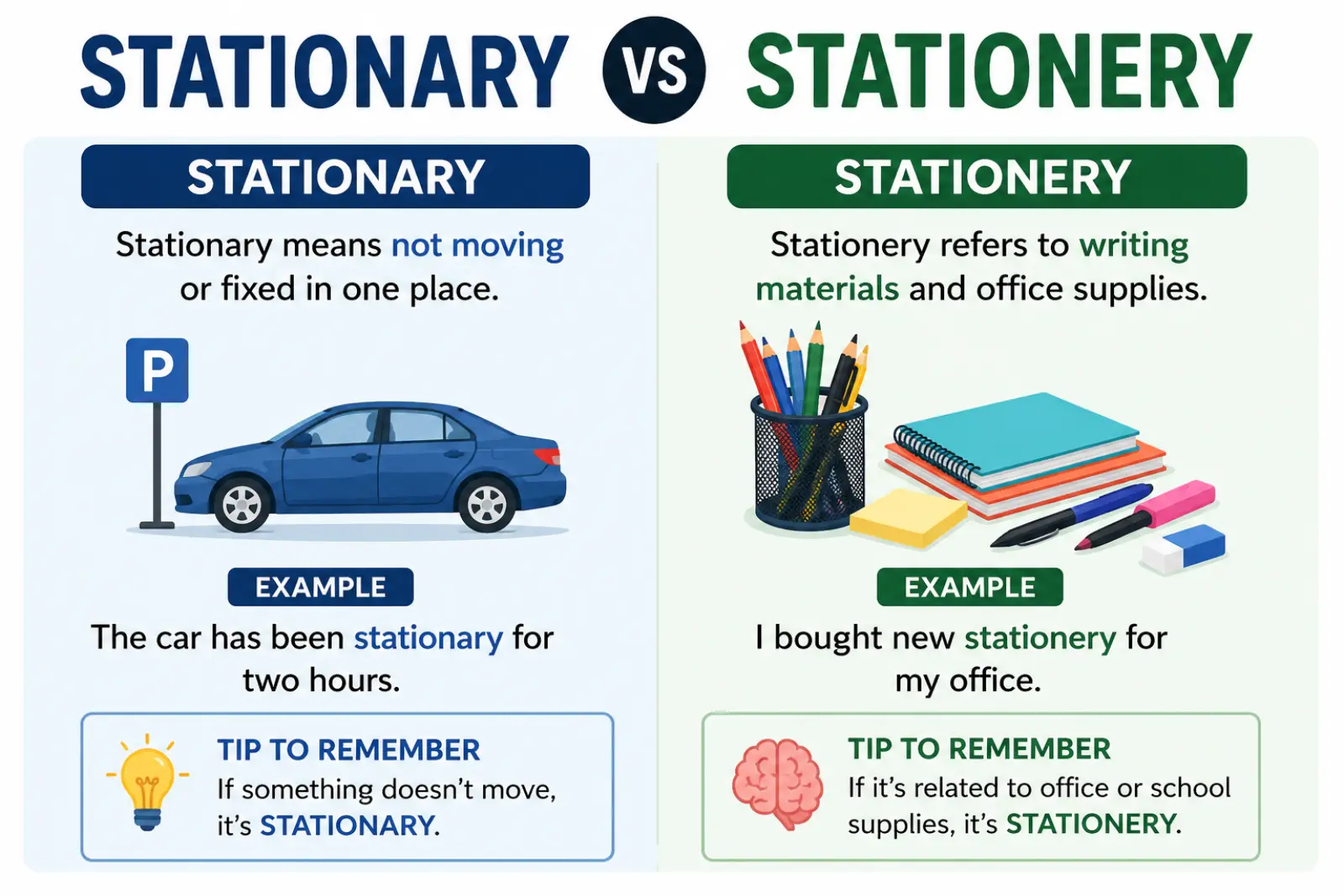
Stationary vs stationery is one of the most confusing word pairs in English. They sound exactly the same, but they have different meanings. Many people use the wrong spelling in emails, school work, and business writing.
The good news is that the difference is easy to remember. Once you know what each word means, you will rarely mix them up again.
In this guide, you will learn the meaning of both words in simple English. You will also see examples, common mistakes, memory tricks, and real-life situations. By the end, you will know exactly when to use stationary and when to use stationery with confidence.
Quick Summary
- Stationary means not moving.
- Stationery means writing materials, such as paper, pens, notebooks, and envelopes.
- They sound the same but have different spellings and meanings.
- Use stationary for people, vehicles, or objects that stay still.
- Use stationery for office or school supplies.
- Remember: Stationery has “e” for envelope.
Stationary vs Stationery Comparison Table
| Feature | Stationary | Stationery |
|---|---|---|
| Part of Speech | Adjective | Noun |
| Meaning | Not moving | Writing materials |
| Used For | People, cars, objects | Paper, pens, envelopes |
| Example | The car remained stationary. | She bought new stationery. |
| Easy Memory Tip | Stay still | “E” for envelope |
What Does “Stationary” Mean?
The word stationary describes something that does not move.
It is an adjective. You use it when talking about something that stays in one place.
Examples
- The bus stayed stationary during the storm.
- Please remain stationary while the photo is taken.
- The train was stationary for ten minutes.
- The bicycle remained stationary near the gate.
- The drone became stationary in the air.
Common Situations
You often hear stationary when talking about:
- Cars
- Trains
- Machines
- People
- Cameras
- Objects
What Does “Stationery” Mean?
Stationery refers to writing supplies and office materials.
It is a noun.
Stationery includes:
- Paper
- Pens
- Pencils
- Notebooks
- Envelopes
- Letterheads
- Greeting cards
- Sticky notes
Examples
- I bought new stationery for school.
- The company ordered custom stationery.
- She keeps colorful stationery in her desk.
- Wedding stationery includes invitations and RSVP cards.
Why Do People Confuse Stationary and Stationery?
These words are homophones.
That means they sound exactly alike but have different meanings and spellings.
Many writers rely on pronunciation instead of spelling. As a result, they choose the wrong word.
Examples of confusion:
❌ I bought beautiful stationary.
✅ I bought beautiful stationery.
❌ The car remained stationery.
✅ The car remained stationary.
Stationary vs Stationery: Key Differences
Here are the biggest differences.
| Stationary | Stationery |
|---|---|
| Means not moving | Means writing supplies |
| Adjective | Noun |
| Describes movement | Names objects |
| Used in transport | Used in schools and offices |
| Example: The bus is stationary. | Example: I need stationery. |
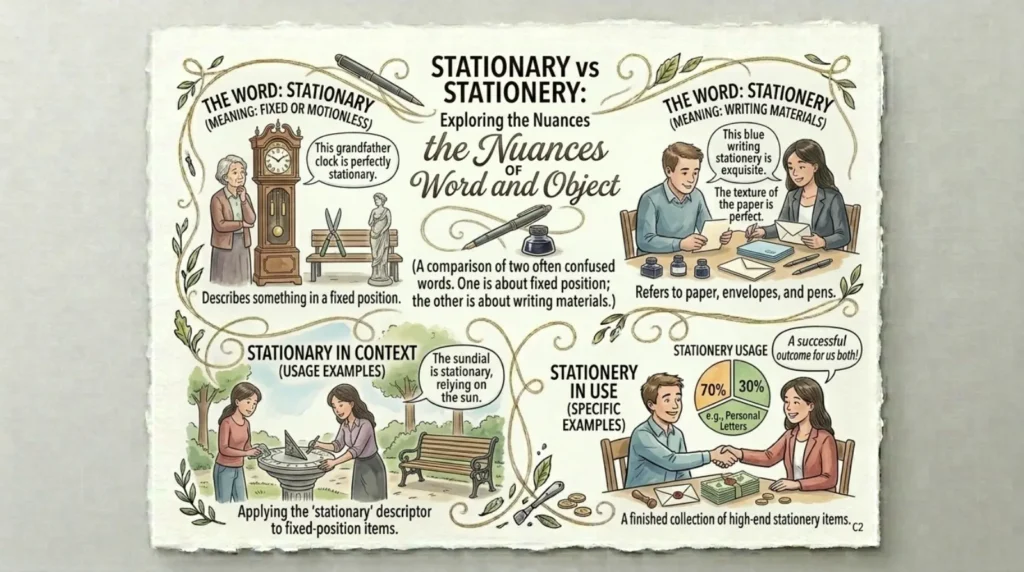
Real-Life Examples of Stationary and Stationery
Understanding real situations makes these words easier to remember.
At School
Correct:
- I forgot my stationery at home.
- The students stayed stationary during the drill.
At the Office
Correct:
- The company ordered branded stationery.
- The printer remained stationary because of a paper jam.
While Traveling
Correct:
- The airplane remained stationary before takeoff.
- I packed a notebook and other stationery for the trip.
Common Mistakes People Make
Many learners swap these words.
Here are common errors.
Mistake 1
❌ I need stationary for class.
✅ I need stationery for class.
Mistake 2
❌ The truck stayed stationery.
✅ The truck stayed stationary.
Mistake 3
❌ Our office sells stationary.
✅ Our office sells stationery.
Mistake 4
❌ The teacher remained stationery.
✅ The teacher remained stationary.
Easy Trick to Remember the Difference
The easiest memory trick is this:
Stationery has an “E” for Envelope.
Envelope is a writing supply.
So:
- Stationery → Envelope
- Stationary → Stay Still
Another trick:
Think of:
Stationary = Stay
Both words begin with Sta.
How to Use Stationary in Daily Life
Use stationary whenever something does not move.
Examples:
- The elevator stayed stationary.
- The bicycle remained stationary.
- The robot became stationary.
- Traffic remained stationary.
- The camera stayed stationary.
How to Use Stationery in Daily Life
Use stationery whenever you talk about office or school supplies.
Examples:
- I bought new stationery online.
- The office ordered company stationery.
- She collects luxury stationery.
- My favorite stationery includes colorful notebooks.
- We designed wedding stationery.
Synonyms and Related Words
Synonyms for Stationary
- Still
- Motionless
- Fixed
- Immobile
- Standing
- Unmoving
Related Words for Stationery
- Office supplies
- Writing supplies
- School supplies
- Paper products
- Notebooks
- Letterhead
- Envelopes
- Pens
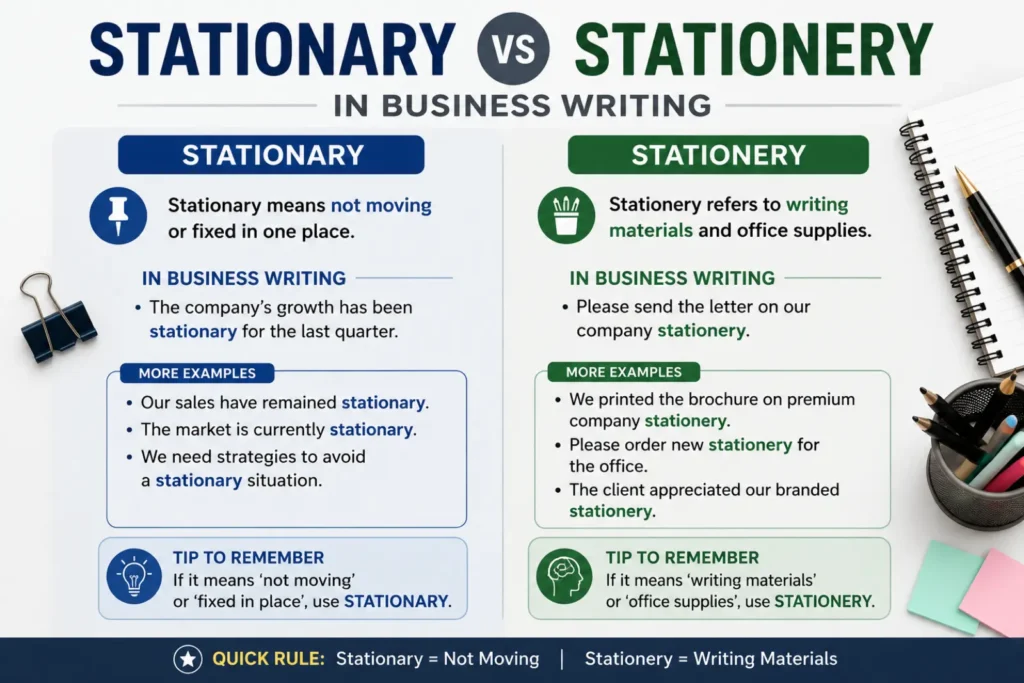
Stationary vs Stationery in Business Writing
Businesses often use stationery for branding.
Business stationery may include:
- Letterheads
- Business cards
- Envelopes
- Notepads
- Thank-you cards
Using the wrong spelling can make a company look unprofessional.
For example:
❌ Premium Business Stationary
✅ Premium Business Stationery
Why Correct Spelling Matters
Correct spelling improves communication.
It also helps:
- Build trust
- Improve professional writing
- Reduce confusion
- Increase credibility
- Create polished documents
Whether you write emails or blog posts, choosing the correct word matters.
Expert Insights
Professional writers always check confusing word pairs before publishing.
Although stationary and stationery sound alike, they serve different purposes.
Using the correct spelling improves clarity and professionalism. It also creates a better reading experience.
Editors recommend learning memory tricks instead of memorizing long grammar rules.
One simple reminder can prevent years of spelling mistakes.
FAQs
Is it stationary or stationery for office supplies?
Use stationery because it refers to paper, pens, envelopes, and other office materials.
Is a car stationary or stationery?
A car is stationary when it is not moving.
What is the easiest way to remember stationery?
Remember stationery has an “E” for envelope.
Can stationary be used as a noun?
No.
Stationary is an adjective.
Is stationery singular or plural?
Stationery is an uncountable noun.
You usually say:
- some stationery
- office stationery
Why do stationary and stationery sound the same?
They are homophones.
Homophones share the same pronunciation but have different meanings and spellings.
Which spelling is correct for wedding invitations?
Use stationery because invitations are writing materials.
Which spelling should I use in school assignments?
Use:
- Stationery for school supplies.
- Stationary for things that are not moving.
Featured Snippet: Stationary vs Stationery
Stationary means not moving and is an adjective. Stationery means writing materials, such as paper, pens, notebooks, and envelopes, and is a noun. A simple trick is to remember that stationery contains the letter “E” for envelope.
Internal Linking Suggestions
To strengthen topical authority, consider linking this article to related grammar guides such as:
- Affect vs Effect
- Then vs Than
- Principal vs Principle
- Its vs It’s
- Compliment vs Complement
- Lose vs Loose
- Everyday vs Every Day
- Advice vs Advise
Conclusion
Understanding stationary vs stationery is easier than many people think. Although these words sound exactly alike, they have very different meanings. Stationary describes something that does not move, while stationery refers to writing materials like paper, pens, notebooks, and envelopes.
The easiest way to remember the difference is the “Envelope” trick. Stationery contains the letter E, just like envelope. Whenever you write emails, school assignments, business documents, or blog posts, choosing the correct spelling will make your writing clearer and more professional.
With a little practice and the examples in this guide, you can confidently use both words correctly every time.

Michael Reed is a language content writer and word comparison researcher based in the United States. He studied English Language and Communication and focuses on grammar, spelling differences, and word usage. His work helps readers understand confusing English words through clear comparisons and practical explanations. Michael creates simple, reader-friendly content designed to improve everyday language skills.