
Truely or truly Australia is a common search because many people feel unsure about the correct spelling of this word. You may have seen both versions online. However, only one spelling is correct in standard English.
Many Australians, students, writers, and business owners make this mistake. The confusion happens because the word comes from “true.” People often assume the extra “e” should stay.
In reality, English spelling follows a different rule here. Knowing the correct form helps you write clearly and professionally. It also prevents mistakes in emails, school assignments, social media posts, and business content.
This guide explains the difference between truely and truly in simple words. You will learn the correct spelling, common mistakes, examples, and useful memory tips.
Quick Summary Box
- Truly is the correct spelling.
- Truely is incorrect in standard English.
- Australia follows the same spelling rule.
- “Truly” means honestly, genuinely, or really.
- Use “truly” in formal and informal writing.
- Never use “truely” in professional documents.
What Does “Truly” Mean?
The word truly is an adverb.
It means:
- Honestly
- Genuinely
- Sincerely
- Really
- In a truthful way
Examples
- I truly appreciate your help.
- She truly loves her family.
- This is truly an amazing experience.
- We are truly grateful for your support.
In each sentence, “truly” adds emphasis to the statement.
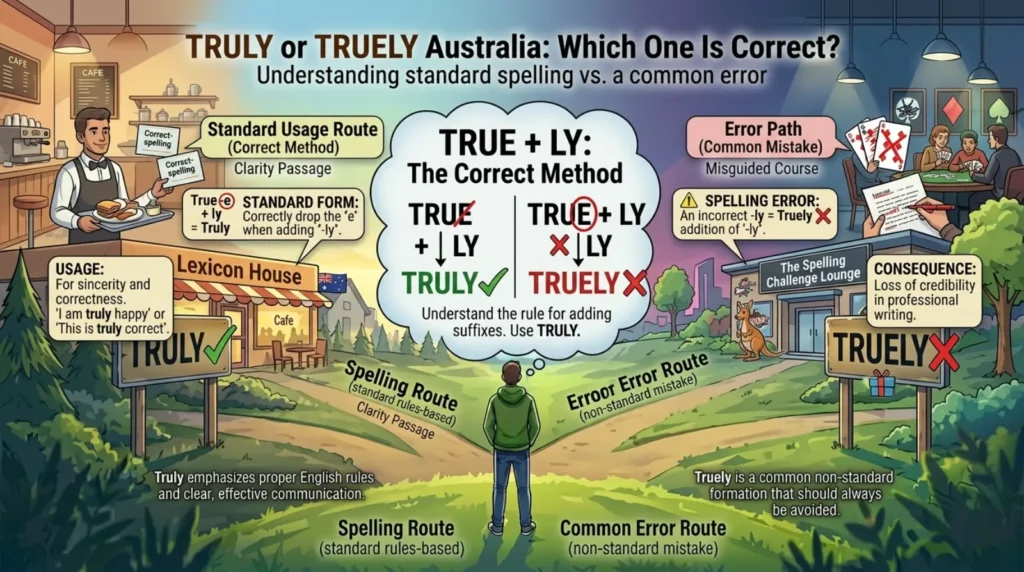
Truely or Truly Australia: Which One Is Correct?
The correct spelling is truly.
The spelling truely is wrong.
Whether you live in Australia, the UK, the United States, or Canada, the correct form remains the same.
Correct
✅ Truly
Incorrect
❌ Truely
Australian English dictionaries recognize only truly as the standard spelling.
Why Do People Write “Truely”?
Many people think the word should keep the “e” from true.
For example:
- True → Truely (incorrect assumption)
However, English removes the final “e” before adding “-ly.”
Correct Formation
- True + ly = Truly
This spelling rule applies to a few common words in English.
That is why “truly” looks unusual but remains correct.
Truely vs Truly Comparison Table
| Feature | Truly | Truely |
|---|---|---|
| Correct spelling | ✅ Yes | ❌ No |
| Accepted in Australian English | ✅ Yes | ❌ No |
| Found in dictionaries | ✅ Yes | ❌ No |
| Suitable for formal writing | ✅ Yes | ❌ No |
| Suitable for academic work | ✅ Yes | ❌ No |
| Recommended for business use | ✅ Yes | ❌ No |
How Australian English Uses “Truly”
Australian English follows standard English spelling rules.
People in Australia use truly in:
- Schools
- Universities
- Government documents
- Business communication
- Newspapers
- Websites
Australian Examples
- We are truly proud of our community.
- The event was truly successful.
- This is truly an Australian experience.
You will rarely see “truely” in professional Australian writing.
Real-Life Examples of Truly
Understanding real examples makes learning easier.
At Work
- I truly appreciate your hard work.
At School
- The teacher was truly impressed.
In Emails
- Thank you. I am truly grateful.
On Social Media
- That sunset was truly beautiful.
In Business
- We truly value our customers.
These examples show natural everyday usage.
Common Mistakes People Make
Many writers accidentally use the wrong spelling.
Mistake 1: Keeping the “E”
❌ Truely
✅ Truly
Mistake 2: Auto-Correct Dependence
Some devices may not immediately flag the error.
Always double-check important documents.
Mistake 3: Copying Incorrect Content
Many websites contain spelling mistakes.
Verify words using trusted dictionaries.
Mistake 4: Confusing Pronunciation
Because “true” contains an “e,” people expect “truely” to be correct.
English spelling does not work that way here.
Easy Trick to Remember the Correct Spelling
A simple memory trick can help.
Think of these words:
- True → Truly
- Due → Duly
Notice how the extra “e” disappears.
Memory Formula
True minus E plus LY = Truly
Repeat this rule a few times, and the spelling becomes easier to remember.
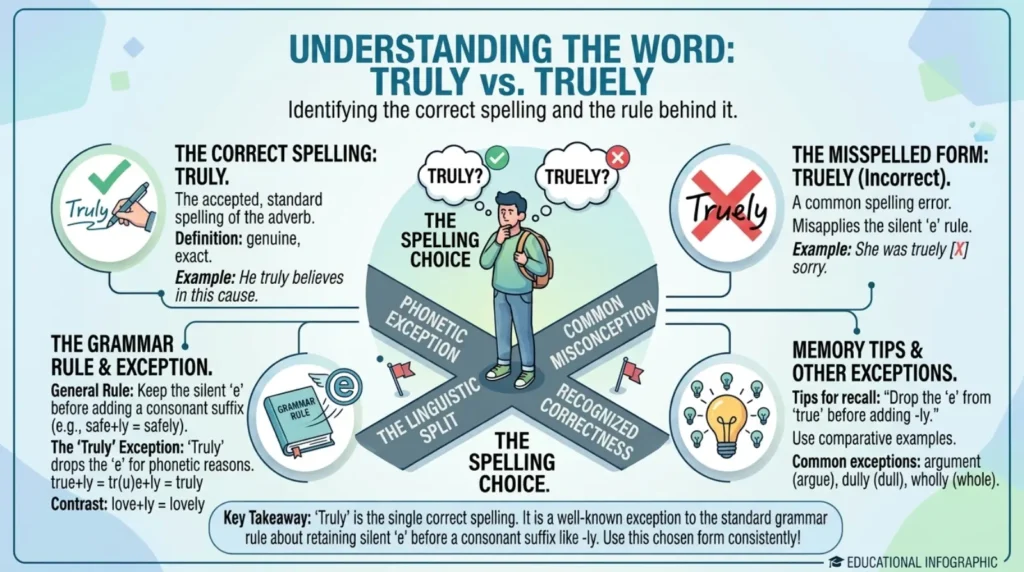
Grammar Rule Behind Truly
English often drops a final silent “e” before adding a suffix.
Examples include:
| Base Word | Correct Form |
|---|---|
| True | Truly |
| Due | Duly |
| Whole | Wholly |
| Argue | Arguing |
This pattern explains why “truly” does not contain the letter “e.”
Synonyms of Truly
Using synonyms can improve your writing.
Common Synonyms
- Honestly
- Genuinely
- Sincerely
- Really
- Certainly
- Indeed
- Actually
- Authentically
Example
Original:
- I truly enjoyed the concert.
Alternative:
- I genuinely enjoyed the concert.
When Should You Use Truly?
Use “truly” whenever you want to express sincerity or emphasis.
Suitable Situations
- Formal letters
- Business emails
- Academic writing
- Blog posts
- Social media captions
- Conversations
Examples
- I truly believe this will help.
- We truly appreciate your feedback.
- She is truly talented.
Is “Truely” Ever Correct?
No.
Modern dictionaries and style guides do not accept truely as a correct spelling.
If you use it, readers may view it as a spelling error.
For professional communication, always choose truly.
Expert Insight: Why Correct Spelling Matters
Correct spelling builds trust.
Readers notice writing errors quickly. A simple mistake can reduce credibility.
Businesses, bloggers, and students benefit from accurate spelling because it:
- Improves readability
- Creates a professional image
- Helps search engine optimization
- Builds reader confidence
- Enhances communication
Using truly instead of truely shows attention to detail.
Related Words Often Confused
People who search for “truely or truly Australia” often confuse other words too.
Examples include:
- Definitely or definately
- Business or bussiness
- Separate or seperate
- Receive or recieve
- Lose or loose
Learning common spelling rules can reduce these errors.
FAQs
Is truly the correct spelling in Australia?
Yes. Australian English uses truly as the correct spelling.
Is truely a real word?
No. It is considered a spelling mistake.
Why is truly spelled without the “e”?
English drops the silent “e” before adding “-ly.”
Can I use truely in formal writing?
No. Use truly instead.
Do Australian dictionaries include truely?
No. Standard dictionaries list only truly.
What does truly mean?
It means honestly, genuinely, sincerely, or really.
Is truly an adverb?
Yes. It modifies verbs, adjectives, or other adverbs.
How can I remember the spelling?
Use this rule: True minus E plus LY equals Truly.
Internal Linking Suggestions
Consider linking this article to:
- Common Australian English spelling mistakes
- Truly vs really
- Business or bussiness
- Definitely or definately
- Grammar rules for adverbs
- English spelling tips for students
Conclusion
When comparing truely or truly Australia, the answer is simple. Truly is the correct spelling, while truely is incorrect. Australian English follows the same rule used in other major English-speaking countries.
The confusion comes from the word true, but English drops the final “e” before adding -ly. As a result, the correct form becomes truly.
Using the right spelling improves your writing and helps you appear more professional. Whether you are writing emails, school assignments, website content, or social media posts, always choose truly.
Remember this easy rule: True minus E plus LY equals Truly. Once you learn it, you will never make this spelling mistake again.

James Carter is a comparison writer and research specialist with over 10 years of experience in digital publishing. With a background in business communication and consumer research, he creates detailed comparison articles, buying guides, and reviews that help readers make informed decisions with confidence. “Every comparison should help readers make better decisions. My goal is to turn complex information into clear, practical guidance that people can trust.” — James Carter