Youth singular or plural is a common grammar question. Many English learners find this word confusing. Sometimes youth refers to one young person. Other times, it describes young people as a group. The correct choice depends on the sentence and its meaning.
This guide explains everything in simple English. You will learn when youth is singular and when youths is the correct plural form. You will also see real-life examples, common mistakes, and easy tips to remember the rule. By the end, you will feel confident using these words in everyday conversations, school writing, and professional content.
Quick Summary Box (Featured Snippet)
- Youth is usually a singular noun.
- Youth can also be a collective noun for young people.
- Youths is the regular plural when talking about several individual young people.
- Youth often refers to the stage of being young.
- Youths is less common in everyday English.
- Use young people if you want a more natural alternative.
What Does “Youth” Mean?
The word youth has several meanings.
It can mean:
- One young person
- The time of life before adulthood
- Young people as a group
Examples
- The youth won the science competition.
- She enjoyed her youth in the countryside.
- Today’s youth spend more time online.
The meaning changes based on the sentence.
Is Youth Singular or Plural?
The answer depends on the context.
| Usage | Singular or Plural? | Example |
|---|---|---|
| One young person | Singular | The youth smiled. |
| Young people as a group | Collective noun | Today’s youth love technology. |
| Several individual young people | Plural (youths) | The police interviewed three youths. |
Quick Rule
- Youth = singular or collective.
- Youths = plural individuals.

When Is “Youth” Singular?
Use youth when talking about one young person.
Examples
- A talented youth joined the team.
- The youth received an award.
- Every youth deserves equal opportunities.
- That youth helped an elderly woman.
- The youth showed great courage.
Here, youth refers to one person.
When Is “Youth” a Collective Noun?
Sometimes youth means all young people together.
In this case, it acts like a group noun.
Examples
- Modern youth face many challenges.
- Youth today enjoy digital learning.
- Our nation’s youth are our future.
- Youth need positive role models.
- Local youth support community projects.
Notice that the word talks about an entire generation.
When Should You Use “Youths”?
Use youths when speaking about several separate young people.
This form appears more often in formal writing, legal reports, and news articles.
Examples
- Three youths were playing football.
- Several youths attended the workshop.
- Police questioned two youths.
- The charity helped homeless youths.
- Five youths won scholarships.
In casual conversation, many people prefer young people instead.
Youth vs Youths Comparison Table
| Feature | Youth | Youths |
|---|---|---|
| Meaning | One young person or young people collectively | Several individual young people |
| Number | Singular or collective | Plural |
| Common Use | Very common | Less common |
| Formal Writing | Yes | Yes |
| Everyday Speech | Yes | Less common |
| Example | Youth need guidance. | The youths entered the competition. |
Real-Life Examples of Youth and Youths
Here are simple examples from daily life.
At School
✅ The youth received first prize.
✅ Several youths joined the science club.
In Sports
✅ Local youth enjoy football.
✅ The coach trained five youths.
In News Reports
✅ Youth unemployment remains a concern.
✅ Police spoke with two youths after the incident.
At Community Events
✅ Youth volunteer every weekend.
✅ The event welcomed hundreds of youths.
Common Mistakes to Avoid
Many learners confuse these words.
Mistake 1
❌ The youths of today love smartphones.
✅ Today’s youth love smartphones.
Mistake 2
❌ Every youths should study hard.
✅ Every youth should study hard.
Mistake 3
❌ One youths was absent.
✅ One youth was absent.
Mistake 4
❌ Youths is an important stage of life.
✅ Youth is an important stage of life.
Mistake 5
❌ Modern youths likes social media.
✅ Modern youth like social media.
Easy Trick to Remember the Difference
Use this simple memory tip.
Think of these questions:
Are you talking about one person?
➡ Use youth.
Are you talking about all young people?
➡ Use youth.
Are you counting several individuals?
➡ Use youths.
This trick works in almost every situation.
Youth in Daily Conversations
Here are natural examples.
Conversation 1
Teacher: Every youth should respect others.
Conversation 2
Coach: The youths practiced every evening.
Conversation 3
Parent: Youth today learn technology very quickly.
Conversation 4
Reporter: Three youths helped rescue a child.
Synonyms and Related Words
Using related words improves writing and SEO.
Synonyms for Youth
- Young person
- Teenager
- Adolescent
- Juvenile
- Child
- Minor
- Young adult
Related Keywords
- youth meaning
- youth grammar
- youths meaning
- youth singular
- youth plural
- young people
- youth definition
- youth examples
- youths examples
- youth vs youths
- collective noun
- grammar rules
Grammar Rules for Youth
Here are simple grammar rules.
Rule 1
Use a youth for one individual.
Example:
A youth won the race.
Rule 2
Use youth for the younger generation.
Example:
Youth shape the future.
Rule 3
Use youths for several separate young people.
Example:
Four youths attended the meeting.
Rule 4
Use verbs that match the meaning.
Example:
Youth today are more connected online.
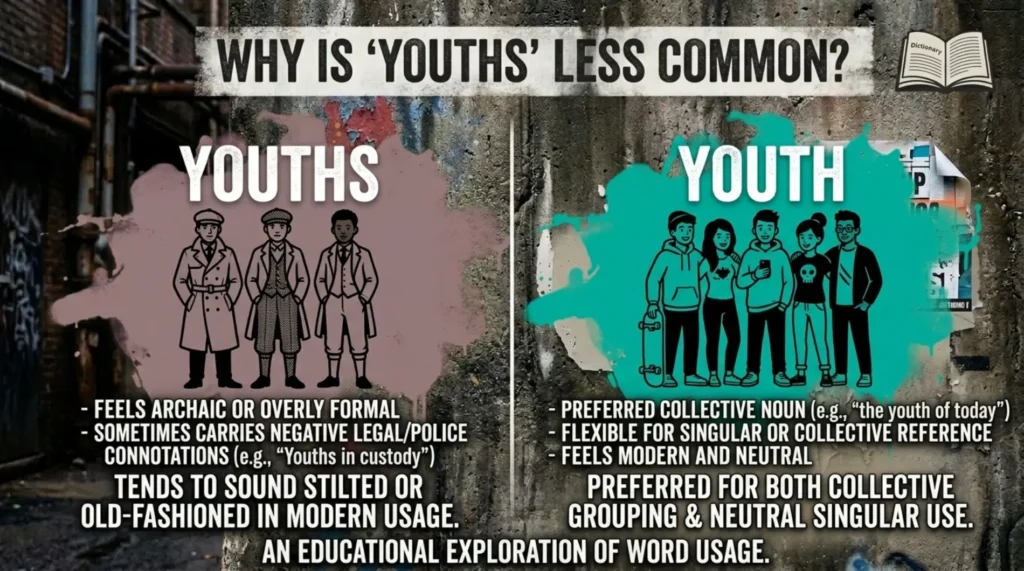
Why Is “Youths” Less Common?
Native speakers usually say:
- young people
- teenagers
- young adults
instead of youths.
However, youths remains correct.
It appears often in:
- newspapers
- police reports
- legal documents
- research papers
Expert Insight
Grammar experts recommend choosing words based on your audience.
If you write for general readers, young people often sounds more natural than youths.
Use youth when discussing an age group or life stage.
Use youths only when referring to several individual young people.
This approach improves readability and matches modern English usage.
FAQs:
Is youth singular or plural?
Youth is usually singular. It can also refer collectively to young people.
What is the plural of youth?
The plural form is youths.
Is “today’s youth” correct?
Yes. It refers to young people as a group.
Can I say “many youth”?
Usually no.
Say:
- many young people
- many youths
depending on the context.
Is “youths” a real word?
Yes. It is the correct plural of youth.
Why do people rarely use “youths”?
Most native speakers prefer young people in everyday conversation.
Is youth a collective noun?
Yes. It often refers to all young people together.
Which sounds more natural?
In everyday English:
✅ young people
In formal writing:
✅ youth
✅ youths
SEO Optimization
Primary Keyword:
- youth singular or plural
Secondary Keywords:
- is youth singular or plural
- youth plural form
- youth grammar
- youths meaning
- youth vs youths
- youth definition
- plural of youth
- youth examples
- young people grammar
- collective noun youth
- youth singular meaning
- grammar rules for youth
Internal Linking Suggestions
Consider linking this article to related grammar topics such as:
- Youth vs Youths
- Person vs People
- Child vs Children
- Singular vs Plural Nouns
- Collective Nouns in English
- Common Grammar Mistakes
- Countable and Uncountable Nouns
Final Takeaway
Understanding youth singular or plural becomes easy once you know the context. Youth usually refers to one young person, the stage of being young, or young people as a group. Youths is the correct plural when you mean several individual young people. Although youths is grammatically correct, everyday English often favors young people because it sounds more natural. Learning this distinction helps you write clearly, avoid common grammar mistakes, and communicate with confidence. Whenever you are unsure, ask yourself whether you are referring to one person, a whole generation, or several individuals. That simple question will guide you to the correct word every time.

Michael Reed is a language content writer and word comparison researcher based in the United States. He studied English Language and Communication and focuses on grammar, spelling differences, and word usage. His work helps readers understand confusing English words through clear comparisons and practical explanations. Michael creates simple, reader-friendly content designed to improve everyday language skills.