
Youth vs youths is a common grammar question. Many English learners wonder which word is correct. The answer depends on the meaning you want to express. Both words are correct, but they are not always interchangeable.
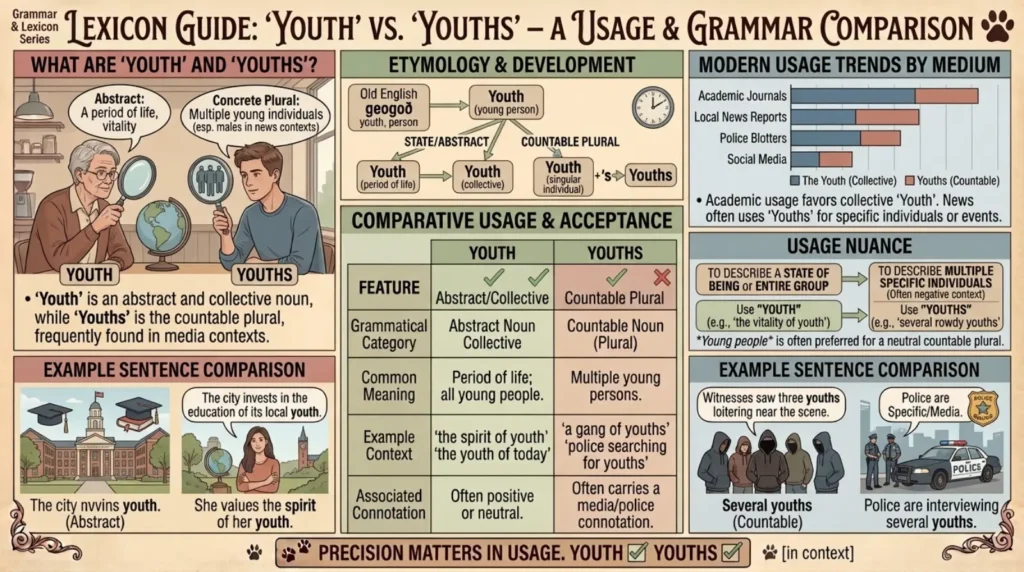
The word youth often refers to young people as a group. It can also describe the period between childhood and adulthood. On the other hand, youths is the plural form. It usually refers to several individual young people.
Knowing the difference helps you write and speak more clearly. It also helps you avoid common grammar mistakes. This guide explains everything in simple words. You will learn definitions, grammar rules, examples, and easy memory tricks.
Quick Summary Box
- Youth refers to young people as a group or the stage of being young.
- Youths means several individual young people.
- Youth is more common in everyday English.
- Youths appears more often in legal, police, or formal writing.
- Use youth when speaking generally.
- Use youths when counting or identifying specific young people.
What Does “Youth” Mean?
Youth has two common meanings.
1. The time of life between childhood and adulthood
Examples
- She spent her youth in a small village.
- Exercise is important during youth.
- His youth was full of adventure.
2. Young people as a group
Examples
- Today’s youth love technology.
- The program supports local youth.
- Youth need positive role models.
Here, youth works like a collective noun.
What Does “Youths” Mean?
Youths is simply the plural form of youth when referring to individual young people.
It is less common than youth in daily conversation.
Examples
- Three youths helped clean the park.
- Police questioned two youths after the incident.
- Several youths joined the sports competition.
This form focuses on separate individuals rather than young people as one group.
Youth vs Youths: Comparison Table
| Feature | Youth | Youths |
|---|---|---|
| Meaning | Young people as a group or the stage of being young | Multiple individual young people |
| Grammar | Singular or collective noun | Plural noun |
| Common Usage | Very common | Less common |
| Tone | General and natural | Formal or specific |
| Example | Today’s youth are creative. | Two youths entered the competition. |
| Used for Age Period | Yes | No |
| Used for Groups | Yes | No |
When Should You Use “Youth”?
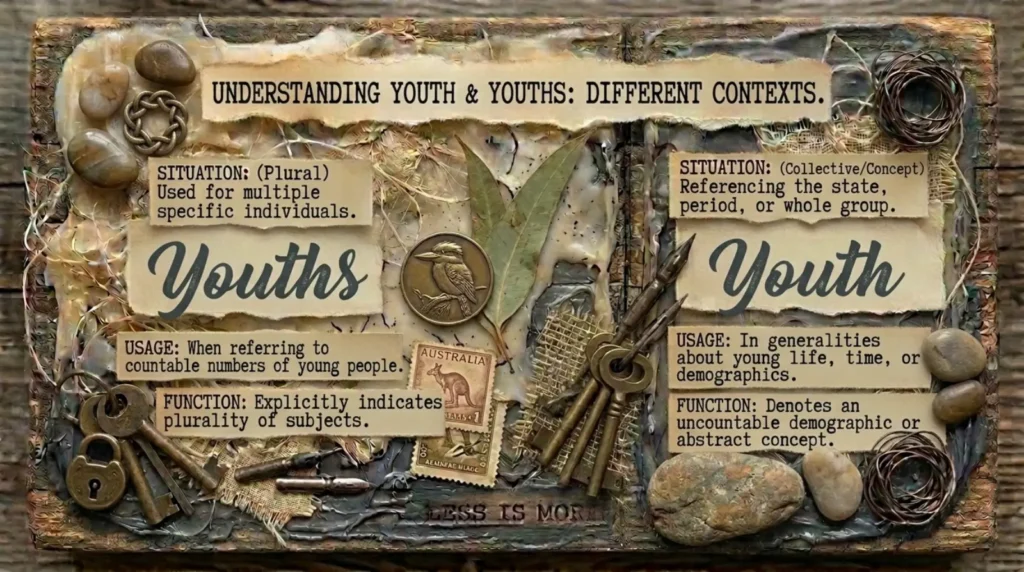
Choose youth when speaking about young people in general.
Examples
- Youth today enjoy social media.
- The city offers programs for youth.
- Education helps every youth succeed.
- Youth unemployment is a global issue.
- Youth leadership builds confidence.
This usage sounds natural in everyday English.
When Should You Use “Youths”?
Use youths when talking about specific young people.
Examples
- Four youths volunteered at the event.
- The teacher praised the youths.
- Several youths attended the meeting.
- Police spoke with two youths.
- The organization honored five outstanding youths.
This form appears more often in newspapers and official reports.
Why Is “Youth” More Common Than “Youths”?
Modern English prefers collective nouns.
Instead of saying:
❌ The youths today love music.
Most native speakers say:
✅ Today’s youth love music.
This sounds smoother and more natural.
That is why youth appears more often in books, blogs, and conversations.
Real-Life Examples of Youth vs Youths
At School
Correct:
- The school supports youth leadership.
Correct:
- Five youths won science awards.
In News Reports
Correct:
- Police arrested two youths.
Correct:
- Local youth organized a charity event.
At Work
Correct:
- The company invests in youth training.
Correct:
- Several youths joined the internship.
In Daily Conversation
Correct:
- Youth today face many challenges.
Correct:
- The youths from our neighborhood visited us.
Common Grammar Mistakes
Mistake 1
❌ Youths today love smartphones.
✅ Youth today love smartphones.
Mistake 2
❌ One youths attended.
✅ One youth attended.
Mistake 3
❌ Many youths’s ideas were helpful.
✅ Many youths’ ideas were helpful.
Mistake 4
❌ Youth is many young people individually.
✅ Youth usually means young people as one group.
Easy Trick to Remember
Think about this simple rule.
- Youth = One group
- Youths = Many individuals
Ask yourself one question.
Am I talking about young people together or separately?
If together, use youth.
If separately, use youths.
Youth vs Youths in Everyday English
Here are natural examples.
| Situation | Correct Usage |
|---|---|
| Government programs | Youth development |
| Sports clubs | Youth teams |
| Community services | Youth center |
| Police reports | Two youths |
| School awards | Three youths received medals |
| Society in general | Today’s youth |
Synonyms and Related Words
Synonyms for Youth
- Young people
- Teenagers
- Adolescents
- Young generation
- Juveniles
- Young adults
Related Terms
- Youth culture
- Youth development
- Youth services
- Youth education
- Youth employment
- Youth leadership
- Young generation
- Teenage years
These semantic keywords improve SEO while keeping the content natural.
Youth vs Youths in Different Contexts
Education
Schools often use youth.
Example:
- Youth education improves communities.
Government
Governments usually say:
- Youth employment
- Youth development
- Youth policy
News
Journalists often write:
- Two youths were rescued.
- Three youths received awards.
Everyday Conversation
People usually prefer:
- Today’s youth.
- Local youth.
This sounds more natural.
Expert Grammar Insights
English grammar allows both youth and youths.
However, context matters.
Professional writers usually choose youth for broad discussions.
They use youths when referring to individual people.
This choice improves clarity and sounds more natural.
For SEO writing, using the correct word also helps readers trust your content.
Featured Snippet
Is it youth or youths?
Both are correct.
- Youth refers to young people as a group or the stage of being young.
- Youths refers to several individual young people.
- Youth is more common in everyday English.
- Youths appears mainly in formal, legal, or news writing.
Frequently Asked Questions
Is “youths” grammatically correct?
Yes. It is the correct plural form of youth when referring to multiple individual young people.
Why do people say “youth” instead of “youths”?
Because youth often acts as a collective noun. Native speakers use it more naturally.
Can I say “today’s youths”?
Yes, but today’s youth is more common and sounds more natural.
Is “youth” singular or plural?
It can be singular or a collective noun referring to many young people.
Is “youths” formal?
Yes. It appears more often in legal documents, police reports, and news articles.
Which word should I use in essays?
Use youth when discussing young people generally. Use youths only when referring to specific individuals.
Can both words appear in the same sentence?
Yes.
Example:
The youth program helped several youths find jobs.
SEO Details
Primary Keyword: youth vs youths
Secondary Keywords:
- youth or youths
- difference between youth and youths
- youth meaning
- youths meaning
- youth grammar
- plural of youth
- youth examples
- youths examples
- youth vs youths grammar
- when to use youth
- when to use youths
- English grammar guide
- collective noun youth
- young people grammar
- youth definition
Common Phrases with “Youth”
- Youth development
- Youth leadership
- Youth sports
- Youth services
- Youth center
- Youth organization
- Youth education
- Youth culture
- Youth employment
- Youth empowerment
Internal Linking Suggestions
To build topical authority, consider linking this article to:
- Young vs Younger: What’s the Difference?
- Children vs Childrens Explained
- Person vs People Grammar Guide
- Teenager vs Adolescent
- Collective Nouns in English
- Common English Plural Rules
Conclusion
Understanding youth vs youths is easier once you know the context. Youth usually refers to young people as a group or the stage of life before adulthood. It is the word you will hear most often in everyday English. Youths, however, is the correct plural when talking about several individual young people. It appears more frequently in formal writing, legal documents, and news reports. Choosing the right word makes your writing clearer and more professional. Remember this simple rule: use youth for a group and youths for specific individuals. With regular practice, selecting the correct form will become natural and help you communicate with confidence.

Emma Collins is a language writer and grammar enthusiast specializing in English vocabulary, spelling comparisons, and word usage guides. She creates easy-to-understand content that helps readers improve their writing, communication, and language skills with confidence.