
Adviser or advisor UK is a common grammar question. Many people wonder which spelling is correct in British English. The good news is that both words are correct. However, one spelling is more common in the UK.
You may see adviser in newspapers, universities, and government websites. You may also find advisor in company names or job titles. This can make the choice confusing.
This guide explains the difference in simple words. You will learn when to use each spelling. You will also see real-life examples, common mistakes, and expert tips. By the end, you will know which spelling fits your writing.
Quick Summary Box
- Adviser and advisor have the same meaning.
- Both describe someone who gives advice.
- Adviser is the preferred spelling in British English.
- Advisor is more common in American English.
- Some UK organizations still use advisor in official job titles.
- Always follow your company’s style guide when writing professionally.
What Does Adviser or Advisor Mean?
Both adviser and advisor mean a person who gives advice or guidance.
They help people make better decisions.
Examples include:
- Financial adviser
- Academic adviser
- Legal adviser
- Career adviser
- Business adviser
The meaning never changes. Only the spelling does.
Adviser vs Advisor UK: What’s the Difference?
The biggest difference is spelling preference.
| Adviser | Advisor |
|---|---|
| Preferred in UK English | Preferred in US English |
| Used by many British publishers | Common in American writing |
| Found in UK government documents | Found in US government documents |
| Same pronunciation | Same pronunciation |
| Same meaning | Same meaning |
Key Point:
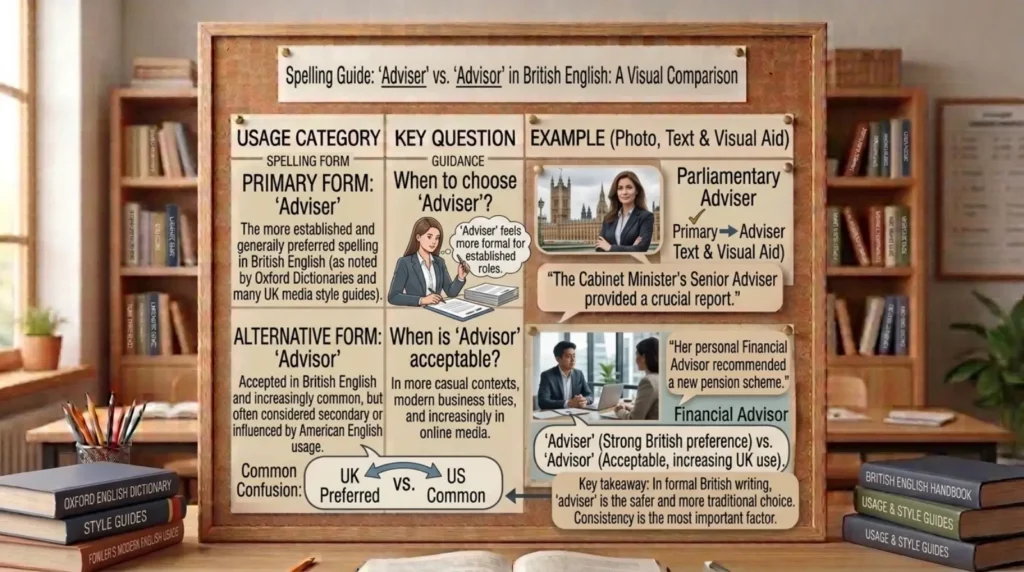
If you write for a UK audience, adviser is usually the safer choice.
Is Adviser or Advisor Correct in British English?
Yes. Both spellings are correct.
However, British dictionaries often list adviser as the preferred spelling.
Many respected UK publishers recommend adviser for general writing.
Still, some British organizations officially use advisor.
For example:
- Special Advisor
- Senior Policy Advisor
- Investment Advisor
In these cases, always use the official title.
Why Does the UK Use Adviser More Often?
British English traditionally prefers -er endings for many job titles.
Examples include:
- Adviser
- Driver
- Teacher
- Farmer
- Builder
The -or ending became more popular through American English.
Today, both spellings exist, but adviser remains more common in everyday UK writing.
Adviser or Advisor in American English
American English usually prefers advisor.
Many US universities and businesses use advisor.
Examples:
- Academic Advisor
- Financial Advisor
- Career Advisor
If your audience is American, advisor is often the better choice.
Real-Life Examples of Adviser and Advisor
UK Examples
- My financial adviser helped me save money.
- The Prime Minister appointed a new policy adviser.
- She met her academic adviser before choosing courses.
- Our legal adviser reviewed the contract.
US Examples
- My academic advisor approved my schedule.
- The company hired a marketing advisor.
- She spoke with her financial advisor.
- His career advisor suggested new opportunities.
Common Job Titles
Here are common job titles in both spellings.
| UK Preference | US Preference |
|---|---|
| Financial Adviser | Financial Advisor |
| Legal Adviser | Legal Advisor |
| Tax Adviser | Tax Advisor |
| Career Adviser | Career Advisor |
| Academic Adviser | Academic Advisor |
| Business Adviser | Business Advisor |
Remember that companies may choose either spelling.
Always respect the official job title.
Common Mistakes People Make
Many writers make these mistakes.
Mixing spellings
❌ The adviser spoke with the financial advisor in one article.
✅ Choose one spelling and stay consistent.
Ignoring regional English
Using advisor for British content may look less natural.
Using adviser for American content may seem unusual.
Changing official job titles
Never change an organization’s official title.
If a company says Senior Advisor, keep that spelling.
How to Choose the Correct Spelling
Use these simple rules.
Choose “Adviser” if:
- You write for UK readers.
- You follow British English.
- No official title exists.
- You write school assignments in the UK.
- You write blog posts for UK audiences.
Choose “Advisor” if:
- You write for American readers.
- The employer uses that spelling.
- You copy an official job title.
- Your company style guide prefers it.
Adviser or Advisor in Daily Life
You will see these words in many situations.
Banking
Talk to your financial adviser before investing.
School
Students often meet an academic adviser.
Business
Companies hire business advisers for growth.
Law
A legal adviser explains contracts.
Healthcare
Medical advisers help hospitals improve patient care.
Tips to Remember the Difference
Here are easy memory tricks.
- UK = Adviser
- US = Advisor
- Same pronunciation.
- Same meaning.
- Follow official job titles.
- Stay consistent throughout your writing.
A simple rule is enough for most situations.
Synonyms and Related Words (LSI Keywords)
These related words help search engines understand your content.
Synonyms
- Consultant
- Guide
- Mentor
- Counselor
- Expert
- Specialist
- Coach
- Professional
- Planner
- Strategist
Related Keywords
- adviser meaning
- advisor meaning
- adviser vs advisor
- British English spelling
- UK grammar
- American English spelling
- financial adviser
- legal adviser
- academic adviser
- business adviser
- grammar differences
- English spelling guide
Expert Insight
Professional editors usually recommend following one style throughout a document.
For UK writing, adviser is the standard choice unless an official title says otherwise.
Consistency improves readability. It also builds trust with readers.
If you write for international audiences, decide whether you use British or American English before you begin.
This small choice makes your content look more professional.
FAQs
Is adviser or advisor correct in the UK?
Both are correct. However, adviser is more common in British English.
Which spelling do UK dictionaries prefer?
Most British dictionaries list adviser as the preferred spelling.
Is advisor wrong?
No. It is completely correct. It is simply more common in American English.
Why do some UK companies use advisor?
Many organizations choose their own official spelling. Always use their preferred job title.
Is financial adviser the correct UK spelling?
Yes. Financial adviser is the common British spelling.
Do adviser and advisor have different meanings?
No. Both words mean someone who gives advice.
Should I change an official job title?
No. Always keep the official spelling used by the organization.
Internal Linking Suggestions
Consider linking this article to related grammar guides such as:
- Adviser vs Advisor
- Adviser Meaning
- British vs American English Spelling
- Judgement or Judgment
- Practice or Practise
- Licence or License
- Defence or Defense
- Programme or Program
Featured Snippet Answer
Is adviser or advisor correct in the UK?
Both adviser and advisor are correct in British English. However, adviser is the preferred spelling in most UK publications and dictionaries. Use advisor only when it appears in an official job title or company name.
Conclusion
Choosing between adviser or advisor UK is easier than many people think. Both spellings are correct and carry the same meaning. The main difference is regional preference. In British English, adviser is generally the standard spelling for everyday writing. In American English, advisor appears more often. Still, some UK organizations officially use advisor, so always respect official titles. The most important rule is consistency. Pick one spelling that matches your audience and use it throughout your document. Following this simple approach will make your writing look more professional, improve readability, and help your content meet both reader expectations and SEO best practices.

James Carter is a comparison writer and research specialist with over 10 years of experience in digital publishing. With a background in business communication and consumer research, he creates detailed comparison articles, buying guides, and reviews that help readers make informed decisions with confidence. “Every comparison should help readers make better decisions. My goal is to turn complex information into clear, practical guidance that people can trust.” — James Carter