Loosing vs losing is a common grammar question. Many people use these words the wrong way. They look almost the same, but they have different meanings.
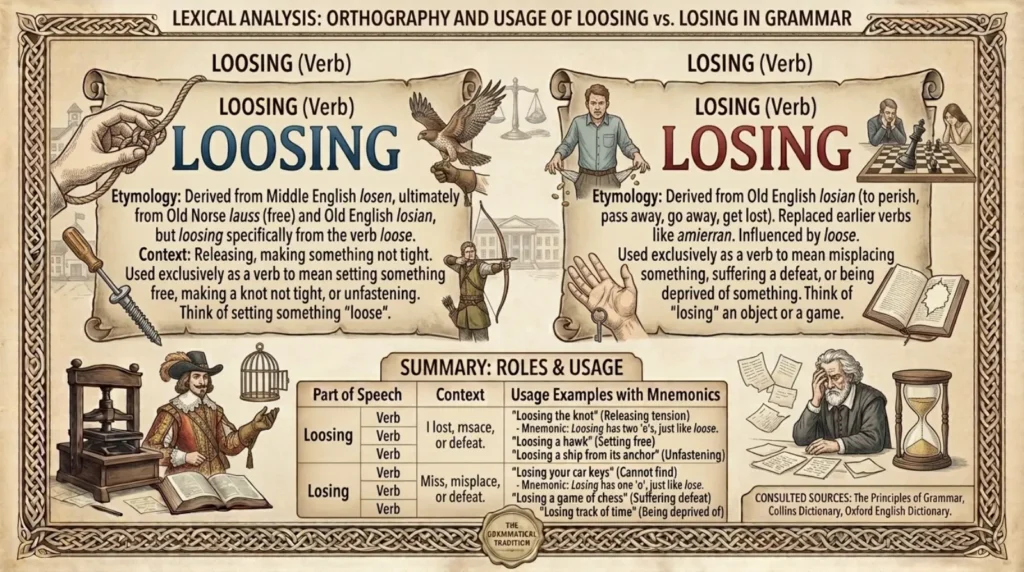
Losing means failing to keep something. It can also mean not winning. Loosing means making something loose or releasing it. This word is much less common.
Knowing the difference helps you write better emails, school work, and social media posts. It also helps you avoid spelling mistakes that confuse readers.
This guide explains both words in simple English. You will learn their meanings, grammar rules, examples, and memory tricks. By the end, you will know exactly when to use loosing and losing.
Quick Summary Box (Featured Snippet)
- Losing means not winning or no longer having something.
- Loosing means making something loose or releasing it.
- Losing is much more common in daily English.
- Loosing usually appears in special situations like archery or sailing.
- Remember: You lose without an extra “o.”
What Does “Losing” Mean?
Losing is the present participle of lose.
It means:
- Not winning
- Misplacing something
- No longer having something
- Becoming smaller or less
Examples
- I am losing my keys again.
- Our team is losing the match.
- She is losing weight.
- They are losing interest.
In modern English, losing appears far more often than loosing.
What Does “Loosing” Mean?
Loosing comes from the verb loose.
It means:
- Releasing something
- Setting something free
- Making something less tight
This word is uncommon in everyday conversations.
Examples
- The hunter is loosing an arrow.
- The sailor is loosing the ropes.
- The worker is loosing the knot.
Many people mistakenly write loosing when they really mean losing.
Loosing vs Losing: Key Differences
| Feature | Losing | Loosing |
|---|---|---|
| Meaning | Not winning or no longer having | Releasing or making loose |
| Verb Base | Lose | Loose |
| Daily Use | Very common | Rare |
| Common Context | Sports, life, work | Archery, sailing, knots |
| Correct Example | I am losing money. | He is loosing an arrow. |
When Should You Use “Losing”?
Use losing whenever someone no longer has something.
Common situations
- Losing a game
- Losing money
- Losing weight
- Losing your phone
- Losing patience
- Losing confidence
- Losing time
Examples
- We are losing the football game.
- She is losing her wallet.
- They are losing customers.
- He is losing hope.
When Should You Use “Loosing”?
Use loosing only when something is released or loosened.
Common situations
- Loosing arrows
- Loosing ropes
- Loosing chains
- Loosing knots
Examples
- The archer is loosing another arrow.
- The sailor is loosing the anchor rope.
- He is loosing the dog’s leash.
These uses are uncommon in everyday writing.
Real-Life Examples of Loosing vs Losing
At School
❌ I am loosing my homework.
✅ I am losing my homework.
During Sports
❌ Our team keeps loosing.
✅ Our team keeps losing.
At Work
❌ The company is loosing money.
✅ The company is losing money.
In Archery
✅ The archer is loosing arrows quickly.
This sentence is correct because the arrows are being released.
Common Mistakes People Make
Many writers add an extra “o” by mistake.
Incorrect
- I’m loosing my phone.
- We’re loosing the game.
- She’s loosing weight.
Correct
- I’m losing my phone.
- We’re losing the game.
- She’s losing weight.
The extra “o” changes the meaning completely.
Easy Trick to Remember the Difference
Here is a simple memory tip.
Losing = Lose + ing
No extra o.
Think:
You lose things, so you write losing.
Loosing = Loose + ing
Loose means not tight.
Think:
You loosen or release something.
This trick helps you avoid one of the most common spelling mistakes.
Loosing vs Losing in Daily Conversations
Most daily conversations use losing.
Examples
- I’m losing my glasses.
- She’s losing sleep.
- We’re losing customers.
- They’re losing money.
- He’s losing confidence.
You rarely need loosing unless you discuss:
- Archery
- Sailing
- Hunting
- Knots
- Historical writing
Grammar Rules for Losing and Loosing
Rule 1
Use losing for the verb lose.
Example:
- We are losing time.
Rule 2
Use loosing only for loose.
Example:
- They are loosing the ropes.
Rule 3
Never replace losing with loosing in everyday writing.
Synonyms and Related Words
Losing
- Misplacing
- Dropping
- Failing
- Falling behind
- Missing
- Giving up
- Surrendering
Loosing
- Releasing
- Freeing
- Untying
- Unfastening
- Letting go
- Unbinding
Related LSI Keywords
- lose vs loose
- losing meaning
- loosing meaning
- spelling mistakes
- grammar rules
- English word differences
- common confusing words
- lose or loose
- correct English spelling
- everyday grammar
Common Phrases with Losing
- Losing weight
- Losing sleep
- Losing hope
- Losing focus
- Losing balance
- Losing confidence
- Losing control
- Losing interest
- Losing money
- Losing patience
Featured Snippet: Is It “Loosing” or “Losing”?
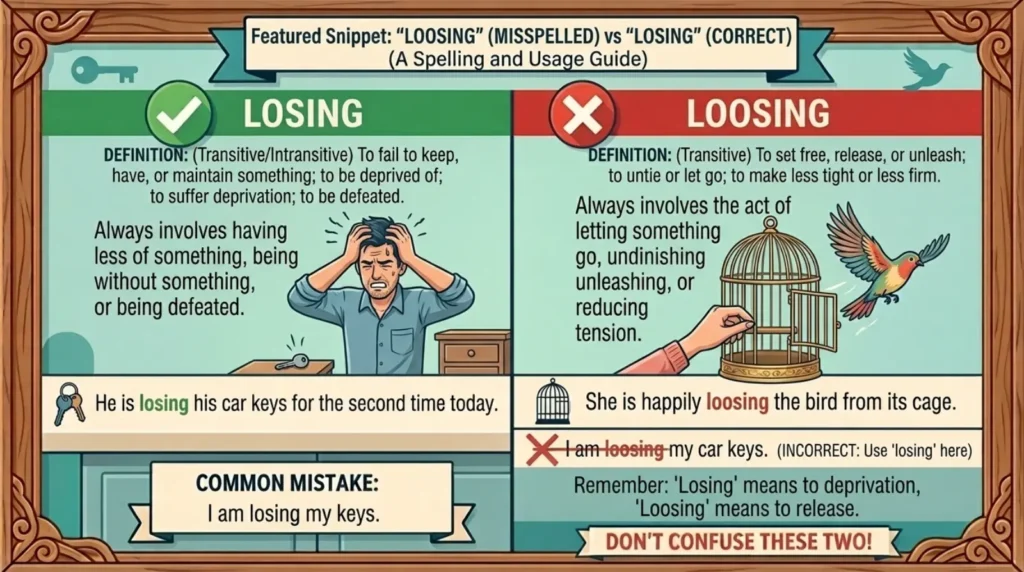
Use “losing” when someone no longer has something or does not win. Use “loosing” only when releasing or making something loose, such as an arrow or rope. In everyday English, “losing” is almost always the correct choice.
Expert Insights
Grammar experts recommend checking whether the sentence means not winning or releasing something.
If it means:
- Not winning → losing
- Misplacing → losing
- Becoming less → losing
- Releasing → loosing
Because losing appears much more often, proofreading for this spelling mistake can improve clarity and professionalism.
FAQs:
Is it losing or loosing weight?
The correct phrase is losing weight.
Is it losing or loosing money?
The correct spelling is losing money.
Why do people write loosing instead of losing?
Both words look similar. Many people mistakenly add an extra o.
Is loosing a real word?
Yes. It means releasing or making something loose.
Which word is more common?
Losing is much more common.
Can loosing be correct?
Yes. It is correct when talking about releasing arrows, ropes, or knots.
Is losing the present tense?
No. Losing is the present participle of lose.
How can I remember the difference?
Remember this:
- Lose → Losing
- Loose → Loosing
No extra o means not winning.
Internal Linking Suggestions
Consider linking this article to related grammar guides such as:
- Lose vs Loose
- Then vs Than
- Affect vs Effect
- Accept vs Except
- Principal vs Principle
- Stationary vs Stationery
- Your vs You’re
- Its vs It’s
Conclusion
Understanding loosing vs losing is easier than it first seems. Losing means not winning, misplacing something, or no longer having it. This is the word you will use in almost every everyday situation. Loosing has a different meaning. It refers to releasing or making something loose, such as an arrow, rope, or knot. Because the spellings are so similar, many writers confuse them. A simple memory trick can help: lose becomes losing, while loose becomes loosing. Before you write, ask yourself whether you mean “not winning” or “releasing.” That quick check will help you choose the correct word every time and make your writing clearer and more professional.

Emma Collins is a language writer and grammar enthusiast specializing in English vocabulary, spelling comparisons, and word usage guides. She creates easy-to-understand content that helps readers improve their writing, communication, and language skills with confidence.