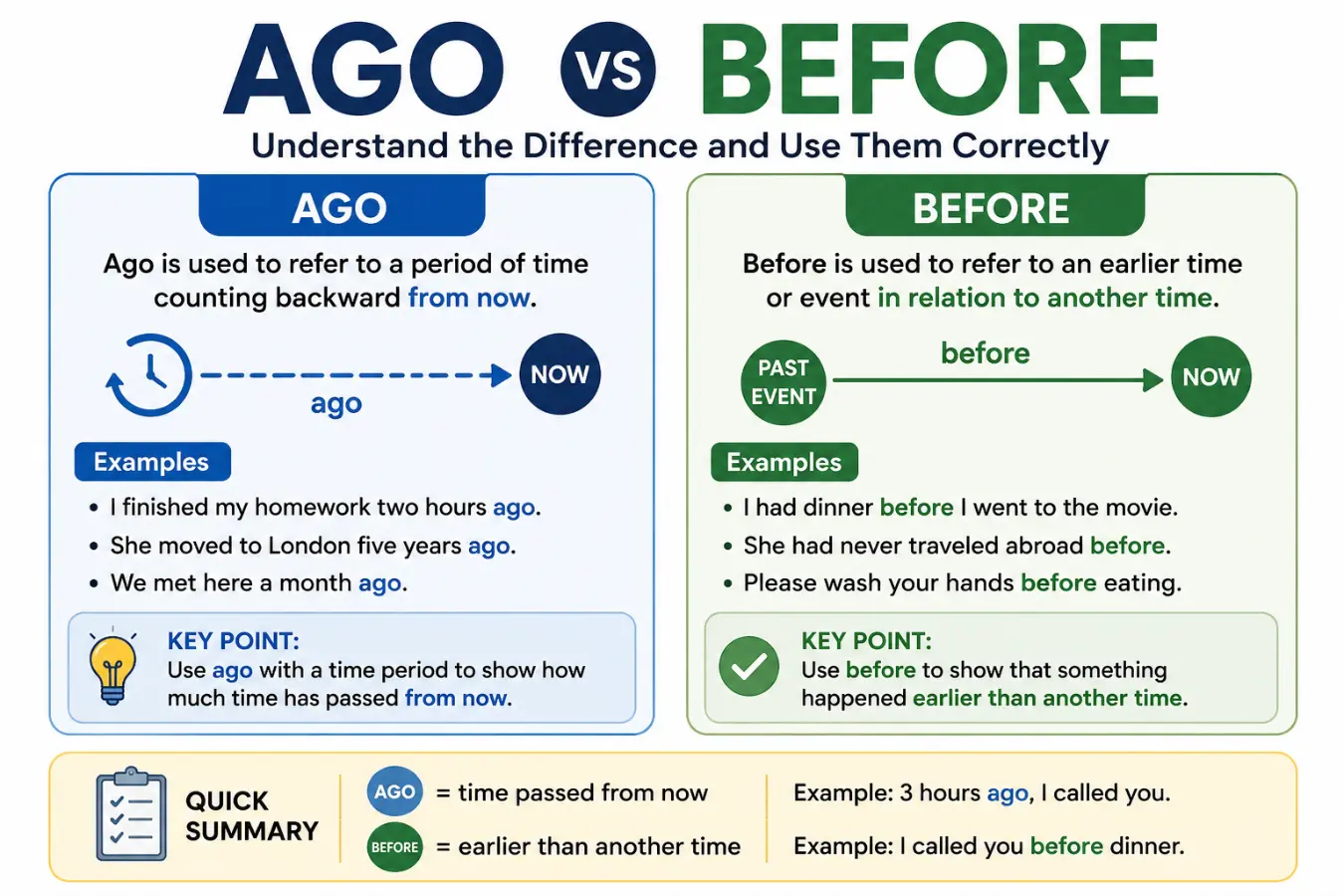
Ago vs before is a common grammar topic that confuses many English learners. Both words talk about time. However, they do not mean the same thing. You cannot always use one instead of the other.
Learning the difference helps you speak and write English correctly. It also makes your sentences sound natural. The good news is that the rule is simple once you understand it.
In this guide, you will learn what ago and before mean. You will also see easy examples, common mistakes, and simple tips. By the end, you will know exactly when to use each word with confidence.
Quick Summary
- Ago counts backward from the present time.
- Before compares one time with another.
- Use ago with the present.
- Use before with both past and future events.
- “Two years ago” means two years before today.
- “Two years before” needs another point in time.
- Ago cannot normally replace before.
- Before is more flexible than ago.
What Does “Ago” Mean?
Ago shows how much time has passed from now.
It always counts backward from the present moment.
Examples
- I met her two years ago.
- We moved here six months ago.
- They arrived an hour ago.
- He graduated five years ago.
Think of ago as asking:
“How long before now?”
What Does “Before” Mean?
Before means earlier than another time or event.
It does not always refer to the present.
Examples
- I had seen him before.
- Wash your hands before dinner.
- She left before sunrise.
- Finish your homework before watching TV.
Think of before as asking:
“Earlier than what?”
Ago vs Before: Key Difference
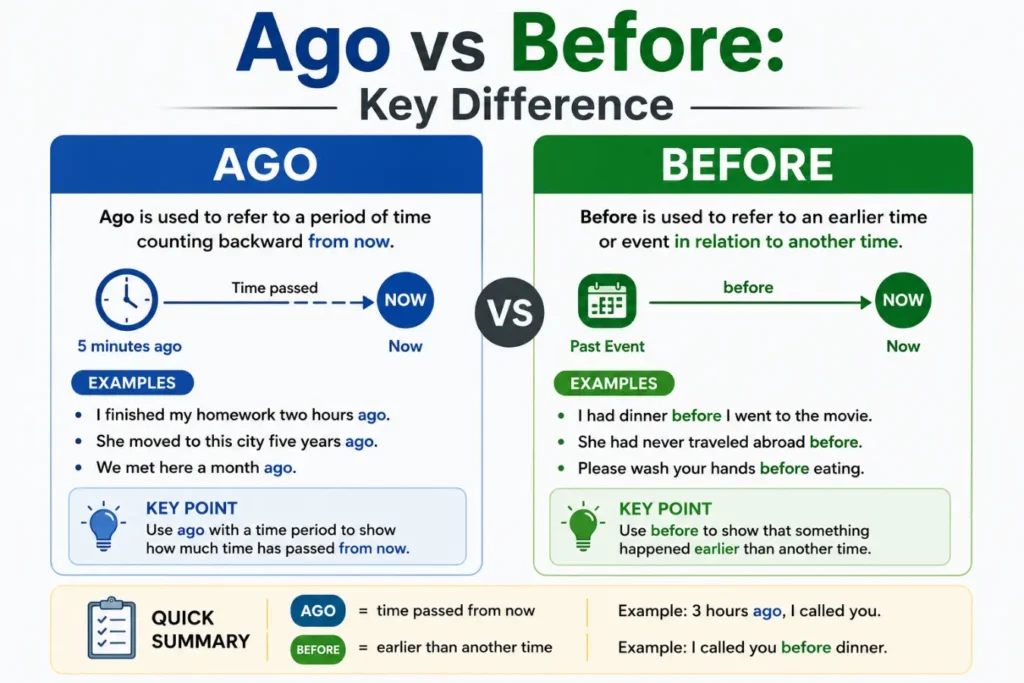
The biggest difference is the reference point.
- Ago starts from now.
- Before starts from another event or time.
This makes before much more flexible.
Ago vs Before Comparison Table
| Feature | Ago | Before |
|---|---|---|
| Reference point | Present time | Any time or event |
| Talks about | Time before now | Earlier than something |
| Used with present reference | Yes | Sometimes |
| Used with past events | Limited | Yes |
| Used with future plans | No | Yes |
| Common question | How long ago? | Before what? |
When Should You Use “Ago”?
Use ago when talking about something that happened before today or before the current moment.
Examples
- I called you ten minutes ago.
- We visited Paris last year.
- They bought this car three months ago.
- She finished school five years ago.
- My parents arrived yesterday.
Notice that ago always measures from now.
When Should You Use “Before”?
Use before when comparing one event with another.
Examples
- Eat breakfast before school.
- She had visited London before moving to Canada.
- Finish your project before Friday.
- We met before the meeting started.
- He always stretches before running.
The focus is not today’s date. The focus is another event.
Real-Life Examples of Ago vs Before
Here are examples from daily conversations.
Using Ago
- I saw that movie three weeks ago.
- We moved here last summer.
- She called an hour ago.
- I bought this phone last month.
Using Before
- Lock the door before leaving.
- I had never flown before.
- Please arrive before noon.
- He studied before taking the exam.
These examples show how naturally each word fits different situations.
Common Mistakes with Ago and Before
Many learners mix these words.
Mistake 1
❌ I met her two years before.
✅ I met her two years ago.
Mistake 2
❌ Finish your homework ago dinner.
✅ Finish your homework before dinner.
Mistake 3
❌ Three days before, I visited my uncle.
✅ Three days ago, I visited my uncle.
Mistake 4
❌ We arrived ago noon.
✅ We arrived before noon.
Learning these patterns helps you avoid common grammar errors.
Easy Trick to Remember the Difference
Remember these simple rules.
Use AGO
Ask yourself:
“How long before now?”
Examples
- One hour ago
- Two weeks ago
- Five years ago
Use BEFORE
Ask yourself:
“Earlier than what?”
Examples
- Before breakfast
- Before school
- Before the meeting
- Before sunset
This memory trick works almost every time.
Ago vs Before in Daily Life
You hear these words every day.
School
- Finish your work before class.
- I completed the project two days ago.
Work
- Wash your hands before eating.
- Dad arrived home thirty minutes ago.
While Traveling
- Book tickets before the holidays.
- We visited Japan three years ago.
Daily practice helps you remember the correct usage.
Synonyms and Related Words
Words Related to Ago
- Earlier
- Previously
- In the past
- Back then
- Formerly
Words Related to Before
- Earlier than
- Prior to
- Ahead of
- Previous to
- Earlier
LSI Keywords
- difference between ago and before
- ago vs before grammar
- when to use ago
- when to use before
- English grammar time expressions
- past time expressions
- English learning tips
- grammar comparison
- use of ago and before
- simple English grammar
Expert Insights
Understanding ago vs before improves both speaking and writing.
Many English learners confuse these words because both describe past time. However, each word has a different job.
Grammar experts recommend focusing on the reference point.
If the reference is now, use ago.
If the reference is another event, use before.
Mastering this small grammar rule makes your English sound much more natural.
Featured Snippet: Ago vs Before
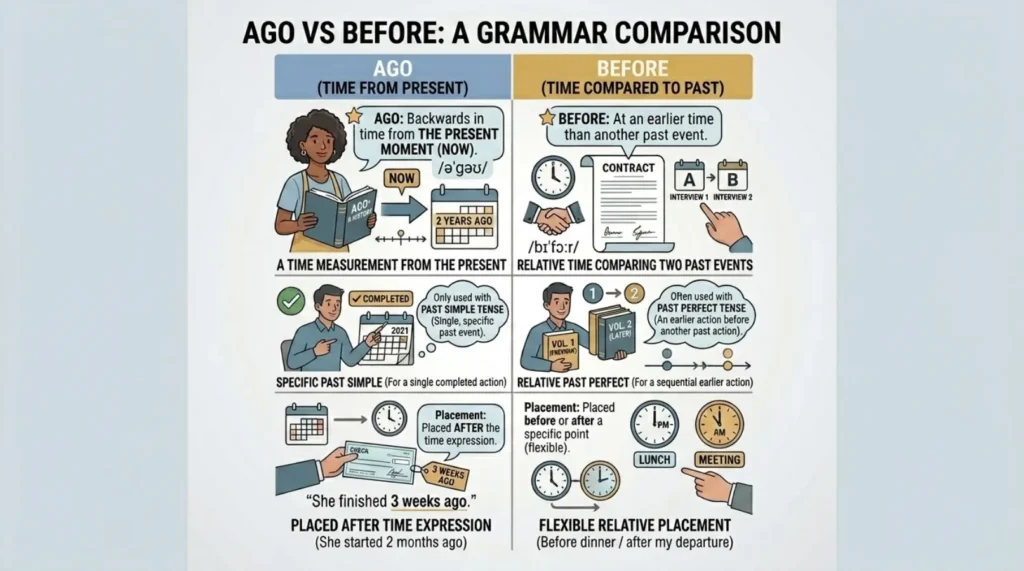
Ago refers to a period of time counted backward from the present. For example, I called you two hours ago.
Before means earlier than another time or event. For example, Finish your homework before dinner.
The key difference is that ago always refers to the present, while before compares one event or time with another.
Frequently Asked Questions
Is “ago” and “before” the same?
No. Ago refers to time before now. Before compares one event with another.
Can I replace “ago” with “before”?
Not always. They have different meanings and grammar rules.
Why do we say “two years ago”?
Because the event happened two years before today.
Can “before” refer to the future?
Yes.
Example:
Finish the report before Monday.
Can “ago” be used with future time?
No.
Ago only refers to time before the present.
Which is easier to remember?
Think of ago as “before now.”
Think of before as “earlier than something.”
Is “before” more flexible?
Yes.
You can use it with past, present, and future situations.
Internal Linking Suggestions
If you run a grammar blog, link this article to:
- Past Tense vs Present Perfect
- Since vs For
- Already vs Yet
- During vs While
- Then vs Than
- Earlier vs Ago
- Before vs After
- In Time vs On Time
These related topics improve user experience and SEO.
Final Comparison
| Ago | Before |
|---|---|
| Counts back from now | Compares one time with another |
| Uses the present as reference | Uses any reference point |
| “Five days ago” | “Before dinner” |
| Less flexible | More flexible |
| Cannot refer to the future | Can refer to future events |
Conclusion
Understanding ago vs before is easier than many learners think. The key is knowing the reference point. Use ago when you count backward from the present. Use before when you compare one event or time with another. This simple rule helps you avoid common grammar mistakes and write with confidence.
Practice using both words in everyday conversations. Read English books, listen to native speakers, and create your own example sentences. The more you practice, the more natural these time expressions will become. Soon, choosing between ago and before will feel easy, and your English will sound clearer and more accurate.

Michael Reed is a language content writer and word comparison researcher based in the United States. He studied English Language and Communication and focuses on grammar, spelling differences, and word usage. His work helps readers understand confusing English words through clear comparisons and practical explanations. Michael creates simple, reader-friendly content designed to improve everyday language skills.