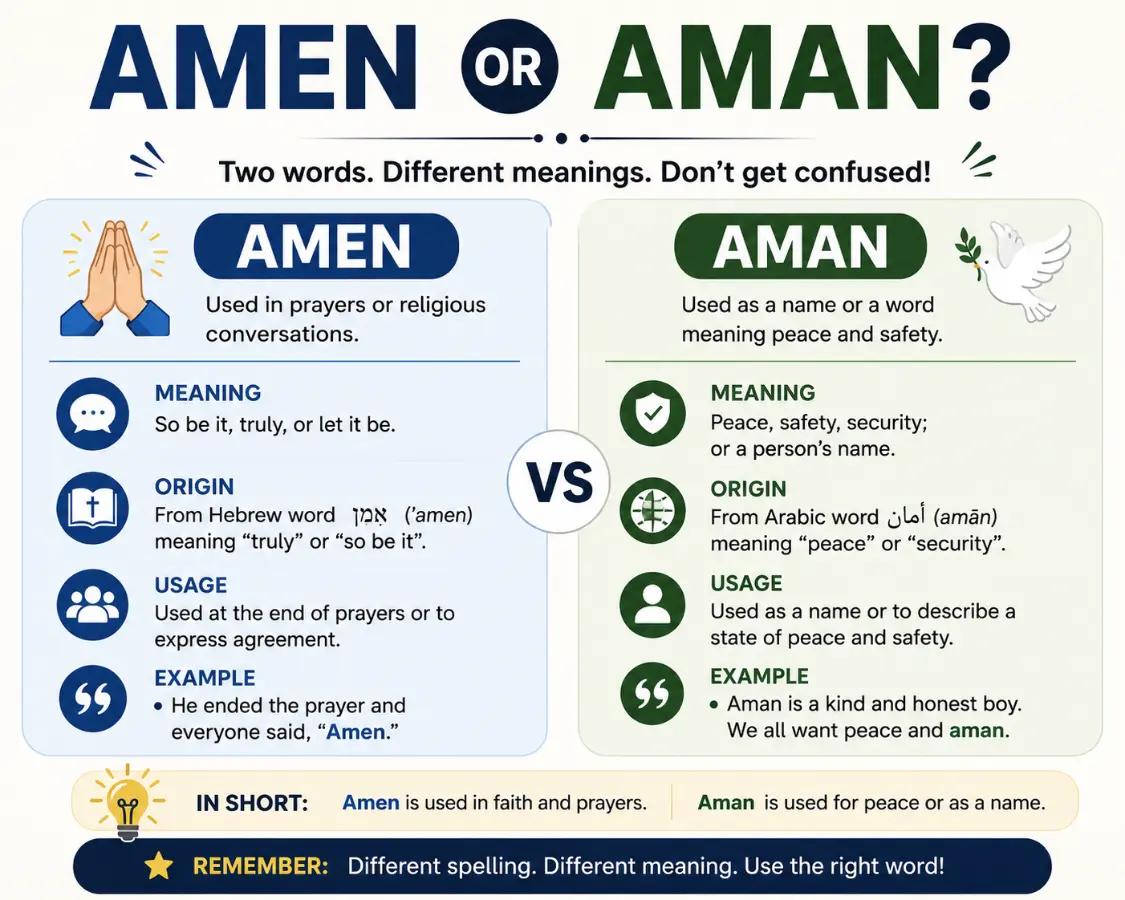
Amen or Aman is a common search because these two words look similar but have very different meanings. Many people wonder which one they should use. The answer depends on what you want to say.
Amen is a well-known word used in prayers and religious settings.Aman is usually a personal name or a word that means peace in several languages. Although they sound alike, they are not interchangeable.
In this guide, you will learn the meaning of each word, when to use them, and how to avoid common mistakes. You will also find simple examples, an easy comparison table, FAQs, and expert tips. By the end, you will know exactly when to write amen and when to write Aman.
Quick Summary Box
- Amen is a word spoken at the end of many prayers.
- Aman is usually a person’s name.
- In several languages, Aman also means peace or safety.
- The two words have different meanings and uses.
- Never replace amen with Aman in religious writing.
- Choose the correct word based on the context.
What Does “Amen” Mean?
Amen is a word used to show agreement, truth, or hope that something will happen. It often appears at the end of prayers.
Simple meaning:
Amen means “so be it,” “truly,” or “let it be so.”
People from many religious traditions use this word.
Examples
- Amen to your prayer.
- We all said, “Amen.”
- The pastor ended with “Amen.”
- May peace be with you. Amen.
What Does “Aman” Mean?
Aman is mainly a male first name used in many countries. In languages such as Hindi, Urdu, Punjabi, Arabic, and Sanskrit-based traditions, it often relates to peace, safety, or security.
Examples:
- Aman is my best friend.
- Aman won the football match.
- Aman lives in Lahore.
- Her brother’s name is Aman.

Amen or Aman: What’s the Difference?
Although the words look alike, they belong to different categories.
| Feature | Amen | Aman |
|---|---|---|
| Part of speech | Religious expression | Proper noun (name) |
| Main meaning | So be it; truly | A person’s name; peace in some languages |
| Used in prayers | Yes | No |
| Used as a name | Rarely | Yes |
| Can they replace each other? | No | No |
When Should You Use “Amen”?
Use amen whenever you finish a prayer or express strong agreement.
Correct examples
- Amen.
- We ended the prayer with amen.
- Everyone answered, “Amen.”
- Amen to that idea.
When Should You Use “Aman”?
Use Aman when referring to a person’s name or when discussing languages where the word means peace.
Correct examples
- Aman is my cousin.
- Aman studies medicine.
- Aman loves cricket.
- The teacher called Aman first.
Real-Life Examples of Amen and Aman
Understanding the context makes choosing the correct word easy.
Religious setting
✅ We finished the prayer with Amen.
❌ We finished the prayer with Aman.
Talking about a friend
✅ Aman is coming tomorrow.
❌ Amen is coming tomorrow.
School attendance
Teacher: Is Aman here?
Student: Yes, Aman is present.
Church service
The priest prayed.
Everyone replied, “Amen.”
Common Mistakes People Make
Many learners confuse these words because they sound similar.
Mistake 1
❌ Aman to that!
✅ Amen to that!
Mistake 2
❌ Amen is my brother.
✅ Aman is my brother.
Mistake 3
Using Amen as a person’s name when you actually mean Aman.
Always check whether you are talking about religion or a person’s name.
Easy Trick to Remember Amen or Aman
Here is a simple memory trick.
Remember this:
- Amen ends many prayers.
- Aman usually begins with a person’s name.
Another tip:
- Think of Amen = Prayer.
- Think of Aman = Person.
This trick helps you remember the difference quickly.
Amen and Aman in Daily Life
You may see these words in different places.
1.You hear “Amen”
- Churches
- Mosques during translated discussions
- Religious books
- Weddings
- Prayer meetings
2.You see “Aman”
- School records
- Office documents
- Social media profiles
- Sports teams
- Friend lists
Synonyms and Related Words
Related to Amen
- Truly
- Certainly
- So be it
- Indeed
- Let it be so
Related to Aman
- Peace
- Safety
- Security
- Calm (when referring to meaning in some languages)
Grammar Rules for Amen and Aman
Both words have different grammar roles.
Amen
- Usually stands alone.
- Often ends a prayer.
- Begins with a capital letter when starting a sentence.
Examples:
- Amen.
- Amen to that.
Aman
- Proper noun.
- Always capitalize it when it is a person’s name.
Examples:
- Aman plays football.
- Aman is my neighbor.
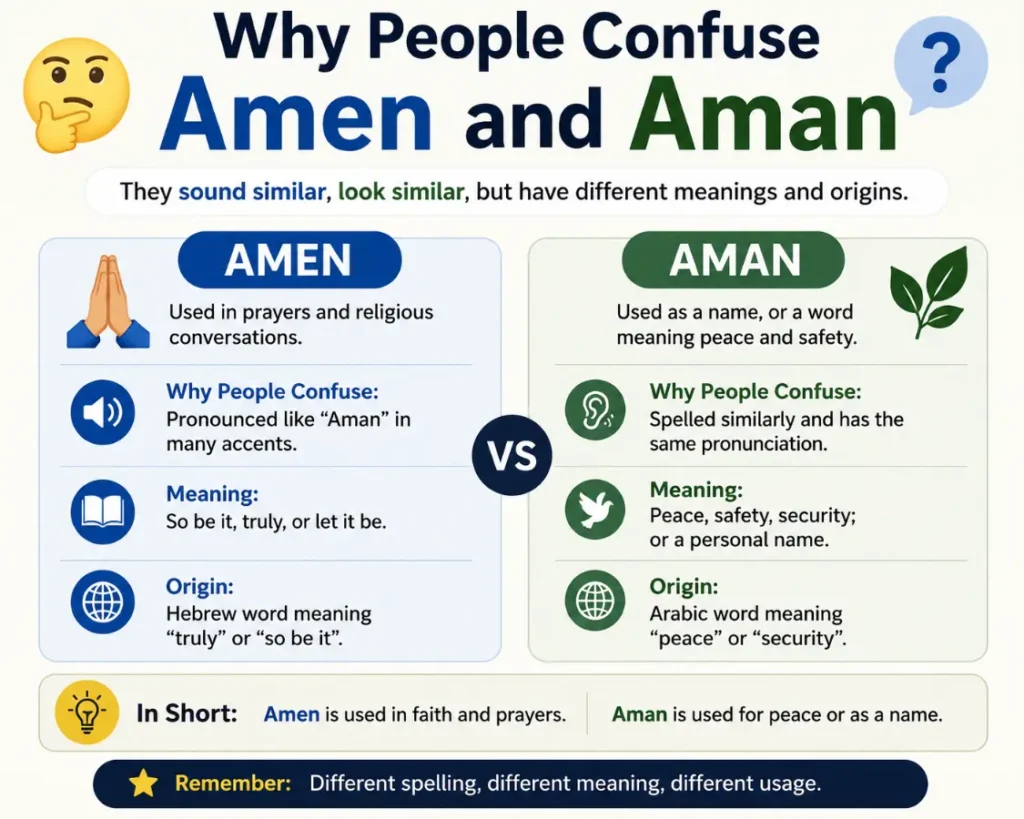
Why People Confuse Amen and Aman
There are several reasons.
- They have similar spelling.
- Their pronunciation is close.
- Voice typing may choose the wrong word.
- Auto-correct sometimes changes one into the other.
- New English learners may not know the difference.
Reading the full sentence usually makes the correct choice obvious.
Expert Insights
Language experts recommend paying attention to context instead of spelling alone.
If the sentence talks about prayer, worship, or agreement, use amen.
If the sentence mentions a person’s identity, school, work, or family, use Aman.
Professional writers always proofread names because spelling mistakes can change the meaning completely.
Understanding these small differences improves your grammar, writing, and communication skills.
FAQs
Is it amen or aman after a prayer?
Use amen after a prayer.
Is Aman a real name?
Yes. Aman is a common male name in many countries.
Can amen be used as a person’s name?
It is very uncommon. Most often, amen is a religious expression.
Does Aman mean peace?
Yes. In several languages, Aman means peace, safety, or security.
Are amen and aman pronounced the same?
They sound similar, but pronunciation may vary depending on language and accent.
Can I replace amen with aman?
No. They have different meanings and should never replace each other.
Why do people confuse amen and aman?
They have similar spelling and pronunciation, but their meanings are completely different.
Featured Snippet: Amen or Aman
Amen is a religious word that means “so be it” or “truly.” It is commonly spoken at the end of prayers. Aman is usually a male given name and, in many languages, means peace or safety. Although they look and sound similar, they have different meanings and cannot be used interchangeably.
Internal Linking Suggestions
Consider linking this article to related grammar guides such as:
- Affect vs Effect
- Then vs Than
- Accept vs Except
- Everyday vs Every Day
- There vs Their vs They’re
- Council vs Counsel
- Stationary vs Stationery
Conclusion
The difference between amen or Aman is simple once you know the context. Amen belongs in prayers and expresses agreement or hope that something will happen. Aman is commonly a person’s name and can also mean peace or safety in several languages.
Choosing the correct word makes your writing clearer and more accurate. Whenever you see these two words, ask yourself whether you are talking about a prayer or a person. That simple question will help you make the right choice every time. With regular practice, you will never confuse amen and Aman again.

James Carter is a comparison writer and research specialist with over 10 years of experience in digital publishing. With a background in business communication and consumer research, he creates detailed comparison articles, buying guides, and reviews that help readers make informed decisions with confidence. “Every comparison should help readers make better decisions. My goal is to turn complex information into clear, practical guidance that people can trust.” — James Carter