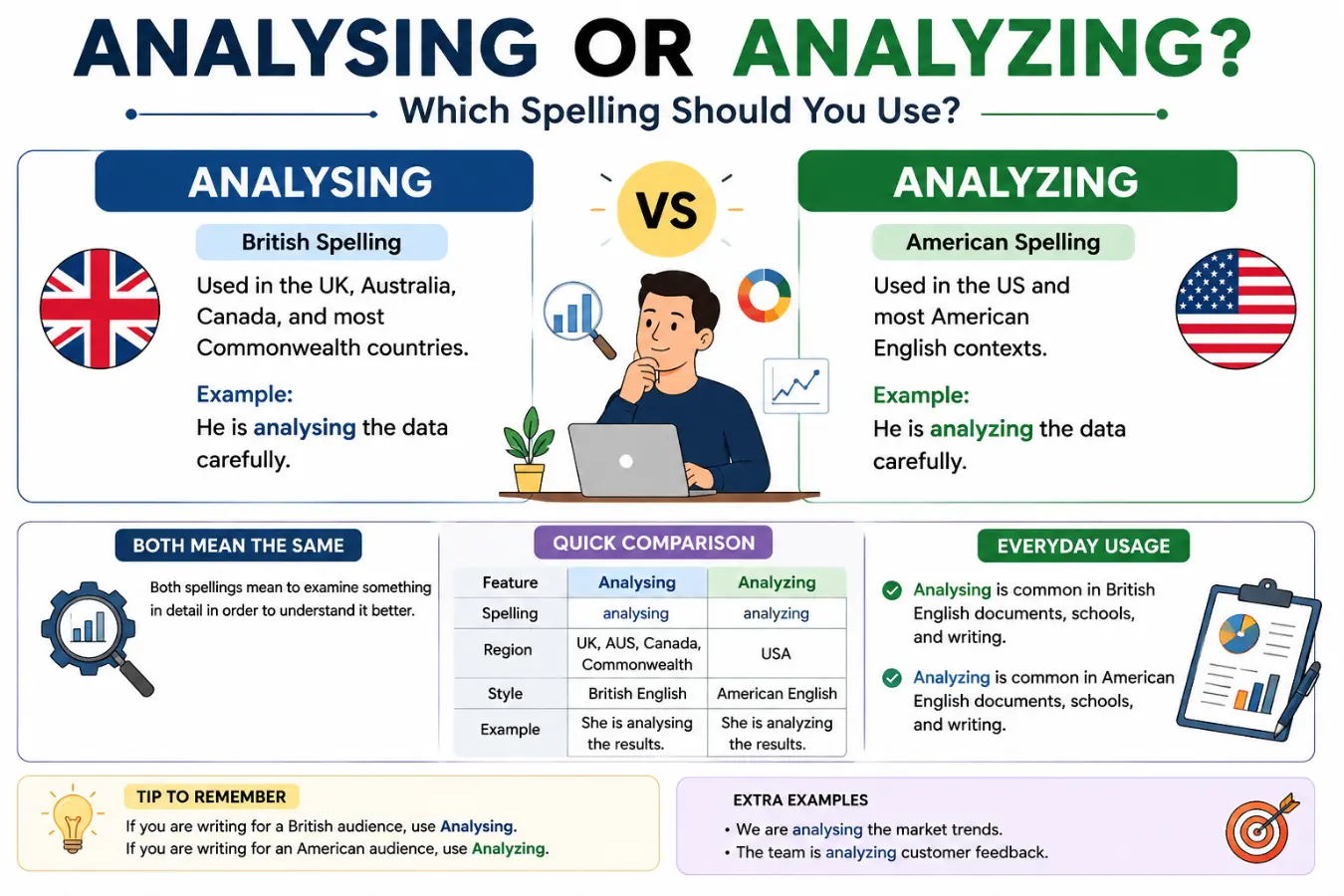
Analysing or analyzing is a common spelling question for English learners and writers. Many people wonder which version is correct. The good news is that both spellings are correct. However, the right choice depends on the type of English you use. Analysing is the preferred spelling in British English. Analyzing is the standard spelling in American English. Knowing the difference helps you write clearly and professionally. It also keeps your writing consistent. Whether you write emails, blogs, essays, or business reports, choosing the correct spelling matters. This guide explains the meaning, grammar rules, examples, and common mistakes. By the end, you will know exactly when to use analysing or analyzing with confidence.
Quick Summary Box
- Analysing is correct in British English.
- Analyzing is correct in American English.
- Both words mean examining something carefully.
- The meaning does not change between spellings.
- Choose one spelling and stay consistent.
- American websites usually use analyzing.
- British publications usually use analysing.
What Does “Analysing or Analyzing” Mean?
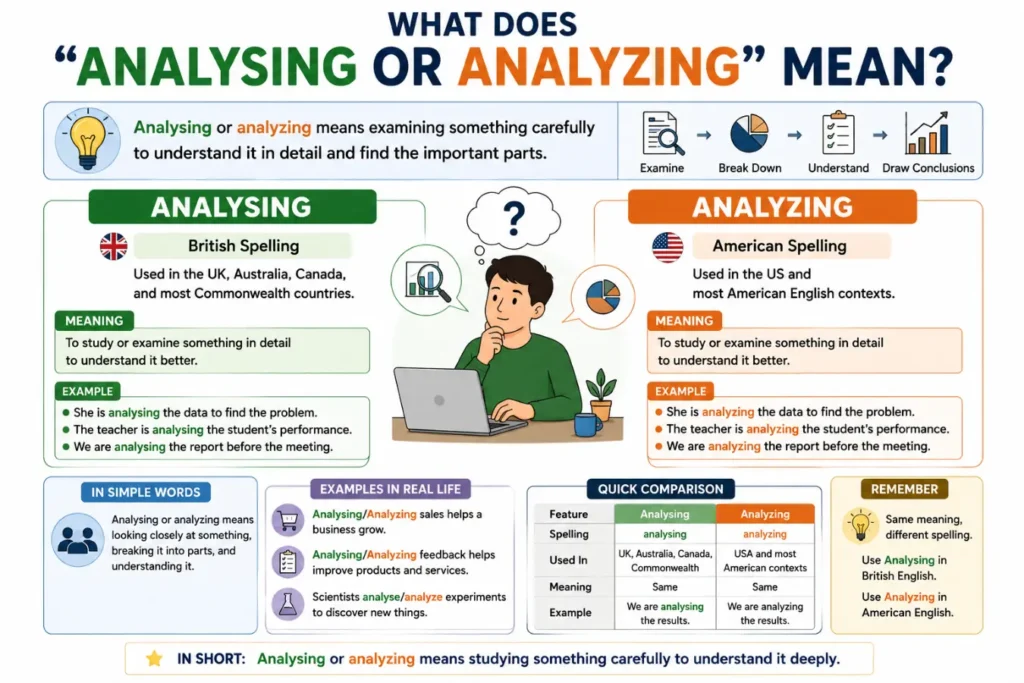
Both analysing and analyzing mean:
To study, examine, or investigate something carefully to understand it better.
People analyze data, books, business reports, sports games, and scientific results.
Simple Definition
- Analysing = examining carefully (British English)
- Analyzing = examining carefully (American English)
Why Are There Two Different Spellings?
The difference comes from regional spelling rules.
American English prefers -ize endings.
British English often prefers -ise endings.
Examples include:
| British English | American English |
|---|---|
| Analysing | Analyzing |
| Organising | Organizing |
| Recognising | Recognizing |
| Realising | Realizing |
Both styles are accepted by dictionaries. The choice depends on your audience.
Analysing vs Analyzing Comparison Table
| Feature | Analysing | Analyzing |
|---|---|---|
| English Style | British English | American English |
| Meaning | Examine carefully | Examine carefully |
| Grammar | Present participle | Present participle |
| Correct? | Yes | Yes |
| Used in UK | Yes | Rarely |
| Used in USA | Rarely | Yes |
| Pronunciation | Same | Same |
When Should You Use “Analysing”?
Use analysing if you write in British English.
It appears in:
- UK schools
- British newspapers
- Australian writing
- New Zealand English
- Many international companies
Examples
- She is analysing the customer survey.
- We are analysing market trends.
- Scientists are analysing the results.
- The teacher is analysing the poem.
When Should You Use “Analyzing”?
Use analyzing if you write in American English.
It appears in:
- American schools
- US businesses
- American universities
- US government documents
- Most American websites
Examples
- The company is analyzing customer feedback.
- We are analyzing sales data.
- Doctors are analyzing blood samples.
- Students are analyzing the novel.
Real-Life Examples of Analysing and Analyzing
At School
British:
Students are analysing Shakespeare’s play.
American:
Students are analyzing Shakespeare’s play.
At Work
British:
The team is analysing customer behavior.
American:
The team is analyzing customer behavior.
In Science
British:
Researchers are analysing the experiment.
American:
Researchers are analyzing the experiment.
In Marketing
British:
We are analysing website traffic.
American:
We are analyzing website traffic.
Grammar Rule Behind Analysing and Analyzing
Both words are the present participle or gerund form of the verb analyse/analyze.
British English
- Analyse
- Analyses
- Analysed
- Analysing
American English
- Analyze
- Analyzes
- Analyzed
- Analyzing
The grammar stays the same.
Only the spelling changes.
Common Mistakes People Make
Many writers mix British and American spellings.
Incorrect
- We are analysing the report and it was analyzed yesterday.
This mixes styles.
Correct (British)
- We are analysing the report.
- It was analysed yesterday.
Correct (American)
- We are analyzing the report.
- It was analyzed yesterday.
Another mistake is changing spellings inside one article.
Always stay consistent.
Easy Trick to Remember the Difference
Use this simple memory trick.
Think About Your Audience
Writing for the USA?
✅ Use analyzing
Writing for the UK?
✅ Use analysing
If your company follows one style guide, use that style throughout your writing.
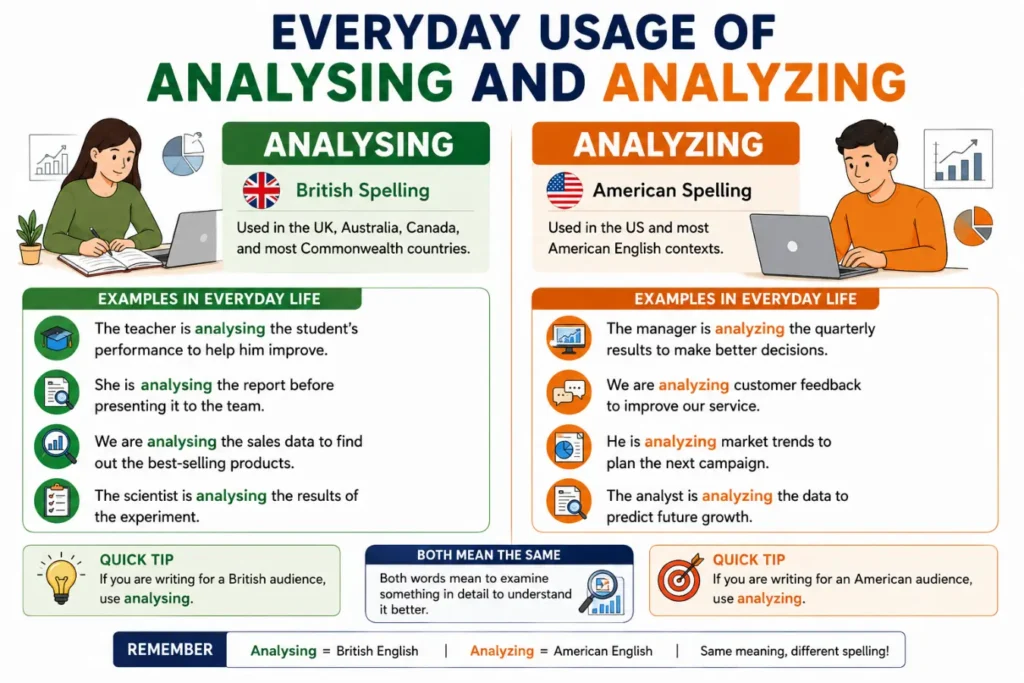
Everyday Usage of Analysing and Analyzing
You can use these words in many situations.
Business
- We are analyzing customer needs.
- We are analysing financial reports.
Education
- Students are analyzing poems.
- Students are analysing novels.
Healthcare
- Doctors are analyzing blood tests.
- Doctors are analysing medical records.
Technology
- Engineers are analyzing software errors.
- Engineers are analysing system performance.
Synonyms and Related Words
Using related words improves readability and SEO.
Synonyms
- Examine
- Study
- Evaluate
- Review
- Investigate
- Assess
- Inspect
- Interpret
- Explore
- Research
LSI Keywords
- analyse vs analyze
- British vs American spelling
- analyzing meaning
- analysing meaning
- grammar differences
- English spelling rules
- writing style guide
- analyze definition
- analyse definition
- spelling comparison
Expert Writing Tips
Follow these tips for professional writing.
- Pick one English style before you start.
- Stay consistent throughout the document.
- Match your audience’s language.
- Follow your company’s style guide.
- Use grammar tools to check consistency.
- Proofread before publishing.
Professional editors always check spelling consistency.
Expert Insight
Language differences do not change meaning. They only reflect regional spelling preferences. Choosing the correct version improves readability and builds trust with your audience. Businesses, schools, and publishers often follow a specific style guide. Consistency is more important than choosing one spelling over the other. If your audience is global, decide on either British or American English before writing. This simple habit strengthens your credibility and improves the overall quality of your content.
FAQs:
Is analysing correct?
Yes. Analysing is the correct British English spelling.
Is analyzing correct?
Yes. Analyzing is the correct American English spelling.
Which spelling is more common?
Globally, analyzing appears more often because American English dominates online content. However, analysing remains standard in the UK, Australia, and other Commonwealth countries.
Do analysing and analyzing have different meanings?
No. Both words mean examining something carefully.
Which spelling should students use?
Students should follow the spelling style required by their school, teacher, or university.
Can I use both spellings in one article?
No. Mixing British and American spellings looks unprofessional. Stay consistent.
Is analysing used in Australia?
Yes. Australian English generally follows British spelling, so analysing is common
Why does American English use “z”?
American spelling reforms favored -ize endings for many verbs, making analyze and analyzing the standard forms in the United States.
Internal Linking Suggestions
To strengthen your grammar website, consider linking this article to:
- Analyse vs Analyze
- Organising or Organizing
- Recognising or Recognizing
- Judgement or Judgment
- Defence or Defense
- Practice vs Practise
- Licence vs License
- British English vs American English Spelling Rules
Featured Snippet Answer
Analysing is the British English spelling, while analyzing is the American English spelling. Both words mean examining something carefully. The meaning and grammar are identical. Choose the spelling that matches your audience and use it consistently throughout your writing.
Conclusion
Understanding analysing or analyzing is simple once you know the regional spelling rules. Analysing belongs to British English, while analyzing belongs to American English. Neither spelling is more correct than the other. The important rule is consistency. Use the version that matches your audience, school, workplace, or publication style. Whether you are writing a report, blog, research paper, or email, staying consistent makes your work look polished and professional. Remember that both spellings share the same meaning, pronunciation, and grammar. Only the regional preference changes. By following these guidelines, you can write with confidence and avoid common spelling mistakes.

James Carter is a comparison writer and research specialist with over 10 years of experience in digital publishing. With a background in business communication and consumer research, he creates detailed comparison articles, buying guides, and reviews that help readers make informed decisions with confidence. “Every comparison should help readers make better decisions. My goal is to turn complex information into clear, practical guidance that people can trust.” — James Carter