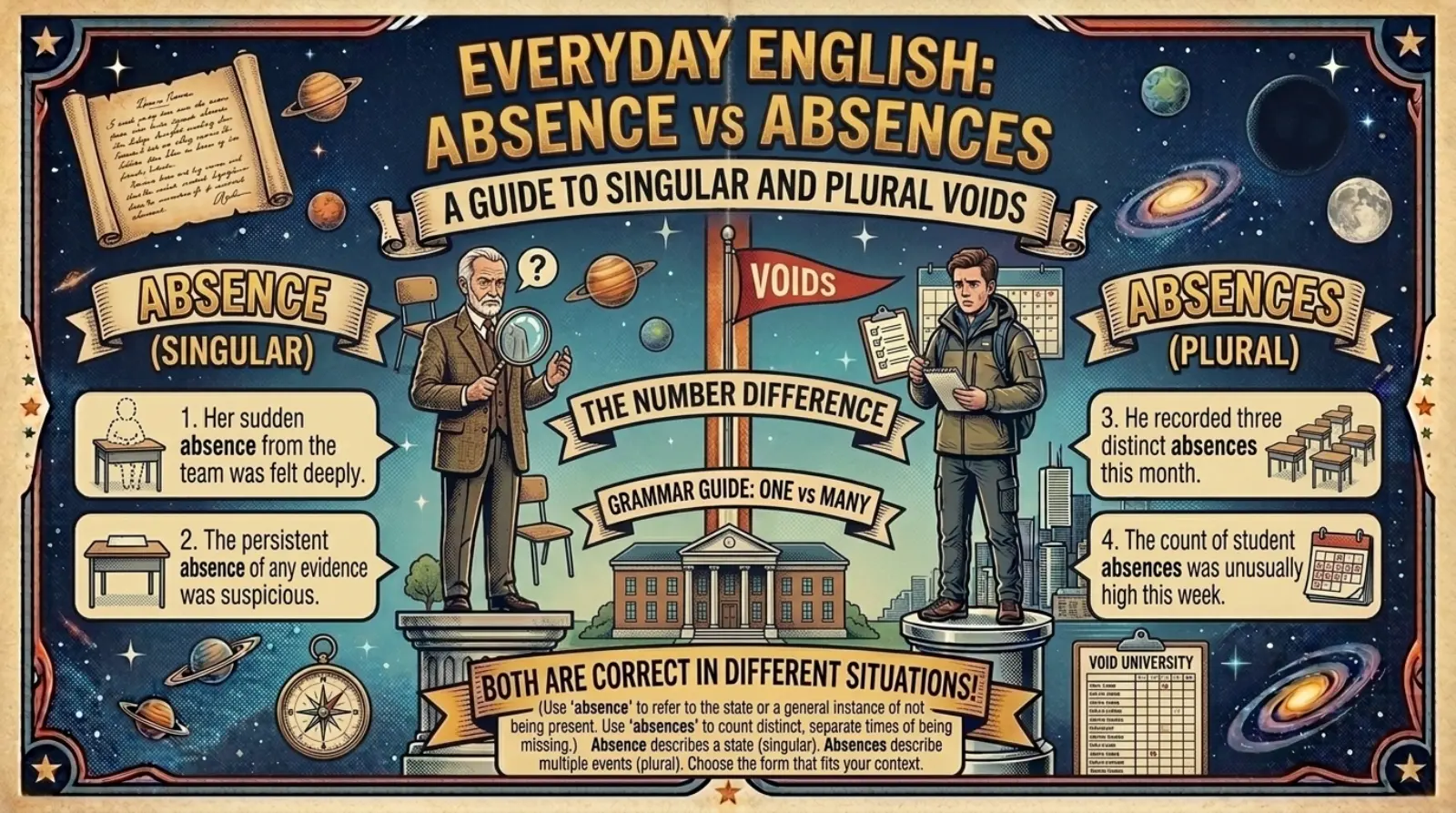
The plural of absence is absences. Many English learners wonder if “absence” changes in a special way. The good news is that it follows a simple grammar rule. Once you understand it, you can use it with confidence in school, work, and daily conversations.
This guide explains the plural form in simple English. You will learn what absence means, when to use absences, and how to avoid common grammar mistakes. You will also find real-life examples, a comparison table, expert tips, and answers to common questions. By the end, you will know exactly how to use this word correctly in every situation.
Quick Summary Box
- Singular: Absence
- Plural: Absences
- Add -s to make the plural.
- Absence means one time someone is missing.
- Absences means two or more times someone is missing.
- Common in schools, workplaces, and attendance records.
- Easy rule: absence → absences
Featured Snippet
What is the plural of absence?
The plural of absence is absences. Use absence for one missing event or person. Use absences for two or more missing events or occasions.
What Does Absence Mean?
An absence means someone or something is not present.
It can describe:
- A student missing school
- An employee missing work
- Someone not attending an event
- The lack of something important
Examples
- Her absence surprised everyone.
- His absence from class worried the teacher.
- The team’s absence changed the game.

What Is the Plural of Absence?
The plural of absence is absences.
Rule
Most nouns ending in -e simply add -s.
| Singular | Plural |
|---|---|
| absence | absences |
| message | messages |
| package | packages |
| promise | promises |
The spelling stays the same except for adding -s.
Why Is the Plural “Absences”?
English grammar follows regular plural rules for most nouns.
Since absence ends with e, simply add s.
Correct
- absence → absences
Incorrect
- absencees
- absense
- absenses
Only absences is correct.
Absence vs Absences
| Absence | Absences |
|---|---|
| Singular | Plural |
| One missing event | More than one missing event |
| Refers to one person or occasion | Refers to multiple occasions |
| “Her absence was noticed.” | “Her absences affected her grades.” |
Examples
Singular
- Your absence was unexpected.
- My absence lasted one day.
Plural
- Your absences were recorded.
- Several absences lowered his attendance score.
How to Use Absences in Sentences
Here are simple examples.
School
- Too many absences can affect your grades.
- The teacher recorded three absences.
Workplace
- Repeated absences may require a meeting.
- Employee absences increased this month.
Family
- We noticed his absences during family dinners.
- Frequent absences worried everyone.
Sports
- Player absences changed the team’s lineup.
- Injuries caused several absences.
Real-Life Examples of Absence and Absences
Understanding real situations makes grammar easier.
School
One student misses class.
- His absence was excused.
Several missed days.
- His absences affected his attendance.
Office
One employee misses work.
- Her absence delayed the meeting.
Many missed workdays.
- Her absences became a concern.
Events
One guest could not attend.
- Their absence was noticeable.
Many guests stayed home.
- Their absences changed the event.
Common Mistakes to Avoid
Many learners make these errors.
1. Using “absence” for more than one
❌ We recorded many absence.
✅ We recorded many absences.
2. Wrong spelling
❌ absense
✅ absence
3. Wrong plural
❌ absencees
✅ absences
4. Mixing singular and plural verbs
❌ The absences was unexpected.
✅ The absences were unexpected.
Easy Trick to Remember
Remember this simple formula.
One = Absence
More than one = Absences
Think about these examples.
- One apple → apples
- One table → tables
- One absence → absences
The pattern stays the same.
Grammar Rules for Plural Nouns
Most English nouns become plural by adding -s.
Examples:
| Singular | Plural |
|---|---|
| absence | absences |
| book | books |
| chair | chairs |
| phone | phones |
| teacher | teachers |
Some words have irregular plurals, but absence is regular.
Synonyms and Related Words
These words have similar meanings depending on the context.
Synonyms
- Nonattendance
- Missing
- Unavailability
- Lack
- Vacancy
- Omission
- Leave
- Time away
Related Keywords
- plural of absence
- absence meaning
- absences meaning
- attendance
- absent
- grammar rules
- English plural nouns
- singular and plural nouns
- absence in a sentence
- absences examples
Usage in Daily Life
You will often see absences in many places.
Schools
Teachers record student absences every day.
Workplaces
Managers monitor employee absences.
Hospitals
Medical staff track staff absences.
Sports
Coaches report player absences before games.
Meetings
Organizations record member absences.

Expert Insights
Grammar experts recommend learning words in context instead of memorizing lists.
The word absences appears often in attendance reports, education, human resources, and business writing.
Knowing the correct plural helps you:
- Write clearly.
- Speak naturally.
- Avoid grammar mistakes.
- Improve academic writing.
- Sound more professional.
Learning regular plural rules also helps with thousands of other English words.
FAQs:
What is the plural of absence?
The plural of absence is absences.
Is “absences” a real word?
Yes. Absences is the correct plural form of absence.
Can I say “absencees”?
No. The correct spelling is absences.
What does absence mean?
An absence means someone or something is not present.
What does absences mean?
Absences means multiple occasions when someone is missing.
Is absence countable?
Yes. You can count absences.
Example:
- One absence
- Two absences
- Several absences
How do schools use the word absences?
Schools record every student’s absences to track attendance.
How can I remember the plural?
Simply add -s.
absence → absences
Internal Linking Suggestions
To improve your grammar knowledge, consider reading related articles about:
- Singular and plural nouns
- Regular vs irregular plurals
- Difference between absent and absence
- Attendance vs attendance record
- Common English spelling mistakes
- Countable and uncountable nouns
Key Takeaways
| Topic | Answer |
|---|---|
| Singular | Absence |
| Plural | Absences |
| Rule | Add -s |
| Countable | Yes |
| Common Mistake | Writing absencees or absense |
| Correct Example | “Her absences affected her attendance.” |
Conclusion
The plural of absence is absences. It follows a regular English grammar rule by simply adding -s to the singular noun. Use absence when talking about one missing event or one person being away. Use absences when referring to two or more occasions of being absent. This small difference makes your writing more accurate and professional. Whether you are discussing school attendance, workplace records, sports teams, or everyday situations, using the correct plural helps readers understand your meaning clearly. Remember the easy rule: absence → absences. With regular practice and real-life examples, this grammar point becomes simple to remember and use with confidence.

Emma Collins is a language writer and grammar enthusiast specializing in English vocabulary, spelling comparisons, and word usage guides. She creates easy-to-understand content that helps readers improve their writing, communication, and language skills with confidence.