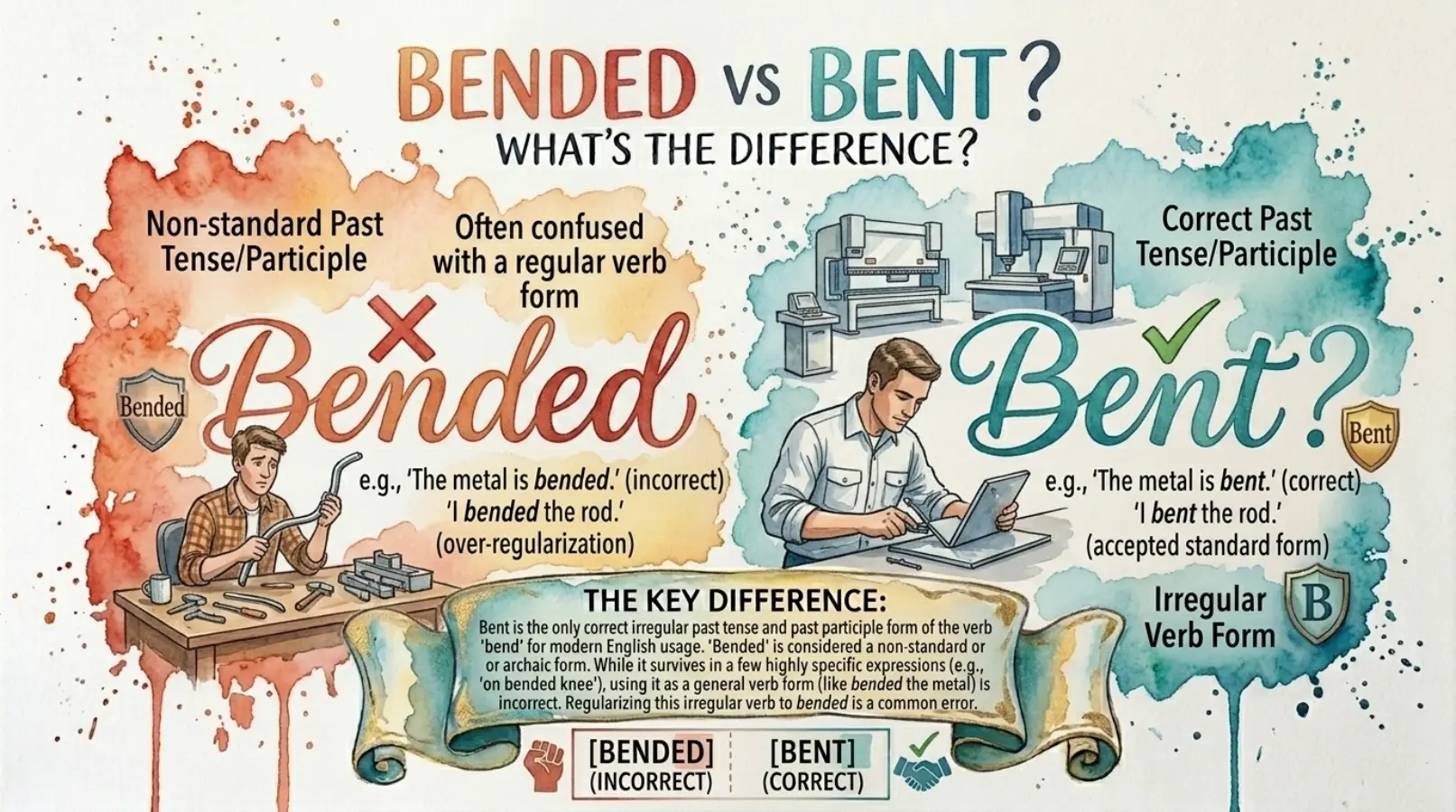
Bended or bent is a common grammar question that confuses many English learners. Both words come from the verb bend, but they do not always mean the same thing. Knowing the difference helps you write and speak more clearly.
Most of the time, bent is the correct word. However, bended still appears in a few special situations. That makes many people wonder which one they should use.
This guide explains everything in simple English. You will learn the meaning of each word, see real-life examples, avoid common mistakes, and discover easy tricks to remember the correct form. By the end, you’ll know exactly when to use bended and when bent is the better choice.
Quick Summary Box
- Bent is the standard past tense and past participle of bend.
- Bended is rare in modern English.
- Use bent in almost all everyday writing.
- Bended mostly appears in poetry, old literature, or special phrases.
- Example: She bent the wire into a circle.
- Example: He bent down to tie his shoes.
- If unsure, choose bent.
What Does “Bent” Mean?
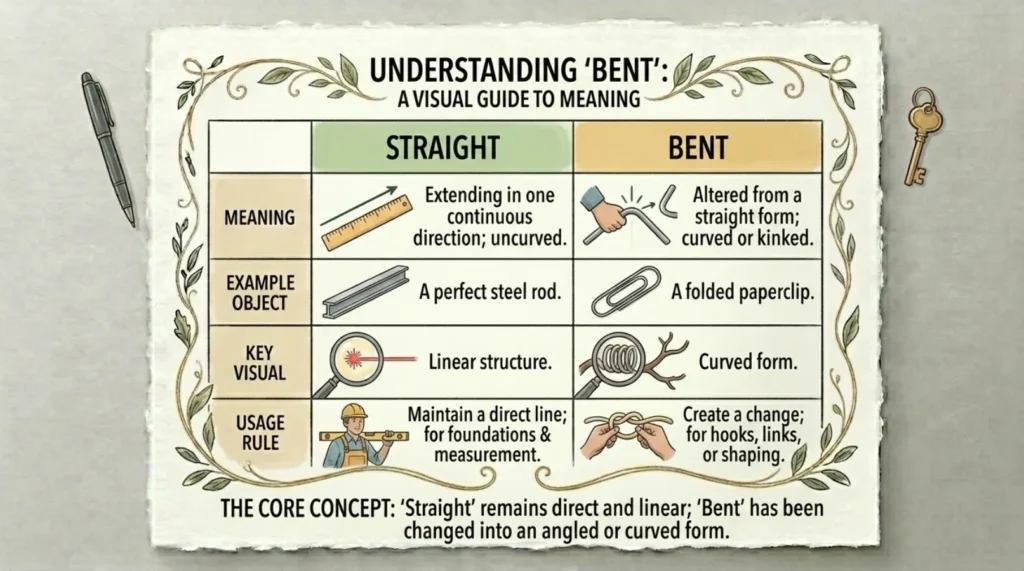
Bent is the normal past tense and past participle of the verb bend.
It means something changed its shape by curving or folding.
Examples
- She bent the spoon.
- He bent down to pick up the keys.
- The tree bent during the storm.
- I accidentally bent my glasses.
Today, bent is accepted in formal writing, business English, schools, and everyday conversations.
What Does “Bended” Mean?
Bended is an old or uncommon form of the verb bend.
Modern English rarely uses it.
Sometimes writers use bended for:
- poetry
- religious writing
- old books
- artistic style
Examples
- The knight walked with bended knees.
- They offered bended prayers.
These examples sound formal or old-fashioned.
Bended or Bent: What’s the Difference?
The biggest difference is frequency.
Bent is standard English.
Bended is uncommon and appears mainly in fixed expressions or literary writing.
| Feature | Bent | Bended |
|---|---|---|
| Modern English | ✅ Yes | ❌ Rare |
| Everyday conversation | ✅ Yes | ❌ No |
| Business writing | ✅ Yes | ❌ No |
| School writing | ✅ Yes | ❌ No |
| Poetry | Sometimes | ✅ Often |
| Old literature | Sometimes | ✅ Common |
Simple Rule
If you are writing today, use bent almost every time.
Why Is “Bent” More Common?
English has many irregular verbs.
The verb bend is one of them.
Just like:
- send → sent
- spend → spent
- build → built
The verb bend changes to bent, not bended.
That is why dictionaries and grammar experts recommend bent for modern English.
Real-Life Examples of Bent
Here are examples you hear every day.
Home
- Dad bent the nail with a hammer.
- The chair leg bent.
School
- She bent the paper into a plane.
- The ruler bent easily.
Work
- He bent the metal pipe.
- The engineer bent the wire carefully.
Outdoors
- The tree bent in the strong wind.
- He bent down to pick flowers.
Real-Life Examples of Bended
Although rare, you may still find bended in literature.
Literary Examples
- He stood with bended knees.
- They offered bended worship.
- She walked with a bended head.
These phrases sound poetic rather than modern.
Common Mistakes People Make
Many learners make these mistakes❌ Incorrect
- I bended the stick.
✅ Correct
- I bent the stick.
❌ Incorrect
- She has bended the wire.
✅ Correct
- She has bent the wire.
❌ Incorrect
- The tree has bended.
✅ Correct
- The tree has bent.
Remember:
In normal English, always choose bent.
Easy Trick to Remember
Here’s a simple memory tip.
Think about these words:
- send → sent
- spend → spent
- bend → bent
Notice the pattern?
The ending changes to -ent, not -ended.
This trick helps many English learners remember the correct word.
How to Use Bent in Daily Life
You probably hear bent every day.
objects
- The spoon is bent.
- My phone case bent.
- people
- He bent down.
- She bent forward.
nature
- The grass bent.
- The branches bent.
Synonyms of Bent
Here are useful alternatives.
When talking about shape
- curved
- folded
- twisted
- warped
- arched
- crooked
When talking about movement
- leaned
- stooped
- bowed
- crouched
These words improve your vocabulary while keeping your writing natural.
Grammar Rule for Bend
Here is the verb form.
| Verb Form | Word |
|---|---|
| Base Verb | bend |
| Present | bend / bends |
| Present Participle | bending |
| Past Tense | bent |
| Past Participle | bent |
Notice that bended is not the regular form used today.
When Can You Use “Bended”?
Although uncommon, bended is acceptable in certain situations.
Poetry
Writers sometimes choose it to fit rhythm.
Religious Language
Some older religious texts use bended knees.
Historical Writing
Old English literature sometimes prefers bended.
Outside these situations, use bent.

Expert Insights
Grammar experts agree that bent is the correct choice for modern English.
Using bent makes your writing sound natural and professional.
Choosing bended in everyday writing may confuse readers because it feels outdated.
When editing documents, essays, emails, or blog posts, replace bended with bent unless you intentionally want an old-fashioned style.
This simple choice improves clarity and follows current English grammar standards.
FAQs
Is it bent or bended?
Bent is correct in modern English.
Is bended a real word?
Yes. It is a real word but rarely used today.
Which is grammatically correct?
For everyday English, bent is grammatically correct.
Why do some books use bended?
Older books and poetry sometimes use bended for style.
Can I say “bended knees”?
Yes. It appears in literary and religious expressions.
Is “I bended the wire” correct?
Modern English prefers:
I bent the wire.
Is bent an adjective?
Yes.
Examples:
- a bent spoon
- bent metal
- bent branch
Should students learn bent or bended?
Students should learn bent because it is the standard form.
Featured Snippet: Bended or Bent
Bent is the correct past tense and past participle of bend in modern English. Bended is an older and uncommon form used mainly in poetry, literature, or certain fixed expressions such as bended knees. For everyday speaking and writing, always choose bent.
Internal Linking Suggestions
Consider linking this article to related grammar guides such as:
- Chose or Choose
- Lay vs Lie
- Loose or Lose
- Affect vs Effect
- Brought or Bought
- Spoken vs Spoke
- Other or Others
- Youth or Youths
Conclusion
Understanding bended or bent is easier than many people think. In modern English, bent is almost always the correct choice. It serves as both the past tense and past participle of bend, making it the standard form used in schools, workplaces, books, and daily conversations.
While bended is still a real word, it mainly appears in poetry, historical writing, and a few traditional expressions. Most English learners will rarely need it.
Whenever you write or speak, choose bent unless you intentionally want an old-fashioned or poetic style. Following this simple rule will make your English sound more natural, accurate, and confident.

Emma Collins is a language writer and grammar enthusiast specializing in English vocabulary, spelling comparisons, and word usage guides. She creates easy-to-understand content that helps readers improve their writing, communication, and language skills with confidence.