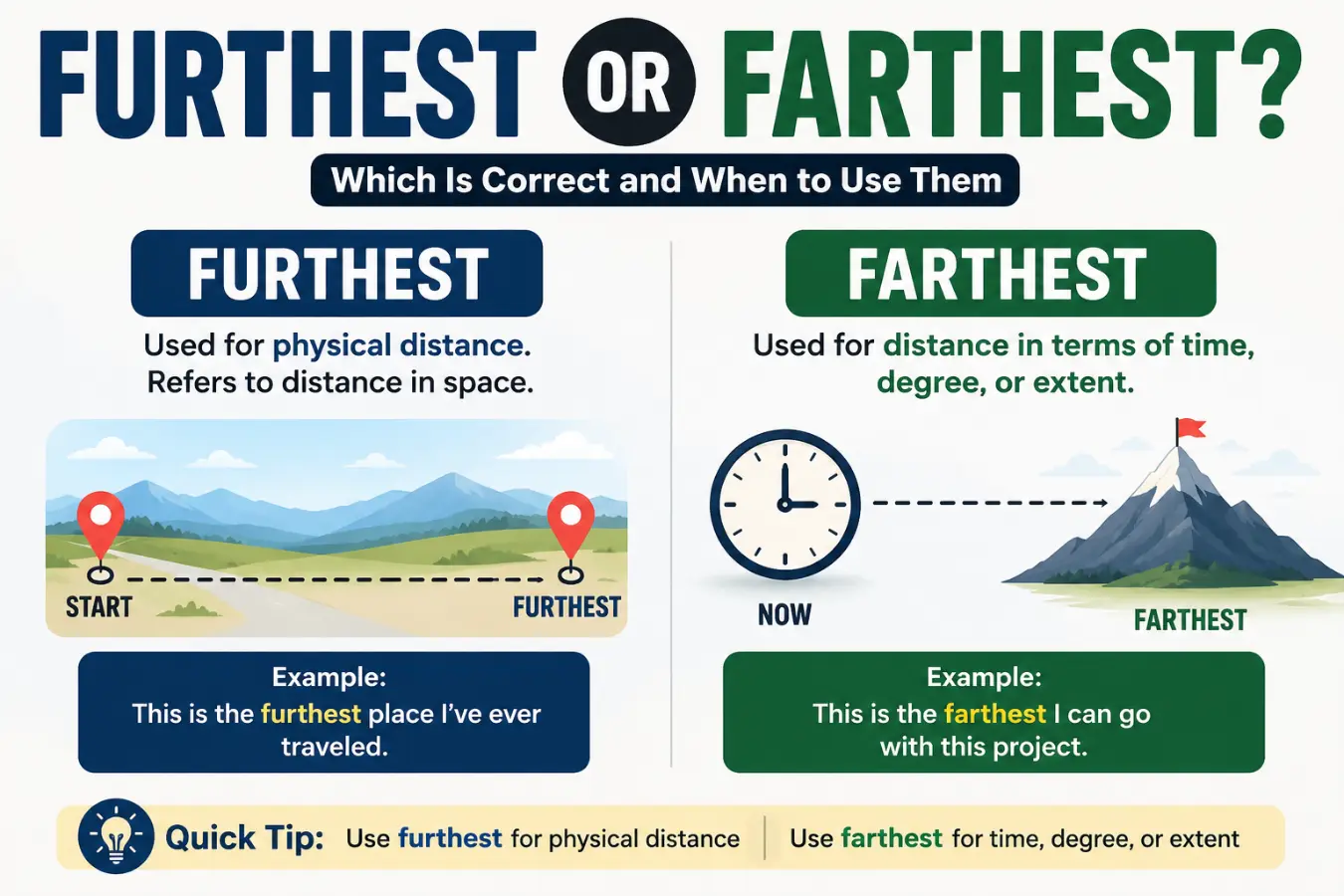
Furthest or farthest is a common grammar question that confuses many English learners and native speakers. Both words describe the greatest distance. However, they do not always mean the same thing.
Many people use these words as if they are identical. In casual conversations, that often works. Still, understanding the small difference can make your English sound more natural.
In this guide, you will learn when to use furthest and farthest. You will also see simple definitions, comparison tables, real-life examples, common mistakes, and expert tips.
By the end, you will know which word fits your sentence with confidence.
Quick Summary Box (Featured Snippet)
- Farthest usually refers to physical distance.
- Furthest often refers to figurative or abstract distance.
- Many modern dictionaries accept both words in most situations.
- Farthest is slightly more common in American English.
- Furthest is often preferred for ideas, progress, or degree.
- Both words are the superlative forms of far.
What Do “Furthest” and “Farthest” Mean?
Both furthest and farthest mean the greatest distance or the highest degree.
They are superlative forms of the adjective and adverb far.
Simple Definitions
Farthest
- Usually describes the greatest physical distance.
Furthest
- Often describes the greatest figurative or non-physical distance.
Today, many grammar experts accept both words in many contexts. The difference is mainly about style and clarity.
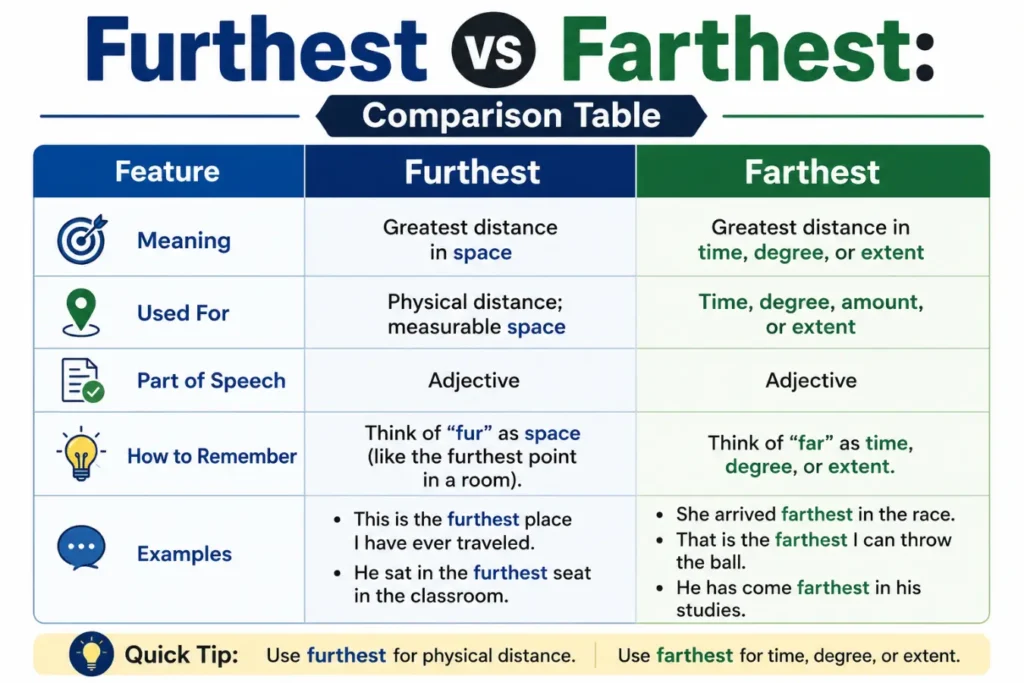
Furthest vs Farthest: Comparison Table
| Feature | Furthest | Farthest |
|---|---|---|
| Main meaning | Greatest degree or distance | Greatest physical distance |
| Physical distance | Correct | Most common |
| Figurative meaning | Preferred | Also acceptable |
| Common in modern English | Yes | Yes |
| Formal writing | Frequently used | Frequently used |
| Everyday speech | Very common | Very common |
When Should You Use “Farthest”?
Use farthest when talking about actual places or measurable distances.
Examples
- Canada is the farthest country I have visited.
- She threw the ball the farthest.
- Which house is the farthest from the school?
- The hikers reached the farthest point of the trail.
- Our hotel sits the farthest from the beach.
These examples involve real locations or measurable distances.
When Should You Use “Furthest”?
Use furthest when discussing ideas, goals, progress, or abstract concepts.
Examples
- We need the furthest explanation possible.
- Her research went the furthest in solving the problem.
- His idea took the discussion the furthest.
- She pushed the project the furthest.
- This plan moves us the furthest toward success.
These examples describe progress rather than physical movement.
Can You Use Them Interchangeably?
Yes. In modern English, many dictionaries accept both words in most situations.
For example:
- She lives the farthest away.
- She lives the furthest away.
Both sentences sound natural.
However, many writers still follow the traditional guideline:
- Use farthest for physical distance.
- Use furthest for figurative distance.
Following this rule adds clarity to your writing.
Real-Life Examples of Furthest and Farthest
Here are examples from daily conversations.
1:1 Talking About Travel
- Tokyo is the farthest city on my trip.
- Which airport is the farthest from here?
1:2 Talking About School
- Her project went the furthest in the competition.
- His idea took the class discussion the furthest.
1:3 Talking About Sports
- Jake kicked the ball the farthest.
- Emma ran the farthest during practice.
1:4 Talking About Business
- This strategy moved our company the furthest toward growth.
- Their research reached the furthest stage.
Common Mistakes People Make
Many learners make these mistakes.
1. Thinking One Word Is Wrong
Both words are correct.
2. Using Only One Word Everywhere
It is better to choose the word that best matches the context.
3. Ignoring Context
Ask yourself:
- Is the distance physical?
- Or is it an idea or level of progress?
This question often gives you the answer.
Easy Trick to Remember the Difference
Here’s a simple memory trick.
Think About the Letter “A”
Farthest has an A.
Think of A for Actual distance.
Think About the Letter “U”
Furthest has a U.
Think of U for Understanding, ideas, or progress.
This trick is not a grammar rule. However, it helps many learners remember the difference.
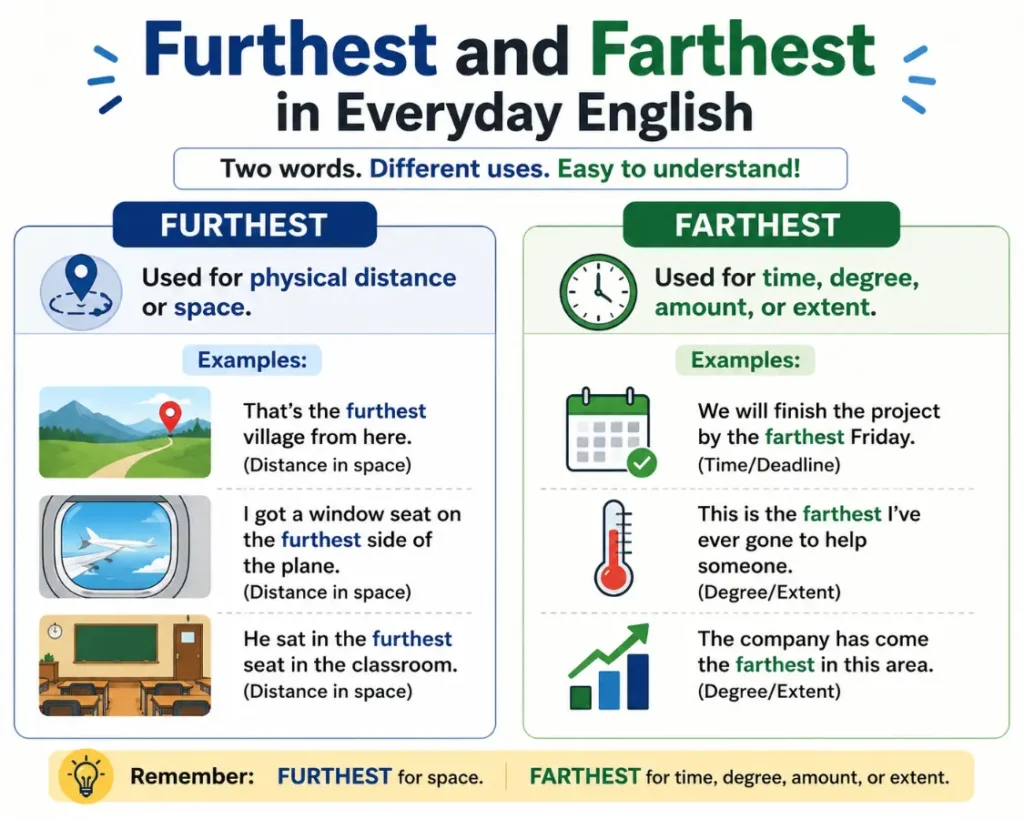
Furthest and Farthest in Everyday English
Most people do not notice the difference during casual conversations.
Examples include:
- Which restaurant is the farthest from downtown?
- We have gone the furthest we can today.
- This road goes the farthest north.
- Her explanation goes the furthest toward answering the question.
Native speakers often use either word naturally.
Synonyms and Related Words
Here are useful alternatives.
Synonyms
- Most distant
- Most remote
- Greatest distance
- Extreme
- Beyond
- Remote
- Further
- Farther
- Distance
- Away
Related Search Terms (LSI Keywords)
- difference between furthest and farthest
- farther vs further
- farthest meaning
- furthest meaning
- when to use furthest
- when to use farthest
- grammar rules for far
- English grammar comparison
- superlative of far
- furthest or farthest examples
Expert Insight
Good writing depends on choosing words that fit the context.
Modern dictionaries accept both furthest and farthest in many situations. Still, experienced editors often prefer farthest for measurable distance and furthest for figurative meaning.
Using the traditional distinction improves clarity. It also shows strong grammar skills in academic and professional writing.
When you write for exams, business, or websites, consistency matters more than strict rules.
Choose one style and use it throughout your document.
FAQs
Is it furthest or farthest?
Both are correct. Farthest usually refers to physical distance, while furthest often refers to figurative distance.
Which is more common?
Farthest is slightly more common in American English, especially for physical distance.
Can I use furthest for distance?
Yes. Modern English accepts furthest for physical distance too.
Is farthest grammatically correct?
Yes. It is completely correct and widely used.
Is furthest more formal?
Not necessarily. Both words appear in formal and informal writing.
Which word should students use?
Follow the traditional rule if you want clearer grammar:
- Farthest for places.
- Furthest for ideas.
Are farther and further different?
Yes. Farther usually describes physical distance. Further often refers to additional amount, degree, or progress.
Common Examples
Correct
- This is the farthest point on the map.
- Her research went the furthest.
- Who lives the farthest away?
- We pushed the project the furthest.
Also Acceptable
- She lives the furthest away.
- They traveled the furthest.
Modern English accepts these forms.
Writing Tips for Better English
- Match your word to the context.
- Use farthest for measurable distance.
- Use furthest for progress or ideas.
- Stay consistent throughout your writing.
- Read your sentence aloud to check if it sounds natural.
Small grammar choices make your writing more professional.
Internal Linking Suggestions
If you run a grammar blog, consider linking this article to:
- Farther vs Further
- Then vs Than
- Affect vs Effect
- Among vs Between
- Toward vs Towards
- Less vs Fewer
- Who vs Whom
- Its vs It’s
These related topics improve topical authority and user engagement.
Conclusion
Understanding furthest or farthest is easier than it first appears. Both words are correct and widely accepted in modern English. The traditional guideline simply makes your writing clearer. Use farthest when talking about physical distance, such as places or measurable locations. Choose furthest when discussing ideas, progress, or abstract concepts. Even though many people use the words interchangeably, selecting the best one for your sentence shows strong grammar skills and improves readability. Whether you are writing for school, work, or your website, this small distinction helps your English sound more polished. Keep practicing with real-life examples, and soon choosing between furthest and farthest will become natural.

Michael Reed is a language content writer and word comparison researcher based in the United States. He studied English Language and Communication and focuses on grammar, spelling differences, and word usage. His work helps readers understand confusing English words through clear comparisons and practical explanations. Michael creates simple, reader-friendly content designed to improve everyday language skills.