
Busyness vs business is a common grammar question because both words look almost the same. However, they have very different meanings. Many English learners and even native speakers confuse them while writing.
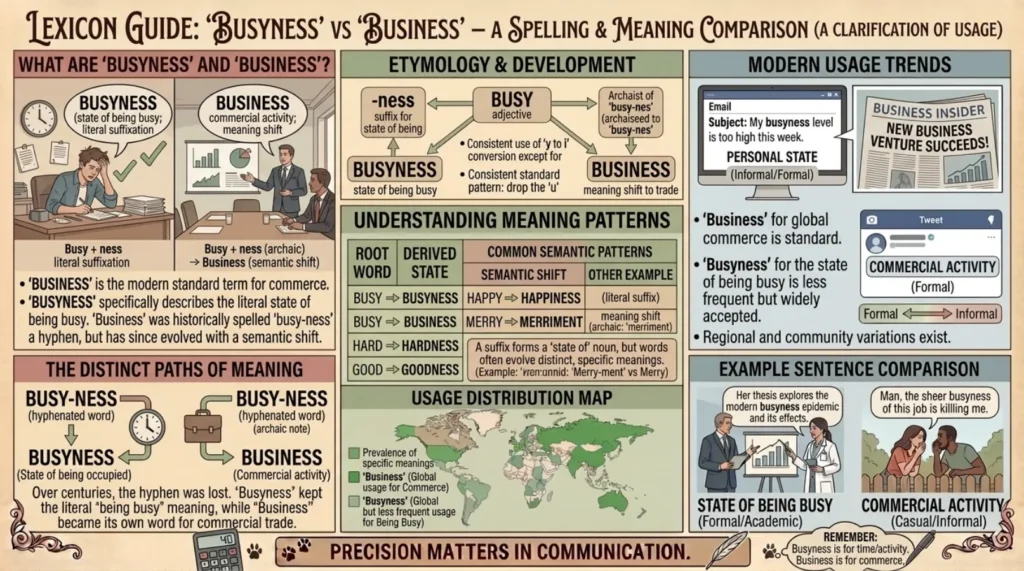
Understanding the difference is easy once you know what each word means. Business refers to work, trade, or a company. Busyness describes the state of being busy. Although they share the same root word, they cannot replace each other.
This guide explains the meanings in simple English. You will also find examples, comparison tables, grammar tips, common mistakes, and FAQs. By the end, you will know exactly when to use business and when to use busyness.
Quick Summary Box (Featured Snippet)
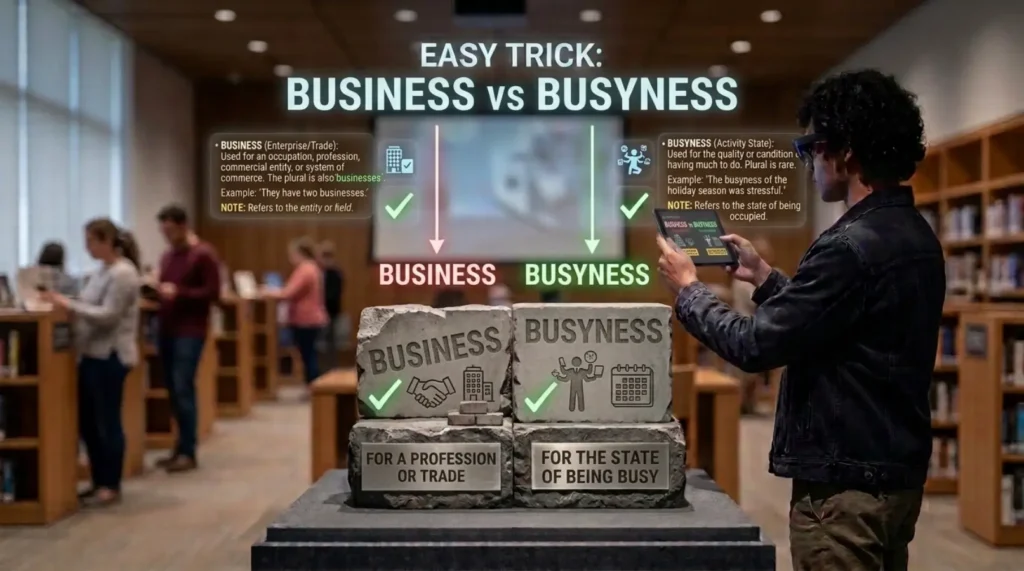
- Business means a company, trade, profession, or work.
- Busyness means the state of being busy.
- Business is very common in everyday English.
- Busyness is correct but much less common.
- Do not use one word instead of the other.
- Remember: Business = work or company. Busyness = being busy.
What Does Business Mean?
Business is a noun with several meanings.
It can refer to:
- A company
- Trade or commerce
- Professional work
- A person’s concern or responsibility
Examples
- She owns a successful business.
- Their family started a small business.
- Mind your own business.
- He studies business at college.
In daily English, business is one of the most commonly used nouns.
What Does Busyness Mean?
Busyness is also a noun.
It means the condition of being busy.
It describes having many activities or tasks.
Examples
- The office was full of busyness.
- I enjoy the busyness of city life.
- Her busyness kept her from calling.
Although correct, busyness appears much less often than business.
Many writers simply use being busy instead.
Busyness vs Business Comparison Table
| Feature | Business | Busyness |
|---|---|---|
| Meaning | Company, trade, work | State of being busy |
| Part of Speech | Noun | Noun |
| Common Usage | Very common | Less common |
| Related Word | Business owner | Busy person |
| Example | She runs a business. | His busyness surprised everyone. |
Business vs Busyness in Simple Words
The easiest way to remember the difference is this:
Business = Work or Company
Busyness = Being Busy
Think of these examples.
✔ I opened a business.
✔ My busyness prevented me from visiting.
One talks about work.
The other talks about activity.
Real-Life Examples
Here are simple examples from daily life.
Business Examples
- Our local bakery is a family business.
- She wants to start an online business.
- The business meeting begins at noon.
- Good customer service helps every business.
Busyness Examples
- The holiday busyness makes shopping stressful.
- Morning busyness filled the train station.
- His busyness left little free time.
- I enjoy the busyness of festivals.
Why People Confuse Busyness and Business
These words look almost identical.
They also come from the adjective busy.
However, they developed different meanings over time.
People often assume they are spelling variations.
They are not.
Each word has its own meaning.
Using the wrong one can confuse readers.
Common Mistakes to Avoid
❌ Incorrect
My busyness is growing every year.
✔ Correct
My business is growing every year.
❌ Incorrect
She couldn’t attend because of her business.
✔ Better
She couldn’t attend because of her busyness.
❌ Incorrect
He started a new busyness.
✔ Correct
He started a new business.
Grammar Tips for Business and Busyness
Here are easy grammar tips.
Use business when talking about:
- Companies
- Jobs
- Trade
- Commerce
- Professional matters
Example:
The business hired new employees.
Use busyness when talking about:
- A busy schedule
- Many activities
- Constant action
Example:
The busyness of the office increased.
Which Word Is More Common?
Business is much more common.
You will see it in:
- Newspapers
- Books
- School subjects
- Business websites
- Company names
Busyness is correct but less frequent.
Many writers prefer phrases like:
- being busy
- busy schedule
- busy lifestyle
Instead of:
- busyness
Tips to Remember the Difference
Here are simple memory tricks.
Trick 1
Business = Company
Think of:
1.Business owner
2.Business meeting
3.Business card
Trick 2
Busyness = Busy + ness
The ending -ness creates a noun showing a state.
Examples:
- kindness
- happiness
- darkness
- busyness
Trick 3
Ask yourself:
“Am I talking about work?”
If yes, choose business.
If not, and you mean “being busy,” choose busyness.
Synonyms and Related Words
Business
- Company
- Enterprise
- Trade
- Commerce
- Firm
- Profession
- Occupation
- Industry
Busyness
- Activity
- Hustle
- Liveliness
- Motion
- Occupation
- Workload
- Busy schedule
- Constant activity
Related Search Terms (LSI Keywords)
- business meaning
- busyness meaning
- business vs busyness
- busy vs business
- business grammar
- business definition
- busyness definition
- English grammar guide
- confusing English words
- commonly confused words
Daily Life Usage
Let’s see how both words appear naturally.
At Work
Our business hired five new workers.
The office busyness increased before the deadline.
At School
She studies business management.
The busyness of exam week was exhausting.
At Home
Their family business has existed for decades.
Holiday busyness kept everyone occupied.
Business and Busyness in Writing
Professional writing usually uses business far more often.
Examples include:
- business reports
- business emails
- business plans
- business proposals
Creative writing sometimes uses busyness to describe an active place.
Example:
“The marketplace buzzed with joyful busyness.”
Expert Insight
Grammar experts recommend choosing words based on meaning rather than spelling.
Although busyness is a valid English word, it is less common in modern writing. Many style guides prefer simple alternatives like being busy when possible.
Using business correctly is important because it appears in education, professional communication, and everyday conversation. Knowing the distinction improves writing clarity and helps readers understand your message immediately.
FAQs:
Is busyness a real word?
Yes. Busyness is a correct English noun. It means the state of being busy.
Is business the same as busyness?
No.
Business refers to work, trade, or a company.
Busyness means being busy.
Which word is more common?
Business is far more common in everyday English.
Can I use busyness instead of business?
No.
They have different meanings.
Why do these words look so similar?
Both come from the adjective busy, but they developed different meanings.
Is busyness formal?
Yes.
However, many writers prefer phrases like being busy because they sound more natural.
How do I remember the difference?
Remember:
Business = company or work
Busyness = being busy
Featured Snippet: Busyness vs Business
Business means a company, trade, work, or professional activity. Busyness means the state of being busy or having many tasks. Although the words look similar, they are not interchangeable. Use business for companies and work. Use busyness when talking about a busy schedule or constant activity.
Internal Linking Suggestions
Consider linking this article to related grammar guides such as:
- Business or Bussiness
- Affect vs Effect
- Stationary vs Stationery
- Its vs It’s
- Your vs You’re
- Than vs Then
- Lose vs Loose
- Accept vs Except
Conclusion
Understanding busyness vs business is simple once you know their meanings. Business refers to work, trade, a company, or professional matters. Busyness describes the condition of being busy. While both words come from busy, they are not interchangeable.
Because business appears much more often in everyday English, many people mistakenly use it when they actually mean busyness, or vice versa. Learning the difference helps you write more clearly and professionally. Whenever you are unsure, ask yourself whether you are talking about a company or simply describing a busy schedule. This simple habit will help you choose the correct word every time.

James Carter is a comparison writer and research specialist with over 10 years of experience in digital publishing. With a background in business communication and consumer research, he creates detailed comparison articles, buying guides, and reviews that help readers make informed decisions with confidence. “Every comparison should help readers make better decisions. My goal is to turn complex information into clear, practical guidance that people can trust.” — James Carter