
Later or latter is a common grammar question that confuses many English learners. The two words look alike, but they have different meanings. Using the wrong one can change the meaning of your sentence. The good news is that the difference is easy to learn. Once you understand when to use each word, you will write and speak with more confidence. This guide explains both words in simple English. You will also find examples, a comparison table, common mistakes, memory tricks, and expert grammar tips. By the end, you will know exactly when to use later and when to use latter in everyday conversations and writing.
Quick Summary Box (Featured Snippet)
- Later means after some time or at a future time.
- Latter means the second of two people or things.
- Use later when talking about time.
- Use latter when choosing the second item from two options.
- Remember: Later = Time, Latter = Second Choice.
What Does “Later” Mean?
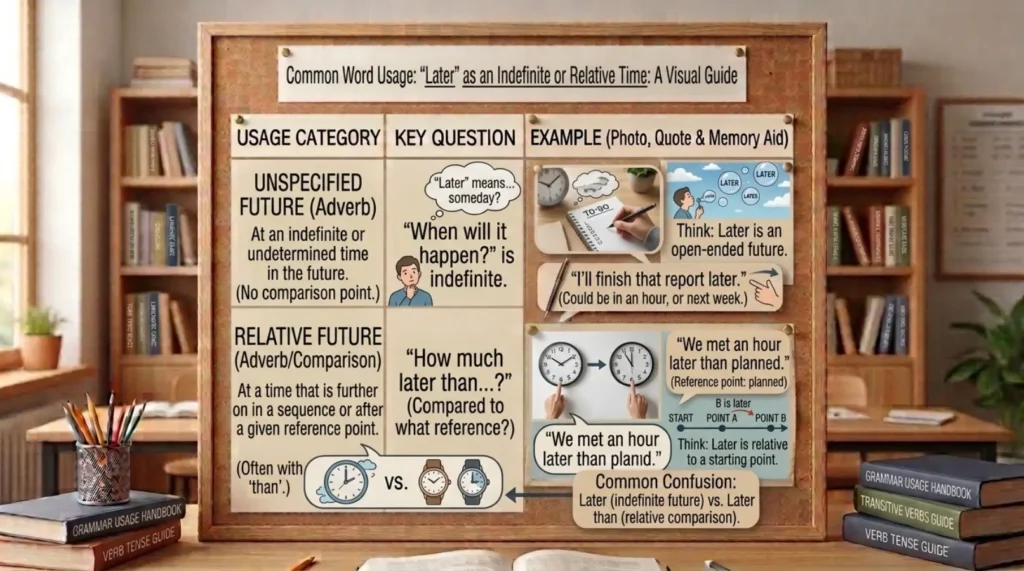
The word later refers to a future time. It tells us that something happens after another event.
Examples
- I’ll call you later.
- We can eat dinner later.
- She arrived later than expected.
- Let’s discuss it later today.
Simple Definition
Later = After now or after another time.
What Does “Latter” Mean?
The word latter refers to the second item when only two people, ideas, or things are mentioned.
Examples
I enjoy reading novels and magazines. I prefer the latter.
Between tea and coffee, I choose the latter.
John and David applied for the job. The latter was selected.
Simple Definition
Latter = The second of two choices.
Later vs Latter Comparison Table
| Feature | Later | Latter |
|---|---|---|
| Meaning | After a period of time | The second of two things |
| Used For | Time | Comparison |
| Part of Speech | Adverb or adjective | Adjective or noun |
| Example | See you later. | I chose the latter. |
| Opposite | Earlier | Former |
Later vs Latter in Simple Words
Think about these questions.
Are you talking about time?
Use later.
Example:
- We will travel later this week.
Are you talking about two choices?
Use latter.
Example:
- Between football and basketball, I prefer the latter.
This simple trick helps most people avoid mistakes.
Real-Life Examples of Later and Latter
At School
Teacher:
Finish your homework now. We will play games later.
At Work
Manager:
We’ll discuss your report later this afternoon.
Shopping
“I liked both jackets. I bought the latter.”
Restaurant
“I ordered soup and pasta. The latter was delicious.”
Friends
“I’ll text you later.”
Common Mistakes People Make
Many learners confuse these words because they look similar.
Incorrect
I will see you latter.
Correct
I will see you later.
Incorrect
Between pizza and burgers, I chose later.
Correct
Between pizza and burgers, I chose the latter.
Incorrect
We’ll meet the latter today.
Correct
We’ll meet later today.
Easy Tricks to Remember Later or Latter
Here are simple memory tips.
Trick 1
Later = Time Later
Both relate to time.
Trick 2
Latter = Last Mentioned
The second item mentioned is the latter.
Trick 3
If you can replace the word with afterward, use later.
If you can replace it with the second one, use latter.
When Should You Use Later?
Use later in these situations.
- Future plans
- Time schedules
- Delayed actions
- Conversations about tomorrow
- Events happening afterward
Examples
- I’ll finish it later.
- Come back later.
- We’ll decide later.
- Talk to you later.
- The meeting starts later today.
When Should You Use Latter?
Use latter only when comparing two things.
Examples
- Between science and history, I enjoy the latter.
- Sarah and Emma arrived. The latter brought dessert.
- The movie and the book were great. I liked the latter more.
Later and Latter in Daily Conversations
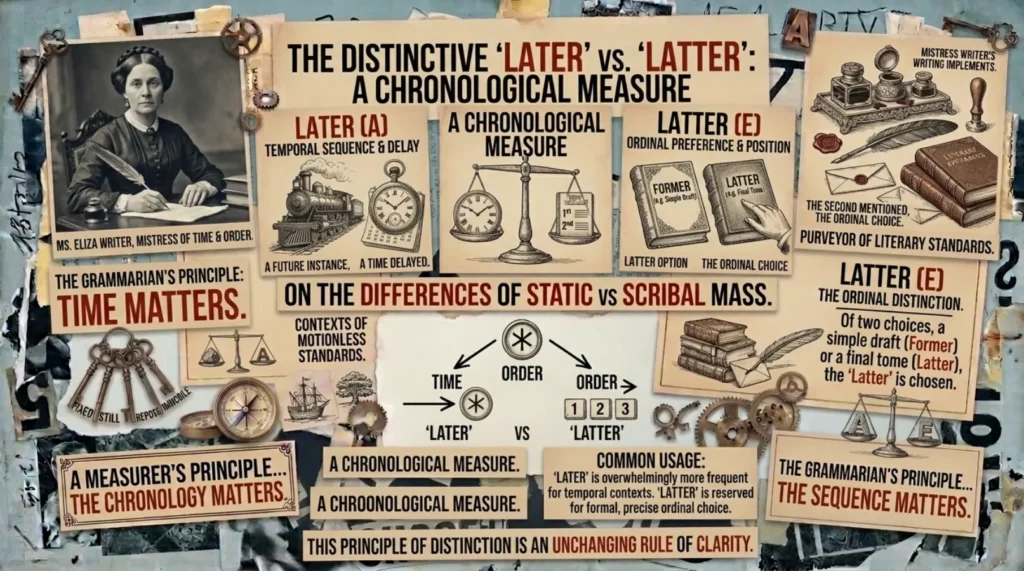
People use later much more often than latter.
Daily Examples
- See you later.
- Maybe later.
- Call me later.
- I’ll explain later.
Examples with latter
- I preferred the latter.
- The latter option costs less.
- The latter answer is correct.
Synonyms and Related Words
Synonyms for Later
- Afterward
- Afterwards
- Eventually
- Subsequently
- Soon
- In the future
Synonyms for Latter
- Second
- Last-mentioned
- Final (in some contexts)
- Second option
Related Grammar Keywords
- later vs latter meaning
- former and latter
- later definition
- latter definition
- grammar differences
- English vocabulary
- commonly confused words
- English writing tips
Later vs Latter: Which One Is More Common?
Later appears much more often in daily English.
People say:
- Talk later.
- See you later.
- Later today.
- Later this week.
Latter mostly appears in books, articles, formal writing, and comparisons.
Expert Grammar Insights
Professional writers choose the correct word because clarity matters.
Remember these rules:
- Use later for time.
- Use latter for the second item.
- Avoid using latter unless two choices exist.
- Read your sentence aloud.
- Ask yourself if you’re discussing time or comparison.
This simple habit prevents grammar mistakes.
Common Grammar Rules
Use Later
✔ Future time
✔ Delayed events
✔ After another event
Use Latter
✔ Second of two
✔ Comparisons
✔ Formal writing
Internal Linking Suggestions
To improve SEO and user engagement, consider linking to related grammar articles such as:
- Former vs Latter
- Then vs Than
- Affect vs Effect
- Farther vs Further
- Its vs It’s
- Who vs Whom
- Lay vs Lie
These related topics help readers strengthen their English grammar skills.
FAQs:
Is it later or latter today?
Use later because you’re talking about time.
What does latter mean?
It means the second of two people, ideas, or things.
Is “See you latter” correct?
No.
The correct phrase is “See you later.”
Can latter mean after?
No.
Only later means after a period of time.
What is the opposite of latter?
The opposite is former.
Which word is used more often?
Later is much more common in everyday speech.
Can latter refer to three things?
No.
Use latter only when discussing two items.
How can I remember the difference?
Remember:
Later = Time
Latter = Second Choice
Final Comparison
| Situation | Correct Word |
|---|---|
| Future time | Later |
| Tomorrow | Later |
| This afternoon | Later |
| Second choice | Latter |
| Second person mentioned | Latter |
| Comparing two options | Latter |
Conclusion
Understanding later or latter becomes easy once you know their different purposes. Later always relates to time. It tells us that something happens after the present or after another event. Latter, however, points to the second item when only two choices are mentioned. Although these words look similar, they are never interchangeable. Using the correct word makes your writing clearer and more professional. A simple memory trick can help: Later = Time, Latter = Second Choice. Practice with everyday sentences, and soon choosing the right word will become natural. Keep this guide handy whenever you need a quick grammar refresher, and you’ll avoid one of the most common English vocabulary mistakes.

Emma Collins is a language writer and grammar enthusiast specializing in English vocabulary, spelling comparisons, and word usage guides. She creates easy-to-understand content that helps readers improve their writing, communication, and language skills with confidence.