
Chose or choose is a common grammar question for English learners and native speakers alike. Many people mix up these two words because they look similar. However, they have different meanings and uses.
Understanding the difference is important for clear writing and speaking. A small grammar mistake can change the meaning of a sentence. The good news is that learning the difference is easy.
In this guide, you will learn what chose and choose mean, when to use them, and how to avoid common mistakes. You will also see simple examples, comparison tables, expert tips, and answers to common questions.
By the end, you will know exactly when to use chose and when to use choose.
Quick Summary Box
- Choose means to select something now or in the future.
- Chose is the past tense of choose.
- Use choose for present or future actions.
- Use chose for actions completed in the past.
- Example: “I choose coffee every morning.”
- Example: “Yesterday, I chose tea.”
- Remember: Choose = present, Chose = past.
What Does Choose Mean?
The word choose means to select, pick, or decide between options.
It is the base form of the verb.
Examples
- I choose healthy food.
- Please choose a color.
- They choose their own seats.
- We will choose a winner tomorrow.
In all these examples, the action happens now or in the future.
What Does Chose Mean?
Chose is the simple past tense of choose.
It describes a decision made in the past.
Examples
- I chose the blue shirt yesterday.
- She chose a new laptop last week.
- We chose the best route.
- They chose to stay home.
These actions already happened.
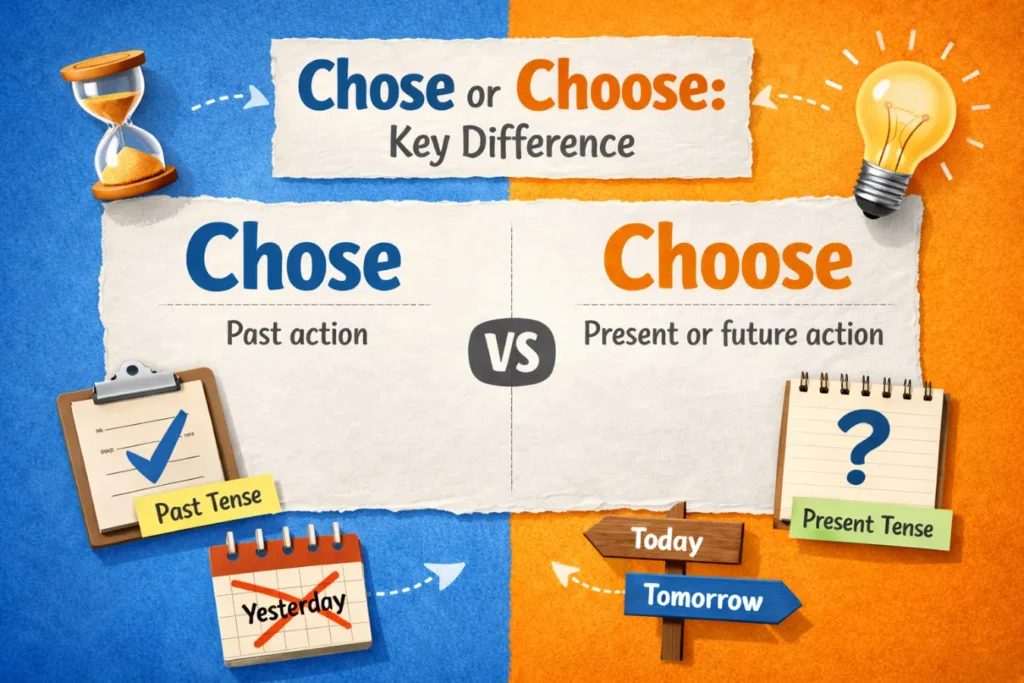
Chose or Choose: Key Difference
The main difference is time.
| Word | Tense | Meaning | Example |
|---|---|---|---|
| Choose | Present/Future | Select something | I choose water. |
| Chose | Past | Selected something | I chose water. |
Think of it this way:
- Choose = happening now
- Chose = already happened
How to Remember Chose vs Choose
A simple trick can help.
Choose Has Extra O’s
The double “oo” in choose can remind you of an ongoing action.
Example:
- I choose my outfit every morning.
Chose Looks Shorter
The shorter spelling can remind you that the action is already finished.
Example:
- I chose my outfit yesterday.
This memory trick helps many learners avoid mistakes.
Real-Life Examples of Choose
Here are common situations where you use choose.
At a Restaurant
- I choose the pasta.
1.1: At School
- Students choose their subjects.
At Work
- We choose the best candidate.
Shopping
- You can choose any size.
In each case, the choice is happening now or later.
Real-Life Examples of Chose
Here are examples using chose.
At a Restaurant
- I chose the pasta yesterday.
1.2: At School
- She chose science last year.
At Work
- The company chose a new manager.
Shopping
- They chose the black shoes.
Each choice happened in the past.
Common Mistakes People Make
Many writers confuse these words.
Mistake #1
❌ Yesterday, I choose a book.
✅ Yesterday, I chose a book.
Why?
The word “yesterday” signals the past.
Mistake #2
❌ I always chose tea.
✅ I always choose tea.
Why?
The action happens regularly in the present.
Mistake #3
❌ Tomorrow, I chose a college.
✅ Tomorrow, I will choose a college.
Why?
The action is in the future.
Choose, Chose, and Chosen
Many learners also confuse chosen.
Here is the difference:
| Word | Verb Form | Example |
|---|---|---|
| Choose | Base Form | I choose wisely. |
| Chose | Past Tense | I chose wisely. |
| Chosen | Past Participle | I have chosen wisely. |
Examples
- Choose carefully.
- She chose carefully.
- She has chosen carefully.
Understanding all three forms improves grammar accuracy.
Why Do People Confuse Chose and Choose?
Several reasons cause confusion.
Similar Spelling
Only one letter changes.
Similar Pronunciation
Many learners hear them as nearly identical.
Irregular Verb Pattern
English verbs do not always follow simple rules.
For example:
- Choose → Chose → Chosen
- Speak → Spoke → Spoken
- Break → Broke → Broken
Learning verb patterns helps reduce mistakes.
Tips to Use Chose or Choose Correctly
Look for Time Words
Check for words such as:
- Yesterday
- Last week
- Last year
These usually require chose.
Check for Present Actions
Words like these often need choose:
- Always
- Usually
- Every day
- Often
Read the Sentence Aloud
Sometimes hearing the sentence helps identify the correct verb tense.
Practice Daily
Small grammar exercises improve accuracy over time.
Synonyms and Related Words
Understanding related words builds vocabulary.
Synonyms for Choose
- Select
- Pick
- Decide
- Opt for
- Prefer
- Elect
Related Keywords
- choose meaning
- chose meaning
- choose vs chose
- chose and choose difference
- when to use chose
- when to use choose
- grammar rules for choose
- past tense of choose
- English grammar verbs
- choose or chose examples
These terms often appear in grammar searches.
How Chose and Choose Are Used in Everyday English
These words appear in daily conversations.
Family Discussions
- We choose a movie together.
Travel Planning
- They chose Italy for vacation.
Education
- Students choose courses.
Business
- The company chose a new strategy.
Correct verb usage makes communication clearer and more professional.
Expert Insights: Why This Grammar Rule Matters
Grammar experts stress the importance of correct verb tense.
Using chose and choose properly improves:
- Writing quality
- Professional communication
- Academic performance
- Reader trust
Search engines also favor clear, well-written content. Good grammar improves user experience and readability.
When readers understand your message quickly, they stay on the page longer. This can support stronger SEO performance.
Frequently Asked Questions (FAQs)
Is chose the past tense of choose?
Yes. Chose is the simple past tense of choose.
Which is correct: I choose or I chose?
Both are correct. The right choice depends on time.
- Present: I choose.
- Past: I chose.
What is the difference between chose and chosen?
Chose is past tense. Chosen is the past participle.
Example:
- I chose a book.
- I have chosen a book.
Is choose present tense?
Yes. Choose is the base and present-tense form.
How do I remember chose or choose?
Remember:
- Choose = present or future
- Chose = past
Can I use chose for future actions?
No.
Future actions require choose or will choose.
Why do English learners confuse chose and choose?
The words have similar spelling and pronunciation.
What is the past participle of choose?
The past participle is chosen.
Internal Linking Suggestions
To strengthen SEO, link this article to related content such as:
- Common English grammar mistakes
- Past tense verb guide
- Irregular verbs in English
- Chosen vs chose explained
- English writing tips for beginners
These related topics can improve site structure and user engagement.
Conclusion
Understanding chose or choose is easier than many people think. The key difference is time. Use choose for present and future actions. Use chose for actions that already happened in the past.
A simple sentence check can prevent most mistakes. Look for time clues like “yesterday,” “last week,” or “every day.” These words often reveal the correct verb form.
The more you practice, the more natural the difference becomes. Whether you write emails, school assignments, blog posts, or business documents, using chose and choose correctly improves clarity and confidence.
Remember this simple rule: Choose happens now. Chose happened before.

James Carter is a comparison writer and research specialist with over 10 years of experience in digital publishing. With a background in business communication and consumer research, he creates detailed comparison articles, buying guides, and reviews that help readers make informed decisions with confidence. “Every comparison should help readers make better decisions. My goal is to turn complex information into clear, practical guidance that people can trust.” — James Carter

