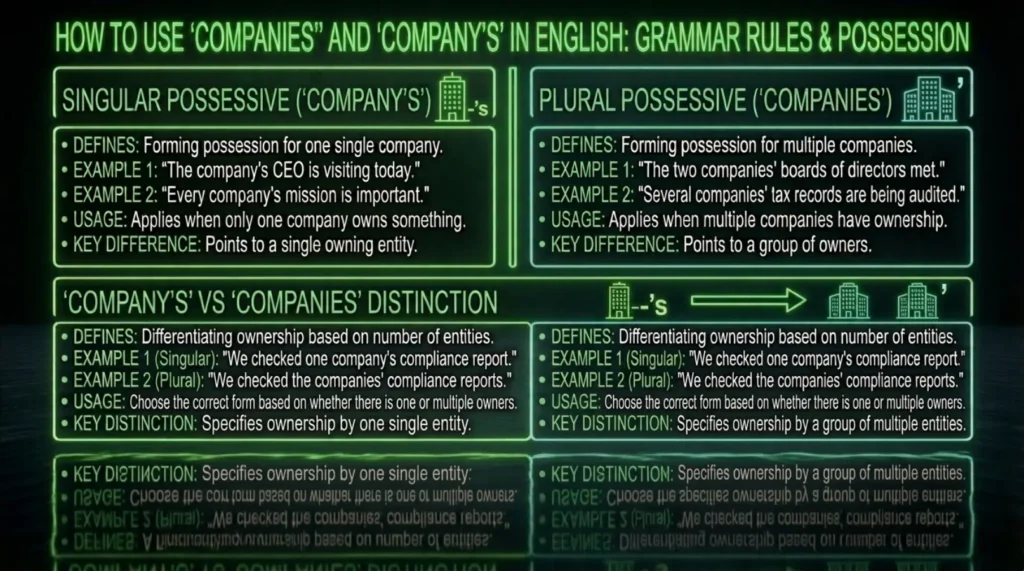
Companies’ vs company’s is a common grammar question that confuses many writers. Both forms are correct, but they have different meanings. The difference depends on who owns something. A small apostrophe changes the meaning of the word. That is why learning this rule is important.
Many people make mistakes in emails, reports, school work, and business writing. These errors can make your writing look less professional. The good news is that the rule is easy to learn. Once you understand singular and plural possession, you can use each form with confidence.
This guide explains everything in simple English. You will learn the meaning, grammar rules, examples, common mistakes, and memory tips. By the end, you will know exactly when to use company’s and when to use companies’.
📌 Quick Summary Box (Featured Snippet)
Company’s shows something belongs to one company.
Companies’ shows something belongs to more than one company.
Both words are possessive nouns.
The apostrophe changes position based on singular or plural ownership.
Use company’s for one business.
Use companies’ for multiple businesses.
What Does Companies’ vs Company’s Mean?
Both words show ownership.
Company’s = belonging to one company.
Companies’ = belonging to two or more companies.
The apostrophe tells readers who owns something.
Examples
The company’s logo looks modern.
The companies’ profits increased this year.
Understanding Company’s in Simple Words
Use company’s when talking about one company.
Formula
Company + ‘s = Company’s
It shows one business owns something.
Examples
The company’s website is easy to use.
The company’s employees attended training.
The company’s CEO gave a speech.
The company’s policy changed today.
The company’s office moved downtown.
Think of company’s as meaning:
Something belongs to one company.
Understanding Companies’ in Simple Words
Use companies’ when talking about more than one company.
Formula
Companies + ‘ = Companies’
The noun is already plural, so only add an apostrophe.
Examples
The companies’ products reached global markets.
The companies’ managers met yesterday.
The companies’ profits increased together.
The companies’ agreements expired last month.
The companies’ offices share the same building.
Think of companies’ as meaning:
Something belongs to several companies.
Companies’ vs Company’s Comparison Table
Feature
Company’s
Companies’
Meaning
Belongs to one company
Belongs to multiple companies
Number
Singular
Plural
Apostrophe Position
Before the s
After the s
Grammar Type
Singular possessive
Plural possessive
Example
The company’s policy
The companies’ policies
When Should You Use Company’s?
Choose company’s if only one business owns something.
Correct Examples
The company’s mission inspires employees.
The company’s brand became famous.
The company’s lawyer prepared the contract.
The company’s customer service improved.
The company’s products sell worldwide.
These sentences refer to one company.
When Should You Use Companies’?
Choose companies’ if two or more businesses own something.
Correct Examples
The companies’ leaders signed the agreement.
The companies’ investments created jobs.
The companies’ factories reduced pollution.
The companies’ research improved technology.
The companies’ teams worked together.
These examples involve multiple companies.
Real-Life Examples of Companies’ vs Company’s
Here are examples from daily life.
Business
✅ The company’s annual report impressed investors.
✅ The companies’ joint project succeeded.
News
✅ The company’s shares rose today.
✅ The companies’ merger created a larger organization.
School Writing
✅ The company’s history began in 1995.
✅ The companies’ competition helped consumers.
Workplace
Manager:
The company’s budget increased.
Business analyst:
The companies’ financial results exceeded expectations.
Common Mistakes People Make
Many writers confuse singular and plural possession.
Mistake 1
❌ The companies policy
✅ The company’s policy
Mistake 2
❌ The company’s profits (when talking about several companies)
✅ The companies’ profits
Mistake 3
❌ Companies’s products
✅ Companies’ products
Never add another s after a plural noun ending in s.
Easy Trick to Remember the Difference
Remember this simple rule.
One company
➡ Add ‘s
Example:
Company → Company’s
Many companies
➡ Add only ‘
Example:
Companies → Companies’
Memory Tip
Ask yourself:
How many companies own it?
One → Company’s
More than one → Companies’
Grammar Rules Behind Companies’ and Company’s
English possessive nouns follow simple rules.
Rule 1
Singular noun
Add ‘s
Example
Company → Company’s
Rule 2
Plural noun ending in s
Add only an apostrophe.
Example
Companies → Companies’
Rule 3
Ownership matters.
Count the owners before adding the apostrophe.
Companies’ vs Company’s in Daily Writing
You will often see these words in:
Business reports
Legal documents
Emails
Financial statements
Marketing content
News articles
School assignments
Company profiles
Correct grammar builds trust and professionalism.
Related Grammar Rules
These grammar topics are similar.
Company’s vs Companies’
Employee’s vs Employees’
Business’s vs Businesses’
Client’s vs Clients’
Customer’s vs Customers’
Manager’s vs Managers’
Owner’s vs Owners’
Learning one rule helps you understand all possessive nouns.
Synonyms and LSI Keywords
Related Search Terms
company’s meaning
companies’ meaning
possessive company
plural possessive nouns
singular possessive nouns
apostrophe grammar rules
grammar for companies
possessive apostrophe examples
company’s or companies’
business grammar guide
Semantic Keywords
English grammar
punctuation rules
ownership grammar
apostrophe usage
business writing
grammar examples
singular ownership
plural ownership
Expert Insights
Grammar experts agree that apostrophe placement changes meaning.
Using the correct possessive form improves clarity. It also makes your writing more professional.
Business documents need precise grammar. Small punctuation mistakes can confuse readers.
Always identify the number of owners before adding the apostrophe.
That simple habit prevents most grammar mistakes.
Internal Linking Suggestions
Consider linking this article to related guides such as:
Apostrophe Rules Explained
Employee’s vs Employees’
Its vs It’s
Whose vs Who’s
Businesses vs Business’s
Company’s or Companies
Singular vs Plural Possessive Nouns
Common English Grammar Mistakes
FAQs:
Is company’s grammatically correct?
Yes. It is the singular possessive form of company.
Is companies’ grammatically correct?
Yes. It is the plural possessive form of companies.
What is the difference between companies’ and company’s?
Company’s refers to one company. Companies’ refers to two or more companies.
Where does the apostrophe go in companies’?
The apostrophe comes after the s because companies is already plural.
Can I write companies’s?
No. That form is incorrect.
Use companies’ instead.
How do I know which one to use?
Count the owners.
One owner = company’s
Many owners = companies’
Why do people confuse these words?
The apostrophe changes position. Many people focus on spelling instead of ownership.
Is this rule used in business writing?
Yes. It appears often in reports, contracts, emails, and financial documents.
Featured Snippet Answer
What is the difference between companies’ and company’s?
Company’s is the singular possessive form and means something belongs to one company. Companies’ is the plural possessive form and means something belongs to two or more companies. The apostrophe comes before the s for singular nouns and after the s for plural nouns ending in s.
Conclusion
Understanding companies’ vs company’s is easier than it first appears. The key is to identify how many companies own something. If one company owns it, use company’s. If several companies own it, use companies’. This simple rule works in business writing, school assignments, emails, and everyday communication.
Correct apostrophe use improves clarity and professionalism. Readers understand your message faster when grammar is accurate. Before writing, pause and ask one question: Is there one company or many? Your answer will tell you exactly which form to use. With regular practice, choosing between company’s and companies’ will become natural.
Emma Collins is a language writer and grammar enthusiast specializing in English vocabulary, spelling comparisons, and word usage guides. She creates easy-to-understand content that helps readers improve their writing, communication, and language skills with confidence.