
Is it conversing or conversating? Many English learners ask this question. The two words sound similar. However, only one is accepted in standard English.
Knowing the correct word helps you speak and write with confidence. It also helps you avoid common grammar mistakes. While you may hear conversating in casual speech or song lyrics, it is not considered standard English.
This guide explains the difference in simple words. You will learn the meaning, correct usage, examples, grammar tips, and common mistakes. By the end, you will know exactly when to use conversing and why conversating is usually avoided.
Quick Summary Box (Featured Snippet)
- Conversing is the correct standard English word.
- Conversating is considered nonstandard English.
- Conversing means talking or having a conversation.
- Use conversing in school, work, and formal writing.
- Some people use conversating in casual speech, music, or regional dialects.
- Dictionaries and grammar experts recommend conversing.
What Does “Conversing” Mean?
Conversing is the present participle of the verb converse.
It means:
- Talking with someone
- Having a conversation
- Exchanging ideas or opinions
Examples
- They were conversing quietly in the library.
- We spent hours conversing about travel.
- She enjoys conversing with new people.
The word sounds natural in both speaking and writing.
What Does “Conversating” Mean?
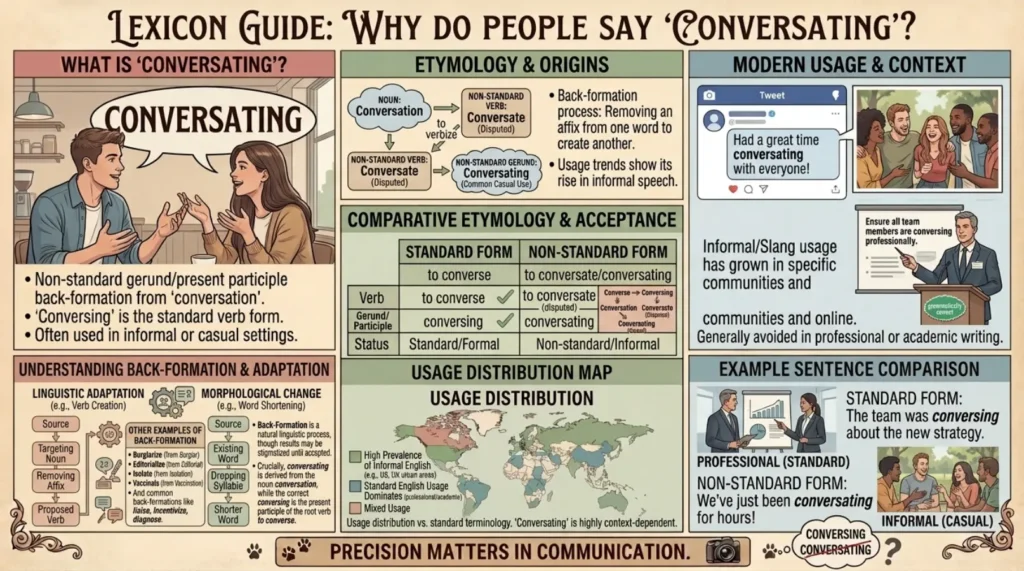
Conversating is a word that some people use instead of conversing.
Many dictionaries label it as:
- Nonstandard English
- Informal speech
- Dialectal usage
It simply means talking.
Although many people understand it, grammar experts recommend avoiding it in professional writing.
Example
❌ We were conversating after dinner.
✅ We were conversing after dinner.
Is Conversating a Real Word?
This question appears often online.
Short Answer
Yes, conversating appears in some dictionaries.
However, it is marked as:
- Nonstandard
- Informal
- Dialectal
That means it exists but is not recommended for formal English.
Most teachers, editors, and style guides prefer conversing.
Conversing vs Conversating Comparison Table
| Feature | Conversing | Conversating |
|---|---|---|
| Standard English | ✅ Yes | ❌ No |
| Dictionary accepted | ✅ Yes | Limited and nonstandard |
| Formal writing | ✅ Yes | ❌ Avoid |
| Academic papers | ✅ Yes | ❌ No |
| Business communication | ✅ Yes | ❌ No |
| Casual speech | ✅ Yes | Sometimes |
| Grammar recommendation | Best choice | Usually avoid |
Why Do People Say “Conversating”?
Many people grow up hearing conversating.
There are several reasons.
Regional Dialects
Some communities naturally use the word.
Music and Pop Culture
Many songs include conversating because it fits the rhythm.
Everyday Speech
Friends and family often repeat words they hear.
Language changes over time. Still, standard English continues to prefer conversing.
When Should You Use Conversing?
Use conversing whenever you want correct grammar.
Good situations
- School assignments
- College essays
- Business emails
- Job interviews
- Reports
- Professional presentations
- Books and blogs
Examples
- The students were conversing before class.
- We enjoyed conversing over coffee.
- She was conversing with the manager.
When Might You Hear Conversating?
You may hear conversating in:
- Everyday conversations
- Song lyrics
- Movies
- Social media
- Regional speech
- Informal storytelling
Although many people use it, remember that it is not the preferred form in formal English.
Real-Life Examples of Conversing and Conversating
At School
✅ The students were conversing after class.
❌ The students were conversating after class.
At Work
✅ We were conversing during the meeting.
❌ We were conversating during the meeting.
At Home
✅ They spent the evening conversing.
Informally, someone might say:
“We were conversating all night.”
While understandable, the second sentence is less formal.
Common Mistakes People Make
Many English learners make these mistakes.
Mistake 1
❌ I enjoy conversating.
✅ I enjoy conversing.
Mistake 2
❌ We were conversating yesterday.
✅ We were conversing yesterday.
Mistake 3
❌ Conversating is always correct.
✅ Conversing is the preferred standard English word.
Mistake 4
Using conversating in business writing.
Instead, use conversing.
Easy Trick to Remember the Correct Word
Think about the base verb.
The correct verb is:
Converse
Not:
Conversate
Since the verb is converse, the -ing form becomes:
Conversing
Simple formula:
Converse → Conversing
Not
Conversate → Conversating
How Native English Speakers Use It
Most native speakers choose:
- talking
- speaking
- chatting
- conversing
Only some speakers use conversating, often in informal settings.
Professional writers almost always choose conversing.
Synonyms for Conversing (LSI Keywords)
Using related words improves your writing naturally.
Common synonyms
- Talking
- Speaking
- Chatting
- Discussing
- Communicating
- Having a conversation
- Exchanging ideas
- Interacting
- Sharing thoughts
- Engaging in conversation
Related Search Terms
- conversing meaning
- conversating meaning
- converse definition
- is conversating correct
- converse vs talk
- talking versus conversing
- formal word for talking
- proper English conversation
- correct grammar for conversing
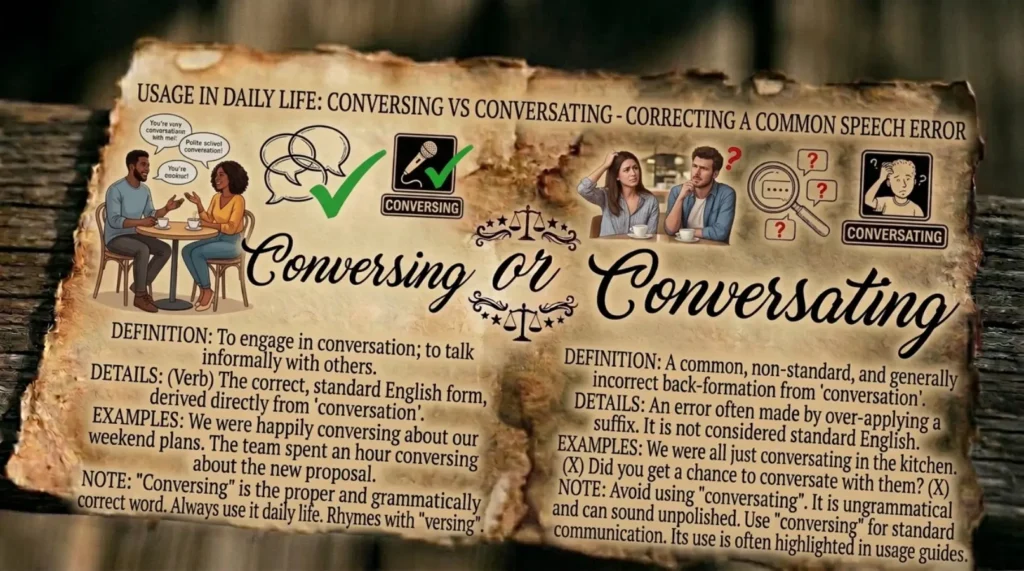
Usage in Daily Life
You can use conversing almost anywhere.
With Friends
“We were conversing about movies.”
At Work
“The manager was conversing with clients.”
At School
“The teacher was conversing with students.”
During Travel
“We spent hours conversing on the train.”
Using the correct word helps you sound more natural.
Expert Insights
Grammar experts agree that conversing is the standard choice.
Here are a few helpful tips.
- Use conversing in all formal writing.
- Avoid conversating in professional situations.
- Choose clear and simple words.
- Read quality books to learn natural English.
- Practice speaking with correct grammar every day.
Using standard English improves credibility and builds trust with readers.
Featured Snippet Answer
Is it conversing or conversating?
Conversing is the correct standard English word. It comes from the verb converse, which means to talk with someone. Although conversating appears in informal speech and some dictionaries, it is considered nonstandard. For school, business, and professional writing, always use conversing.
FAQs:
Is conversating grammatically correct?
It is considered nonstandard English. Use conversing instead.
Is conversating in the dictionary?
Some dictionaries include it as an informal or nonstandard word.
Why do people say conversating?
People use it because of regional dialects, everyday speech, and popular music.
Which is correct in formal writing?
Conversing is the correct choice.
Can I use conversating in conversation?
People may understand it in casual speech, but conversing sounds more natural.
What is the verb form of conversing?
The base verb is converse.
Is conversing better than talking?
Both are correct. Conversing often sounds more formal than talking.
How can I remember the correct word?
Remember:
Converse → Conversing
There is no standard verb conversate.
Internal Linking Suggestions
Consider linking this article to related grammar guides, such as:
- Converse vs Talk
- Speak vs Talk
- Affect vs Effect
- Than vs Then
- Who’s vs Whose
- Lay vs Lie
- Stationary vs Stationery
- Ensure vs Insure vs Assure
Conclusion
Understanding is it conversing or conversating is easier than it seems. The correct standard English word is conversing because it comes from the verb converse. While conversating appears in casual speech, regional dialects, and some song lyrics, it is generally considered nonstandard. For school assignments, professional emails, business communication, and formal writing, always choose conversing. Doing so helps your writing sound polished and grammatically correct. When in doubt, remember the simple rule: Converse becomes conversing—not conversating. Following this guideline will improve your English and help you communicate with greater confidence.

James Carter is a comparison writer and research specialist with over 10 years of experience in digital publishing. With a background in business communication and consumer research, he creates detailed comparison articles, buying guides, and reviews that help readers make informed decisions with confidence. “Every comparison should help readers make better decisions. My goal is to turn complex information into clear, practical guidance that people can trust.” — James Carter