
Complement vs compliment is one of the most common word pairs that confuse English learners. The words sound almost the same, but they have different meanings. Using the wrong one can change the meaning of your sentence.
The good news is that the difference is easy to understand. Once you know what each word means, you can use them correctly every time.
In this guide, you will learn the meaning of both words, see simple examples, compare them in a table, and discover easy memory tricks. You will also find common mistakes, expert grammar tips, FAQs, and everyday examples. By the end, you will know exactly when to use complement and when to use compliment.
Quick Summary (Featured Snippet)
- Complement means something that completes or improves another thing.
- Compliment means praise, kind words, or admiration.
- Complement relates to making something better together.
- Compliment relates to saying something nice.
- Remember:
- Complement = Complete
- Compliment = Praise
What Does “Complement” Mean?
A complement is something that completes, improves, or goes well with something else.
It helps another thing become better.
Simple Definition
Complement = Something that completes or matches another thing.
Examples
- The blue tie complements his black suit.
- Fresh bread complements the soup.
- Her skills complement the team’s strengths.
- Lemon complements grilled fish.
- Good music complements a relaxing evening.
In grammar, a complement can also complete the meaning of a sentence.
Example:
She became a doctor.
Here, a doctor is the complement.
What Does “Compliment” Mean?
A compliment is a kind or polite statement about someone.
It expresses praise or admiration.
Simple Definition
Compliment = Praise or kind words.
Examples
- She gave me a nice compliment.
- He complimented her cooking.
- Thank you for the compliment.
- The teacher complimented the student’s effort.
- My friend complimented my new haircut.
People often give compliments to encourage others.
Complement vs Compliment Comparison Table
| Feature | Complement | Compliment |
|---|---|---|
| Meaning | Completes or improves | Praise or admiration |
| Related Word | Complete | Praise |
| Part of Speech | Noun or verb | Noun or verb |
| Used For | Matching things | Nice words |
| Memory Trick | Complete = Complement | Praise = Compliment |
| Example | This sauce complements pasta. | She gave me a compliment. |
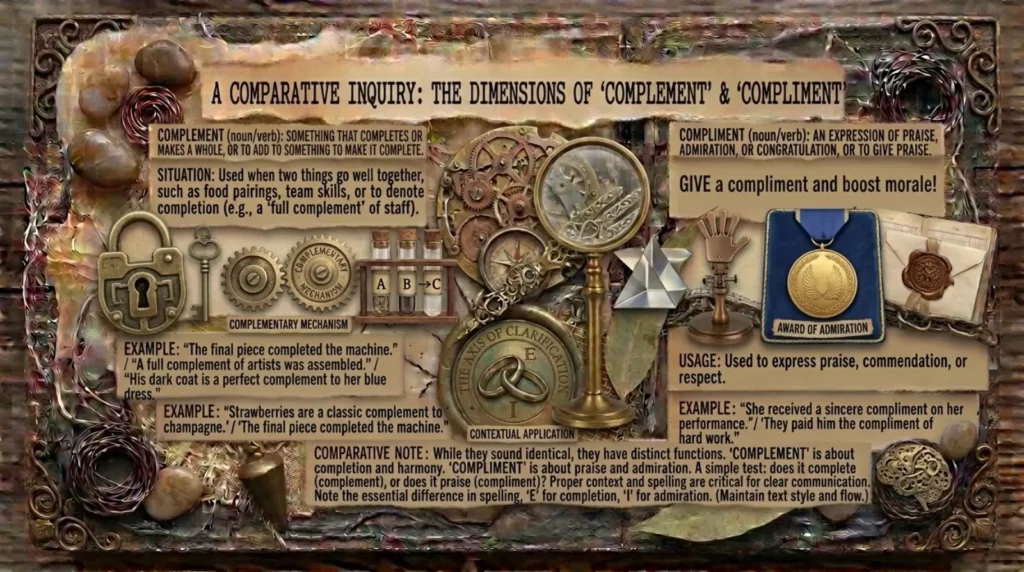
Complement vs Compliment in Simple Words
Think about these two questions.
Does it improve or match something?
Use complement.
Example:
- Cheese complements pizza.
Is someone saying something nice?
Use compliment.
Example:
- My teacher complimented my presentation.
This simple test works most of the time.
Real-Life Examples of Complement vs Compliment
At Work
✔ Your experience complements the team.
✔ My manager complimented my presentation.
At School
✔ Her artwork complements the classroom display.
✔ The teacher complimented the students.
In Fashion
✔ Gold jewelry complements a black dress.
✔ Everyone complimented her beautiful dress.
In Food
✔ Garlic complements steak.
✔ The chef received many compliments.
In Relationships
✔ Their personalities complement each other.
✔ She complimented her husband on his cooking.
Common Mistakes People Make
Many writers confuse these words because they sound alike.
Incorrect
❌ Your shoes compliment your outfit.
Correct
✅ Your shoes complement your outfit.
Incorrect
❌ She gave me a complement.
Correct
✅ She gave me a compliment.
Incorrect
❌ I compliment your cooking because it tastes great together.
Correct
✅ Your spices complement the dish.
Easy Memory Tricks
These tricks help you remember the difference.
Trick 1
Complement contains “complete.”
If something completes another thing, use complement.
Trick 2
Compliment contains “I.”
Imagine saying,
“I like your shirt.”
That is a compliment.
Trick 3
Ask yourself:
“Am I talking about matching or praising?”
- Matching → Complement
- Praising → Compliment
Complement vs Compliment in Daily Life
Here are common situations.
Food
- Cheese complements wine.
Clothes
- The scarf complements her coat.
Friends
- Your kindness complements your personality.
Family
- Dad complimented my report card.
Office
- My boss complimented my work.
Restaurant
- The waiter complimented our choice.
Complement vs Compliment as Verbs
Both words can also be verbs.
Complement (Verb)
Means to improve or complete.
Examples:
- These colors complement each other.
- Herbs complement the soup.
Compliment (Verb)
Means to praise someone.
Examples:
- I complimented her speech.
- He complimented my new laptop.
Synonyms and Related Words
Complement Synonyms
- Complete
- Match
- Improve
- Enhance
- Balance
- Support
- Pair well
- Go with
Related Keywords
- complement meaning
- complement examples
- complement definition
- complement sentence
- complement grammar
Compliment Synonyms
- Praise
- Admire
- Applaud
- Appreciate
- Flatter
- Encourage
- Commend
Related Keywords
- compliment meaning
- compliment examples
- compliment sentence
- compliment definition
- giving compliments
Common Grammar Rules
Follow these grammar tips.
Use “Complement” when:
- Two things go well together.
- Something completes another thing.
- Talking about matching colors.
- Discussing teamwork.
Example:
The curtains complement the furniture.
Use “Compliment” when:
- Someone says something nice.
- Giving praise.
- Showing admiration.
- Appreciating someone’s work.
Example:
She complimented my writing.
Why People Confuse Complement and Compliment
There are three main reasons.
- They sound exactly alike.
- Their spelling differs by only one letter.
- Both are common in everyday English.
Fortunately, remembering complete makes the difference easy.
Expert Grammar Insights
Grammar experts recommend learning confusing word pairs together.
Understanding complement vs compliment improves writing accuracy.
Correct word choice also makes your communication more professional.
Many spelling mistakes happen because people rely on pronunciation instead of meaning.
Always check the sentence meaning before choosing the word.
Internal Linking Suggestions
To strengthen topical authority, consider linking this article to related grammar guides such as:
- Affect vs Effect
- Accept vs Except
- Then vs Than
- Advice vs Advise
- Principal vs Principle
- Stationary vs Stationery
- Its vs It’s
- Your vs You’re
FAQs:
Is it complement or compliment someone?
Use compliment.
Example:
She complimented my speech.
Is it complement your outfit?
Yes.
Example:
Those shoes complement your outfit.
What is the easiest way to remember?
Remember:
- Complement = Complete
- Compliment = Praise
Can complement be a verb?
Yes.
Example:
The sauce complements the pasta.
Can compliment be a noun?
Yes.
Example:
She gave me a compliment.
Why do they sound the same?
They are homophones.
Homophones sound alike but have different meanings.
Which word is used for matching colors?
Use complement.
Example:
Blue complements white.
Which word means praise?
Compliment means praise or admiration.
Featured Snippet: Complement vs Compliment
| Word | Meaning | Example |
|---|---|---|
| Complement | Completes or improves something | The shoes complement the dress. |
| Compliment | Praise or kind words | She gave me a compliment. |
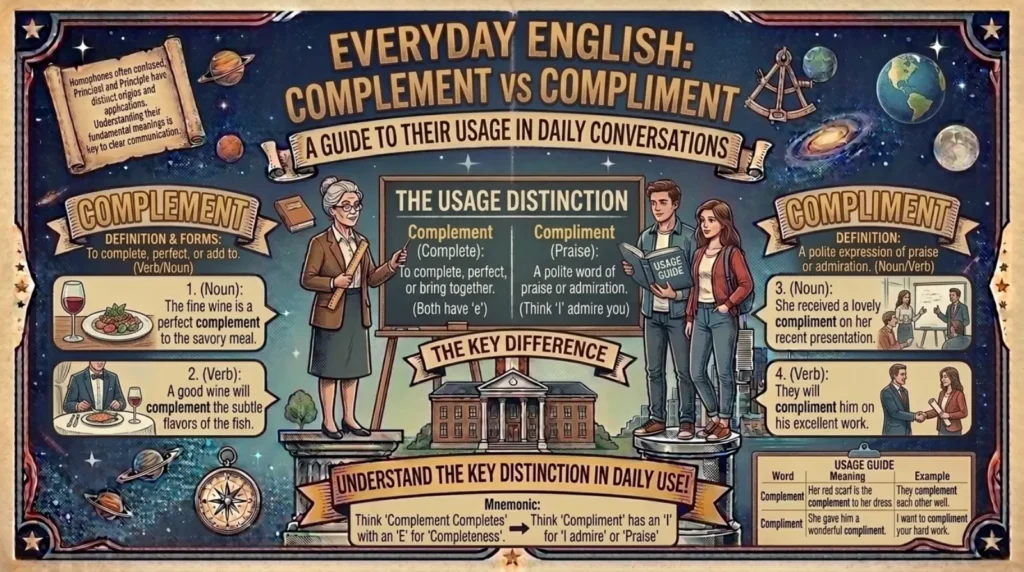
Quick Tip: If it helps something fit better, use complement. If it praises someone, use compliment.
Conclusion
Understanding complement vs compliment is easier than many people think. Although the words sound alike, their meanings are very different. Complement refers to something that completes, matches, or improves another thing. Compliment refers to praise, admiration, or kind words. A simple memory trick can help: complement shares its root with complete, while compliment is connected with giving praise. Practicing these words in everyday conversations will help you remember them naturally. Whether you are writing emails, school assignments, or social media posts, choosing the correct word makes your English clearer and more professional. Keep this guide handy whenever you need a quick reminder, and you’ll confidently use complement and compliment correctly every time.

Emma Collins is a language writer and grammar enthusiast specializing in English vocabulary, spelling comparisons, and word usage guides. She creates easy-to-understand content that helps readers improve their writing, communication, and language skills with confidence.