Each others or each other’s is a common grammar question that confuses many English learners. Both phrases look similar, but they have different meanings. Using the wrong one can make your writing look incorrect. The good news is that the rule is simple once you understand it. In this guide, you will learn when to use each other, each other’s, and why each others is almost always wrong. You will also see easy examples, comparison tables, common mistakes, and helpful tips. By the end of this article, you will know exactly which form to use in daily conversations, school assignments, business writing, and professional emails.
Quick Summary Box (Featured Snippet)
- Each other means one person does something to another person.
- Each other’s is the possessive form.
- Use each other’s to show ownership.
- Each others without an apostrophe is incorrect.
- Remember: add ‘s only when showing possession.
- Both forms usually refer to two or more people sharing an action.
What Does “Each Other” Mean?
Each other is a reciprocal pronoun.
It means two or more people perform the same action toward one another.
Examples
- They respect each other.
- We help each other every day.
- The friends trust each other.
In these sentences, nobody owns anything. The phrase only shows a shared action.
What Does “Each Other’s” Mean?
Each other’s is the possessive form of each other.
It shows that something belongs to both people in a reciprocal way.
Examples
- They borrowed each other’s books.
- We finished each other’s sentences.
- The twins wore each other’s jackets.
Here, the apostrophe shows possession.
Is “Each Others” Correct?
No.
Each others is not standard English.
The word others without an apostrophe changes the meaning completely.
Incorrect
❌ They borrowed each others books.
Correct
✅ They borrowed each other’s books.
Whenever you need the possessive form, always use each other’s.
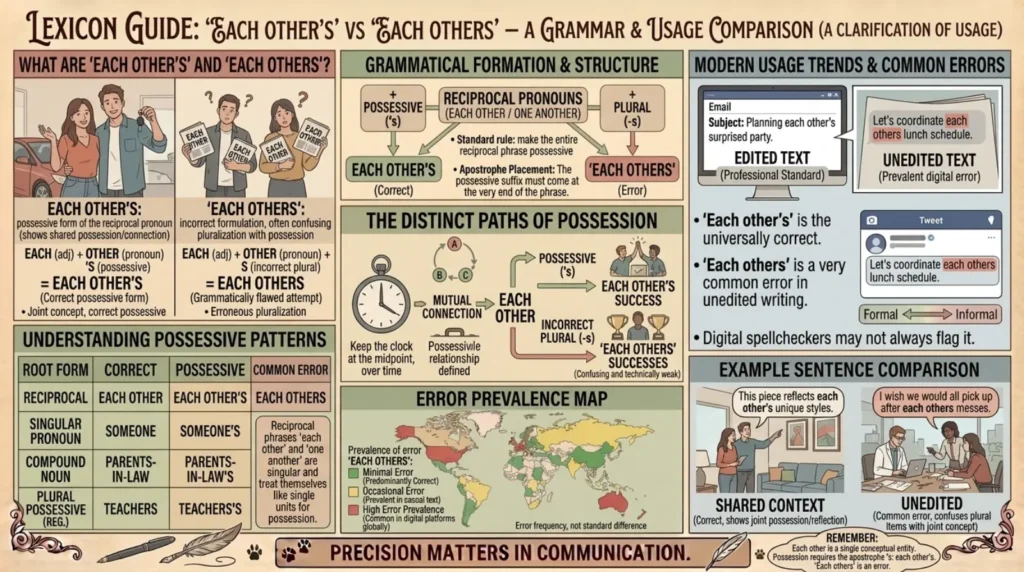
Each Others or Each Other’s: Comparison Table
| Phrase | Correct? | Meaning | Example |
|---|---|---|---|
| Each other | ✅ Yes | Reciprocal action | They love each other. |
| Each other’s | ✅ Yes | Reciprocal possession | They borrowed each other’s bikes. |
| Each others | ❌ No | Incorrect grammar | ❌ They used each others pens. |
Simple Grammar Rule to Remember
Think about one question.
Is someone owning something?
If the answer is No, use each other.
If the answer is Yes, use each other’s.
Easy Formula
Action = Each Other
- We support each other.
- They understand each other.
Ownership = Each Other’s
- We borrowed each other’s notes.
- They copied each other’s homework.
Real-Life Examples of Each Other and Each Other’s
School
- Students help each other.
- Students check each other’s answers.
Work
- Team members support each other.
- They review each other’s reports.
Home
- Brothers protect each other.
- They borrow each other’s clothes.
In Sports
- Players encourage each other.
- They celebrate each other’s success.
Common Mistakes People Make
Many writers confuse these forms.
Here are the most common mistakes.
Mistake 1
❌ They know each others names.
✅ They know each other’s names.
Mistake 2
❌ We respect each other’s.
✅ We respect each other.
No ownership exists here.
Mistake 3
❌ Friends help each others.
✅ Friends help each other.
Mistake 4
❌ They finished each other homework.
✅ They finished each other’s homework.
How to Remember the Difference
These tricks make the rule easy.
Trick 1
Look for ownership.
If something belongs to someone, use each other’s.
Trick 2
Think about apostrophes.
Apostrophes usually show possession.
Trick 3
Remove the noun.
Example:
They borrowed each other’s books.
Take away books.
Now you see the ownership more clearly.
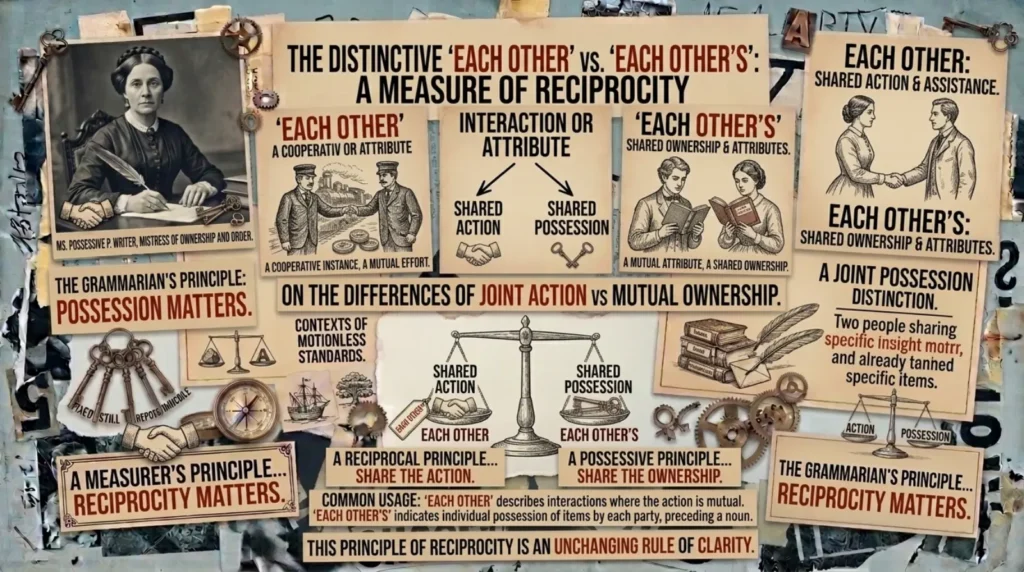
Each Other vs One Another
Many people also ask about this difference.
Traditionally:
- Each other refers to two people.
- One another refers to three or more people.
Modern English accepts both in most situations.
Examples
- John and Mary trust each other.
- The classmates help one another.
Both are correct in everyday English.
Daily Conversation Examples
Here are sentences you may hear every day.
- We understand each other.
- They miss each other.
- The children copied each other’s drawings.
- We exchanged each other’s gifts.
- They admire each other’s work.
- Friends encourage each other.
- Couples support each other.
- They learned from each other’s experiences.
- We respect each other’s opinions.
- They thanked each other.
Synonyms and Related Grammar Terms
Related Keywords
- reciprocal pronoun
- reciprocal possession
- English possessives
- apostrophe rules
- grammar mistakes
- possessive pronouns
- common English errors
- English writing tips
- grammar guide
- reciprocal expressions
Long-Tail Keywords
- each others or each other’s difference
- when to use each other’s
- is each others correct
- each other grammar rules
- examples of each other’s
- possessive reciprocal pronoun
- each other vs one another
- apostrophe in each other’s
Expert Insight
Professional editors recommend checking whether possession exists before choosing between these forms.
Many grammar mistakes happen because writers ignore the apostrophe.
Good grammar improves readability, builds trust, and helps your content rank better.
Clear writing also improves user experience.
When readers understand your message quickly, they stay longer on your page.
That improves SEO performance.
Featured Snippet Answer
Which is correct: each others or each other’s?
Each other’s is correct when showing possession.
Example:
“They borrowed each other’s books.”
Use each other when showing a shared action.
Example:
“They respect each other.”
Each others without an apostrophe is incorrect.
FAQs:
Is “each others” grammatically correct?
No.
Standard English does not accept each others.
When should I use “each other’s”?
Use it whenever you show possession.
Example:
“They borrowed each other’s laptops.”
What does “each other” mean?
It describes a mutual action between two or more people.
Can I use “each other” for more than two people?
Yes.
Modern English accepts it for groups as well.
Is “one another” better than “each other”?
Both are correct.
Traditional grammar separates them, but modern English often treats them the same.
Why does “each other’s” have an apostrophe?
The apostrophe shows possession.
Can I write “each others’?”
No.
That form is not standard.
How can I remember the rule?
Remember:
Action = each other
Ownership = each other’s
Internal Linking Suggestions
Consider linking this article to related grammar guides such as:
- Apostrophe Rules Explained
- Whose vs Who’s
- Everyone’s or Everyones
- Other vs Others
- Its vs It’s
- One Another vs Each Other
- Possessive Nouns Guide
Conclusion
Understanding each others or each other’s is easier than many people think. The key is to decide whether you are describing a shared action or showing possession. Use each other when people do something to one another. Use each other’s when something belongs to one another. Never write each others without an apostrophe because it is not correct in standard English. Learning this simple rule will improve your grammar, make your writing clearer, and help you avoid common mistakes. Whether you are writing emails, essays, blog posts, or social media updates, using the correct form shows attention to detail and builds confidence in your English skills. With regular practice, choosing the right expression will become natural every time.

James Carter is a comparison writer and research specialist with over 10 years of experience in digital publishing. With a background in business communication and consumer research, he creates detailed comparison articles, buying guides, and reviews that help readers make informed decisions with confidence. “Every comparison should help readers make better decisions. My goal is to turn complex information into clear, practical guidance that people can trust.” — James Carter