
Converse vs conversate is a common grammar question. Many people hear both words in daily speech. That makes it hard to know which one is correct.
The short answer is simple. Converse is the standard English verb. Conversate is a nonstandard word in formal English, but many people still use it in casual speech and some regional dialects.
Knowing the difference helps you speak and write with confidence. It also helps you avoid mistakes in school, business, and professional emails.
In this guide, you will learn the meaning of each word, when to use them, and why many dictionaries treat them differently. You will also see examples, a comparison table, grammar tips, and answers to common questions.
Quick Summary Box
Featured Snippet Answer
- Converse means to talk or have a conversation.
- Conversate also means to talk, but it is usually considered nonstandard.
- Use converse in formal writing.
- Use converse in academic, business, and professional communication.
- Conversate appears in some regional dialects and informal conversations.
- When in doubt, choose converse.
What Does “Converse” Mean?
Converse is a standard English verb. It means to talk with someone or exchange ideas through conversation.
Definition
Converse (verb):
To engage in conversation with another person.
Examples
- We like to converse after dinner.
- The teachers conversed about the new lesson plan.
- She can converse in three languages.
- Friends often converse over coffee.
The word sounds formal, but it is correct in every type of writing.
What Does “Conversate” Mean?
Conversate means to have a conversation. However, many grammar guides label it as nonstandard English.
That does not mean it is meaningless.
Many speakers use conversate in everyday speech. It has also appeared in African American English (AAE), regional American dialects, music, and popular culture.
Still, many editors and teachers recommend avoiding it in formal writing.
Examples
- We sat outside and conversated for hours.
- They love to conversate after church.
These sentences sound natural to many speakers. However, most style guides prefer converse.
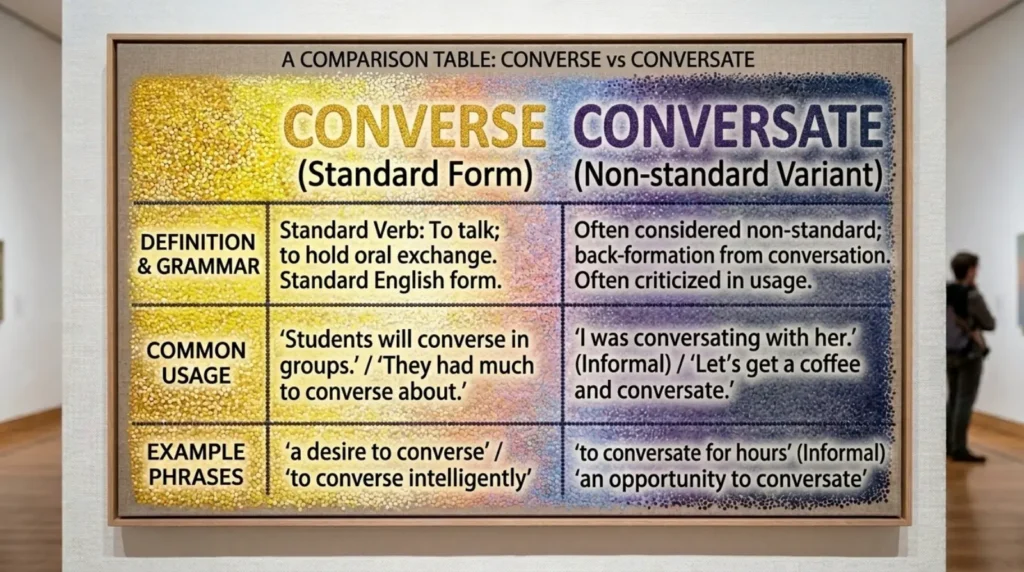
Converse vs Conversate: Key Difference
| Feature | Converse | Conversate |
|---|---|---|
| Standard English | ✅ Yes | ❌ Usually No |
| Formal writing | ✅ Yes | ❌ Avoid |
| Academic writing | ✅ Yes | ❌ Avoid |
| Business writing | ✅ Yes | ❌ Avoid |
| Informal speech | ✅ Yes | ✅ Common in some areas |
| Dictionary acceptance | Widely accepted | Listed but often marked nonstandard |
Winner
If you want safe and correct English, choose converse.
Why Do People Say “Conversate”?
Many people wonder why conversate exists.
The answer is language change.
People often create new words from existing ones. Since we have words like:
- educate
- communicate
- demonstrate
some speakers naturally formed conversate from conversation.
Although it became popular in some communities, grammar experts continued recommending converse.
Today, both words exist, but they do not have the same level of acceptance.
Is “Conversate” a Real Word?
Yes.
Many dictionaries include conversate because people use it.
However, they often add labels like:
- nonstandard
- informal
- dialectal
- chiefly regional
That means the word exists, but it is not recommended in formal English.
When Should You Use “Converse”?
Use converse whenever you write professionally.
Best situations
- School assignments
- College papers
- Business emails
- Reports
- Articles
- News writing
- Job applications
- Presentations
Examples
1.✅ We conversed about the project.
2.✅ The two leaders conversed privately.
3.✅ Students should converse respectfully.
When Can You Use “Conversate”?
You may hear conversate in:
- Casual conversations
- Songs
- Social media
- Regional dialects
- Informal storytelling
Examples
- We conversated all night.
- They like to conversate after work.
These are acceptable in casual settings where your audience understands the usage.
Real-Life Examples of Converse vs Conversate
At School
Teacher:
“Please converse quietly during group work.”
Not recommended:
“Please conversate quietly.”
At Work
Correct:
“We conversed about next year’s budget.”
Less formal:
“We conversated about the budget.”
With Friends
Friend:
“We sat outside and conversated until midnight.”
This sounds natural in some communities.
Others may simply say:
“We talked until midnight.”
In Writing
Correct:
“The author converses with readers through storytelling.”
Avoid:
“The author conversates with readers.”
Common Mistakes People Make
Mistake 1
❌ I conversated with my teacher.
✅ I conversed with my teacher.
Mistake 2
❌ We had a conversate.
✅ We had a conversation.
Mistake 3
❌ Let’s conversate professionally.
✅ Let’s converse professionally.
Mistake 4
❌ The article conversates about science.
✅ The article discusses science.
Simple Trick to Remember the Difference
Think about this:
Conversation → Converse
Not:
Conversation → Conversate
Another easy trick:
Professional writing = Converse
This simple rule works almost every time.
Synonyms for Converse
Use these words naturally in your writing.
Formal Synonyms
- communicate
- discuss
- speak
- talk
- exchange ideas
- interact
- engage in conversation
Informal Synonyms
- chat
- gossip
- catch up
- have a talk
- have a conversation
- talk things over
These related words improve SEO and make your writing sound more natural.
Converse vs Conversate in Daily Life
Here are common situations.
| Situation | Best Word |
|---|---|
| Business meeting | Converse |
| School essay | Converse |
| Job interview | Converse |
| News article | Converse |
| Friendly chat | Converse or Conversate |
| Social media | Either, depending on audience |
Expert Insight
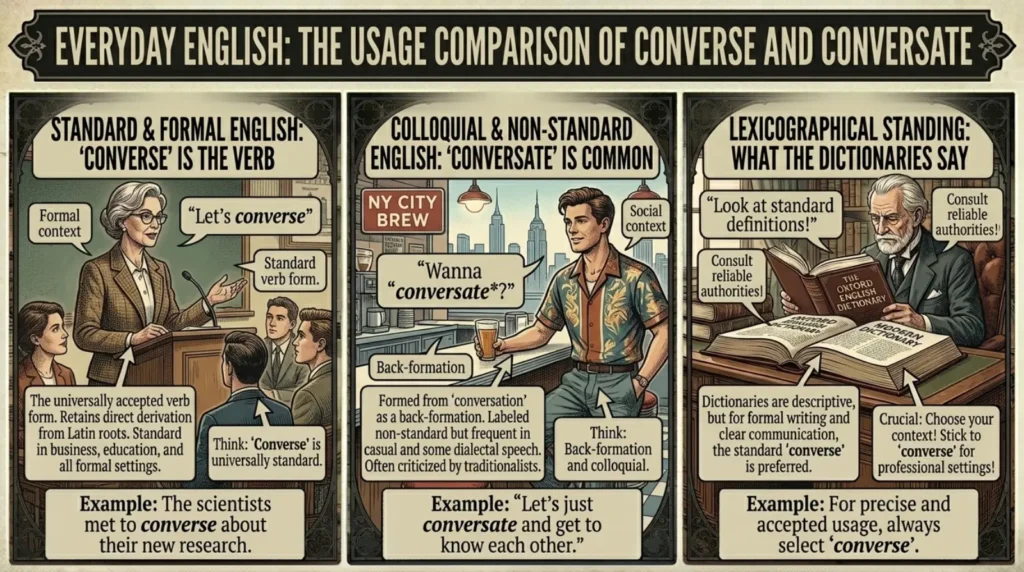
Professional editors almost always choose converse.
The reason is simple.
Readers expect standard English in formal writing.
Using converse improves clarity and credibility.
If you write blogs, business documents, or academic papers, stick with converse.
If you quote someone’s speech or write dialogue, conversate may reflect authentic language.
Good writing matches the audience.
Internal Linking Suggestions
Consider linking this article to related grammar guides, such as:
- Conversation vs Discussion
- Speak vs Talk
- Affect vs Effect
- Lay vs Lie
- Stationary vs Stationery
- Who’s vs Whose
- Everyday vs Every Day
- Further vs Farther
These related topics improve topical authority and user engagement.
FAQs:
Is converse or conversate correct?
Converse is the standard and preferred word. Conversate is considered nonstandard in formal English.
Is conversate in the dictionary?
Yes. Many dictionaries list it. However, they often label it as informal or nonstandard.
Why do people use conversate?
Many speakers use it because it sounds natural and follows patterns like “communicate” and “educate.”
Can I use conversate in business writing?
No. Use converse instead.
Is conversate grammatically wrong?
Not exactly. It exists in English, but many grammar experts recommend avoiding it in formal writing.
Which word should students use?
Students should use converse in essays, assignments, and exams.
Is conversate slang?
Not exactly. It is better described as a nonstandard or dialectal word rather than slang.
What’s the easiest alternative?
Simply use talk if you want very natural English.
Featured Snippet: Converse vs Conversate
| Question | Answer |
|---|---|
| Which is correct? | Converse |
| Is conversate a word? | Yes, but usually nonstandard |
| Which should I use in formal writing? | Converse |
| Which appears in casual speech? | Conversate |
| Best choice for professionals? | Converse |
SEO Keywords
Primary Keyword
- converse vs conversate
Secondary Keywords
- converse meaning
- conversate meaning
- converse or conversate
- is conversate a word
- converse definition
- conversate definition
- difference between converse and conversate
- converse examples
- conversate examples
- standard English verbs
- formal vs informal English
- grammar differences
- English vocabulary
- correct English usage
- common grammar mistakes
Conclusion
Understanding converse vs conversate is easier than it first appears. Both words mean to talk with someone, but they differ in how people view them. Converse is the standard English verb and works well in every situation, from classroom essays to business meetings and professional emails. Conversate exists and has a place in some regional dialects and casual conversations, but many editors and teachers still consider it nonstandard for formal writing.
When you want your writing to sound polished, clear, and professional, choose converse. If you hear conversate in everyday speech, remember that it reflects natural language use in some communities rather than standard grammar. By understanding your audience and choosing the right word, you can communicate with confidence and avoid common grammar mistakes.

Emma Collins is a language writer and grammar enthusiast specializing in English vocabulary, spelling comparisons, and word usage guides. She creates easy-to-understand content that helps readers improve their writing, communication, and language skills with confidence.