
Monies vs money is a common grammar question. Many people wonder if monies is a real word or just a mistake. The answer may surprise you.
Both words are correct. However, they have different meanings and uses. Most people use money in daily conversations. The word monies appears mainly in legal, financial, and accounting documents.
Learning the difference helps you write more clearly. It also prevents common grammar mistakes. Whether you are writing an email, school paper, or business report, knowing when to use each word makes your writing stronger.
This guide explains everything in simple English. You will learn meanings, grammar rules, real-life examples, common mistakes, and expert tips.
Quick Summary Box
- Money is the common word for cash or wealth.
- Monies is the plural form used in legal and financial writing.
- Use money in everyday conversations.
- Use monies only when talking about separate funds or financial sources.
- Money is an uncountable noun.
- Monies is a specialized countable noun.
- Most English learners only need money for daily use.
What Does “Money” Mean?
Money is anything people use to buy goods and services. It includes cash, coins, bank balances, and digital payments.
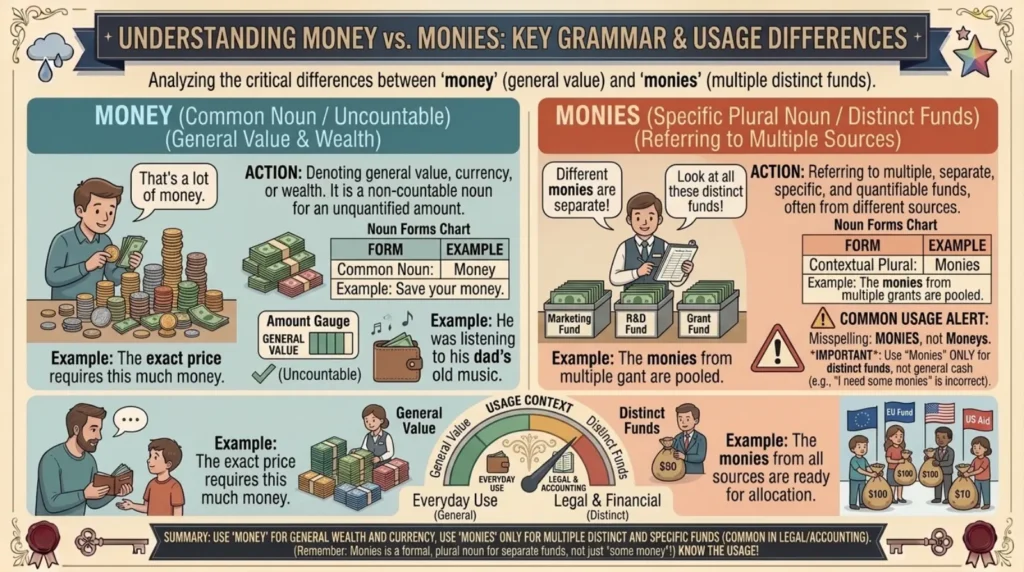
It is an uncountable noun. You do not normally say “one money” or “two monies” in everyday English.
Examples
- I need more money for college.
- She saved enough money for a new car.
- Money cannot buy happiness.
- They spent all their money on vacation.
In almost every normal conversation, money is the correct choice.
What Does “Monies” Mean?
Monies is a real English word. It is mostly used in legal, banking, accounting, and government writing.
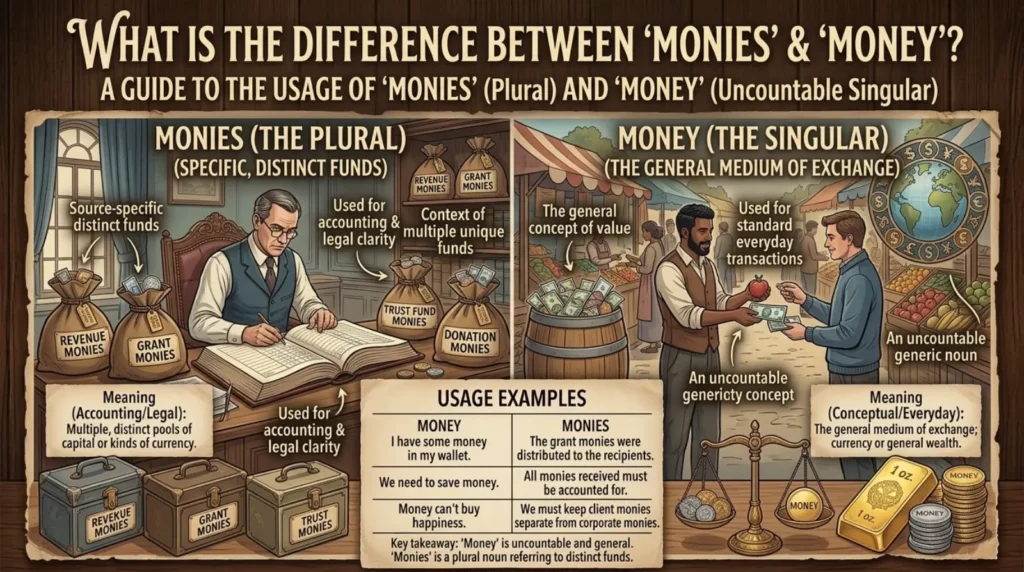
It refers to different sums, funds, or sources of money that are kept separate.
Examples
- The grant monies were distributed equally.
- Federal monies helped fund the project.
- Insurance monies arrived last week.
- The organization tracked all donated monies separately.
Outside professional writing, most native speakers rarely use this word.
Monies vs Money: Key Difference
The biggest difference is how the money is treated.
- Money means wealth or cash in general.
- Monies means separate pools or sources of funds.
For example:
✅ She saved money for retirement.
✅ The charity received monies from three different government programs.
The second sentence focuses on different funding sources rather than one general amount.
Monies vs Money Comparison Table
| Feature | Money | Monies |
|---|---|---|
| Meaning | Wealth or cash in general | Separate funds or financial sources |
| Grammar | Uncountable noun | Specialized plural noun |
| Daily conversation | Very common | Rare |
| Legal writing | Yes | Very common |
| Business documents | Common | Often used |
| Academic writing | Common | Sometimes used |
| Natural speech | Yes | Rarely |
| Example | I need more money. | Grant monies were approved. |
Why Is “Money” More Common?
English speakers usually think about money as one general idea.
That makes money an uncountable noun.
For example:
- Save money.
- Spend money.
- Earn money.
- Borrow money.
- Lose money.
These phrases sound natural because they refer to money as a whole.
When Should You Use “Monies”?
Use monies only when discussing separate financial amounts.
It often appears in:
- Government reports
- Legal contracts
- Accounting records
- Tax documents
- Financial audits
- Grant applications
- Public funding reports
Examples
- Grant monies funded the research.
- Trust monies remain protected.
- Settlement monies were released.
- Public monies must be used responsibly.
Real-Life Examples of Monies vs Money
Everyday Conversation
✅ I forgot my money at home.
❌ I forgot my monies at home.
Banking
✅ Your money is safe in the bank.
Government
✅ Public monies support education.
Charity
✅ Donation monies helped build the hospital.
Personal Finance
✅ She invests her money every month.
Business Accounting
✅ The company separated project monies for auditing.
Common Mistakes People Make
Mistake 1: Using “Monies” in Daily Speech
❌ I need more monies.
✅ I need more money.
Mistake 2: Thinking “Monies” Is Wrong
Many people believe monies is incorrect.
It is actually a recognized English word.
Mistake 3: Using “Monies” for One Amount
❌ The money in my wallet is my monies.
✅ The money in my wallet is my money.
Mistake 4: Replacing Every “Money” with “Monies”
Only use monies when discussing separate funds.
Easy Trick to Remember
Ask yourself one question.
Are you talking about money in general?
If yes, use money.
Are you talking about different funding sources or separate financial amounts?
If yes, use monies.
Memory Tip
Money = General cash
Monies = Multiple funding sources
Monies vs Money in Daily Life
Most people only need money.
Examples include:
- spending money
- saving money
- borrowing money
- making money
- losing money
- investing money
You will rarely hear monies in everyday conversations.
Instead, you may see it in:
- court documents
- government budgets
- nonprofit reports
- accounting records
Grammar Rules for Money and Monies
Money
- Uncountable noun
- General concept
- Everyday English
Example:
She earned more money this year.
Monies
- Specialized plural noun
- Refers to separate funds
- Formal English
Example:
Research monies came from several universities.
Synonyms and Related Words
Synonyms for Money
- Cash
- Funds
- Wealth
- Currency
- Income
- Capital
- Assets
- Finances
- Resources
Related Financial Terms
- Budget
- Investment
- Revenue
- Earnings
- Payment
- Deposit
- Finance
- Banking
- Treasury
- Funding
Expert Insight
Professional editors and grammar experts recommend using money in almost every situation.
Choose monies only when writing legal or financial documents that involve separate funds.
Using the correct word improves clarity. It also makes your writing sound more professional.
Simple language usually communicates ideas better than technical wording.
FAQs:
Is “monies” a real English word?
Yes. It is a correct English word used mainly in legal and financial contexts.
Which is more common, money or monies?
Money is much more common in everyday English.
Can I say “I need more monies”?
No. Say I need more money.
Why do lawyers use “monies”?
They often discuss different pools of funds. The word monies helps distinguish separate financial amounts.
Is “money” singular or plural?
It is an uncountable noun.
Can businesses use “monies”?
Yes. Businesses often use monies in accounting and financial reports.
Should students use “monies” in essays?
Usually no. Use money unless discussing legal or financial topics.
Is “monies” old-fashioned?
Not exactly. It remains common in legal, accounting, and government writing.
Featured Snippet: Monies vs Money
| Word | Best Use |
|---|---|
| Money | Everyday cash, wealth, and finances in general |
| Monies | Separate funds or financial sources in legal and accounting contexts |
Quick Answer: Use money for everyday English. Use monies only when referring to separate funds in formal financial or legal writing.
Internal Linking Suggestions
To strengthen your grammar website, consider linking this article to:
- Money vs Cash
- Finance vs Financial
- Affect vs Effect
- Lay vs Lie
- Everyday vs Every Day
- Stationary vs Stationery
- Who’s vs Whose
- Then vs Than
Conclusion
Understanding monies vs money is easier than many people think. Money is the standard word for cash, wealth, and financial resources. It works in almost every conversation and piece of everyday writing. Monies, on the other hand, has a specialized purpose. It refers to separate funds or distinct financial sources and appears mainly in legal, government, and accounting documents.
For most writers and English learners, money is the right choice. Use monies only when discussing multiple, separate pools of funds in formal contexts. By choosing the correct word, your writing becomes clearer, more accurate, and more professional. Remember this simple rule: general cash equals money, separate funding sources equal monies. This easy distinction will help you avoid mistakes and write with confidence.

James Carter is a comparison writer and research specialist with over 10 years of experience in digital publishing. With a background in business communication and consumer research, he creates detailed comparison articles, buying guides, and reviews that help readers make informed decisions with confidence. “Every comparison should help readers make better decisions. My goal is to turn complex information into clear, practical guidance that people can trust.” — James Carter