
Does or do is one of the most common grammar questions in English. Many learners use these words every day. However, they often choose the wrong one. The good news is that the rule is simple. Once you learn it, your speaking and writing will improve.
Both do and does are forms of the verb “to do.” They help form questions, negatives, and simple present sentences. The correct choice depends on the subject of the sentence.
In this guide, you will learn the meaning of does or do, easy grammar rules, comparison tables, real-life examples, common mistakes, and expert tips. By the end, you will know exactly when to use each word with confidence.
Quick Summary Box
- Do and does are present tense forms of the verb do.
- Use do with I, you, we, and they.
- Use does with he, she, and it.
- Both words help form questions and negative sentences.
- Remember: Singular = does. Plural = do.
- Correct grammar makes your English sound natural.
What Does “Do” Mean?
The word do is the base form of the verb to do.
It means:
- Perform an action
- Complete a task
- Help make questions
- Help make negative sentences
Examples
- I do my homework every day.
- They do their work on time.
- We do our best.
- Do you like coffee?
What Does “Does” Mean?
Does is the third-person singular form of do.
You use it with:
- He
- She
- It
- Singular names
Examples
- She does her homework.
- He does the dishes.
- My brother does exercise daily.
- Does Sarah play tennis?
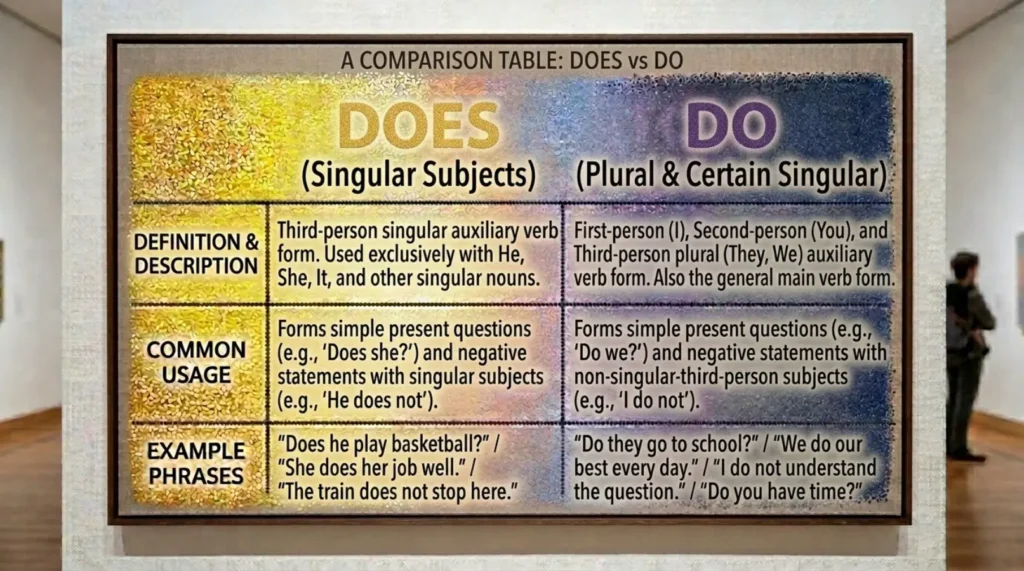
Does or Do: What’s the Difference?
The difference depends on the subject.
| Subject | Correct Word | Example |
|---|---|---|
| I | Do | I do my work. |
| You | Do | You do well. |
| We | Do | We do our homework. |
| They | Do | They do their jobs. |
| He | Does | He does his work. |
| She | Does | She does yoga. |
| It | Does | It does not matter. |
| John | Does | John does his homework. |
Simple Rule
- Singular subject → Does
- Plural subject → Do
When Should You Use “Do”?
Use do with plural subjects and the pronouns I and you.
Examples
- I do my homework.
- You do a great job.
- We do our shopping together.
- They do the cleaning.
Questions
- Do you like pizza?
- Do they play football?
- Do we have enough time?
Negative Sentences
- I do not know.
- They do not agree.
- We do not watch TV often.
When Should You Use “Does”?
Use does with third-person singular subjects.
Examples
- He does his homework.
- She does the cooking.
- It does make sense.
- Emma does her work carefully.
Questions
- Does he play soccer?
- Does she like music?
- Does your cat sleep all day?
Negative Sentences
- He does not like tea.
- She does not drive.
- It does not work.
Does or Do in Questions
Questions often begin with do or does.
Structure
Do + subject + base verb?
Does + subject + base verb?
Examples
Correct:
- Do you speak English?
- Do they live nearby?
- Does she work here?
- Does he like ice cream?
Incorrect:
- Does they play?
- Do he work?
- Does she likes pizza.
Remember:
After does, always use the base verb.
Correct:
- Does she like coffee?
Incorrect:
- Does she likes coffee?
Does or Do in Negative Sentences
Negative sentences also use do and does.
Examples
With Do
- I do not understand.
- They do not agree.
- We don’t know.
With Does
- He does not drive.
- She doesn’t cook.
- It doesn’t matter.
Real-Life Examples of Does or Do
Here are everyday examples.
At School
Teacher: Do you have your books?
Student: Yes, I do.
At Home
Mom: Does your brother clean his room?
Child: Yes, he does.
At Work
Manager: Do you need help?
Employee: No, I do not.
Shopping
Cashier: Does this card work?
Customer: Yes, it does.
Restaurant
Waiter: Do you want dessert?
Customer: Yes, I do.
Common Mistakes with Does or Do
Many learners make these errors.
Mistake 1
❌ He do homework.
✅ He does homework.
Mistake 2
❌ They does homework.
✅ They do homework.
Mistake 3
❌ Does she likes pizza?
✅ Does she like pizza?
Mistake 4
❌ Do he play football?
✅ Does he play football?
Mistake 5
❌ She don’t know.
✅ She doesn’t know.
Easy Tricks to Remember
These tricks make grammar easier.
Trick 1
Think:
He, She, It = Does
Trick 2
Think:
I, You, We, They = Do
Trick 3
After does, never add -s to the main verb.
Correct:
- Does he work?
Wrong:
- Does he works?
Trick 4
If the subject is one person, use does.
If the subject is more than one person, use do.
Does or Do in Daily Conversations
Native speakers use these words all day.
Asking Questions
- Do you drive?
- Does he cook?
- Do they live here?
- Does your sister work?
Giving Answers
- Yes, I do.
- No, I don’t.
- Yes, she does.
- No, he doesn’t.
Making Statements
- We do our best.
- She does her job well.
- They do great work.
- He does everything carefully.
Synonyms and Related Grammar Terms
Although do and does have specific grammar functions, these related words help you understand English better.
Related Words
- Perform
- Complete
- Carry out
- Execute
- Act
- Accomplish
- Manage
LSI Keywords
- do vs does
- when to use do
- when to use does
- grammar rules
- English grammar
- auxiliary verbs
- helping verbs
- present simple tense
- singular and plural verbs
- subject-verb agreement
Expert Insights
Grammar experts agree that subject-verb agreement is one of the first grammar skills every learner should master.
Learning does or do helps you:
- Ask better questions.
- Write clear sentences.
- Speak confidently.
- Avoid common grammar mistakes.
- Improve English exam scores.
- Communicate naturally.
Practice speaking these words every day. Small improvements lead to better fluency over time.
FAQs
Is it “do” or “does”?
Use do with I, you, we, and they. Use does with he, she, it, and singular nouns.
Why do we use “does”?
We use does because it matches third-person singular subjects in the present tense.
Do we say “does he plays”?
No.
Correct:
Does he play?
The main verb stays in its base form.
Can I use “do” with “she”?
No.
Use does with she.
Example:
She does her homework.
Which is correct: “Do your brother” or “Does your brother”?
Correct:
Does your brother…
“Brother” is singular.
Is “do” a helping verb?
Yes.
It is an auxiliary (helping) verb in questions and negative sentences.
Why doesn’t the verb end in -s after “does”?
Because does already shows the third-person singular form.
Example:
✔ Does he work?
✘ Does he works?
Featured Snippet Answer
What is the difference between “do” and “does”?
The difference between do and does depends on the subject. Use do with I, you, we, and they. Use does with he, she, it, and singular nouns. Both words are present tense forms of the verb to do and help form questions, negative sentences, and simple present statements.
Internal Linking Suggestions
To strengthen your grammar knowledge, consider linking this article with:
- Subject-Verb Agreement Rules
- Is vs Are Explained
- Has vs Have
- Was vs Were
- Their vs There vs They’re
- Do vs Make
- Simple Present Tense Guide
Conclusion
Understanding does or do becomes easy once you know the basic rule. Use do with I, you, we, and they. Use does with he, she, it, and singular nouns. This simple pattern helps you build correct questions, negative sentences, and everyday statements.
Practice these forms during daily conversations and writing exercises. Pay close attention to the subject before choosing do or does. Also, remember that after does, the main verb always stays in its base form. With regular practice, these grammar rules will become natural. Mastering does or do is a small step that leads to stronger English skills, clearer communication, and greater confidence in both speaking and writing.

James Carter is a comparison writer and research specialist with over 10 years of experience in digital publishing. With a background in business communication and consumer research, he creates detailed comparison articles, buying guides, and reviews that help readers make informed decisions with confidence. “Every comparison should help readers make better decisions. My goal is to turn complex information into clear, practical guidance that people can trust.” — James Carter