
Lead or led is one of the most confusing word pairs in English. Many people use these words incorrectly because they look and sound similar. However, they have different meanings and different jobs in a sentence.
The good news is that the difference is simple once you know the rule. Lead is usually the present tense. Led is the past tense of lead. Knowing when to use each word will improve your writing and speaking.
In this guide, you will learn the meaning of both words, see real-life examples, avoid common mistakes, and discover easy memory tricks. By the end, you will confidently know whether to write lead or led in any sentence.
Quick Summary
- Lead = present tense verb that means to guide.
- Led = past tense of lead.
- Lead can also be a noun that refers to a type of metal.
- Never write “leaded” as the past tense of lead.
- Led is always used for actions that already happened.
What Does “Lead” Mean?
The word lead has more than one meaning.
As a verb, it means:
- To guide someone
- To show the way
- To be in charge
- To direct others
Examples
- I lead the team every Monday.
- Good teachers lead by example.
- They lead the project together.
- She will lead tomorrow’s meeting.
As a noun, lead refers to a heavy metal.
Example
- Old pipes sometimes contain lead.
Notice that the metal is pronounced differently from the verb.
What Does “Led” Mean?
Led is the simple past tense and past participle of lead.
It describes an action that already happened.
Examples
- She led the meeting yesterday.
- Our coach led the team to victory.
- The guide led us through the forest.
- They led the discussion well.
Whenever the action happened in the past, use led.
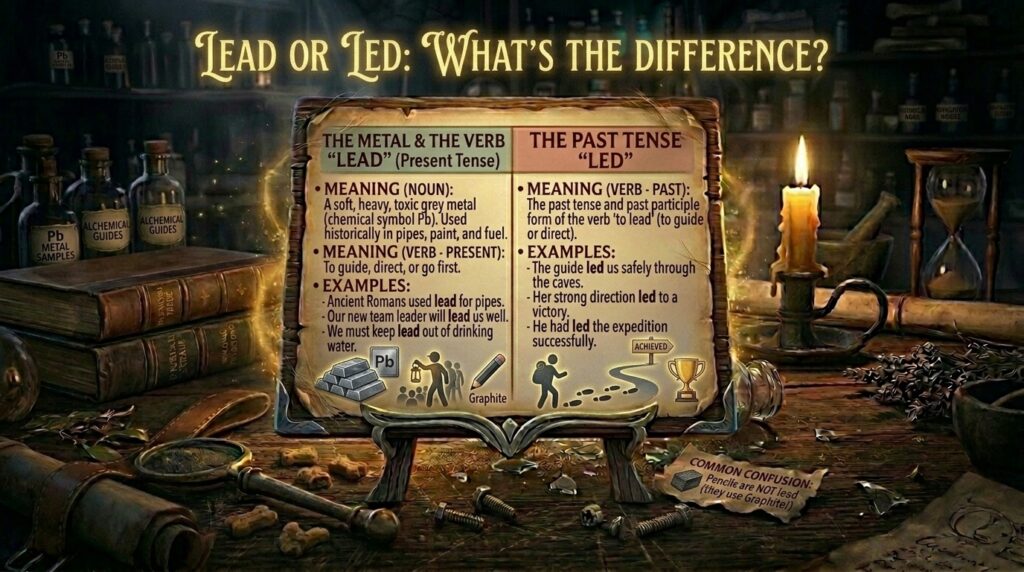
Lead or Led: What’s the Difference?
The biggest difference is the time of the action.
| Feature | Lead | Led |
|---|---|---|
| Part of speech | Verb (present), noun | Verb (past) |
| Time | Present or future | Past |
| Meaning | Guide or direct | Guided or directed |
| Example | I lead the group. | I led the group yesterday. |
Easy Rule
- Happening now → Lead
- Already happened → Led
How to Use Lead in Sentences
Use lead when talking about the present or future.
Examples
- I lead my class every morning.
- They lead the market today.
- We lead by helping others.
- She will lead the next project.
- Great leaders lead with honesty.
How to Use Led in Sentences
Use led when the action happened before now.
Examples
- He led the team last season.
- The teacher led the class yesterday.
- Our guide led us safely home.
- She led the discussion well.
- They led the company for years.
Real-Life Examples of Lead and Led
Here are examples you may hear every day.
At School
Present:
- Our teacher leads the science club.
Past:
- Our teacher led the science fair last year.
At Work
Present:
- Sarah leads the sales team.
Past:
- Sarah led yesterday’s meeting.
In Sports
Present:
- The captain leads the team.
Past:
- The captain led the team to the championship.
During Travel
Present:
- The guide leads visitors through the museum.
Past:
- The guide led us to the castle.
Why Do People Confuse Lead and Led?
Many learners struggle because of pronunciation.
The verb lead sounds like “leed.”
The noun lead (the metal) sounds like “led.”
This difference makes writing confusing.
Remember this simple fact:
- Lead (verb) → sounds like leed
- Led (past tense) → sounds like led
- Lead (metal) → sounds like led
Context tells you which meaning is correct.
Common Mistakes with Lead and Led
Many writers make these mistakes.
❌ Incorrect
- Yesterday I lead the meeting.
✅ Correct
- Yesterday I led the meeting.
❌ Incorrect
- She has lead the team for years.
✅ Correct
- She has led the team for years.
❌ Incorrect
- They lead us yesterday.
✅ Correct
- They led us yesterday.
❌ Incorrect
- He lead the race last week.
✅ Correct
- He led the race last week.
Easy Tricks to Remember Lead or Led
Learning becomes easier with memory tricks.
Trick 1
Lead = Now
Think of today’s leader.
Trick 2
Led = Already Done
The action has ended.
Trick 3
Yesterday always matches led.
Example:
Yesterday → led
Today → lead
Trick 4
If you can replace the word with “guided yesterday,” choose led.
Lead and Led in Daily Life
You use these words more often than you think.
School
- Our teacher leads every lesson.
- She led last week’s workshop.
Business
- He leads the company.
- He led the company through hard times.
Sports
- The coach leads practice.
- The coach led the team to victory.
Family
- Mom leads family discussions.
- Dad led the vacation planning.

Synonyms and Related Words
Synonyms for Lead
- Guide
- Direct
- Manage
- Control
- Head
- Supervise
- Conduct
- Command
- Organize
- Influence
Related Keywords (LSI)
- lead vs led
- when to use lead
- when to use led
- lead meaning
- led meaning
- lead grammar
- past tense of lead
- English grammar guide
- lead examples
- led examples
Expert Insight: Why This Grammar Rule Matters
Good grammar builds trust.
Using lead and led correctly makes your writing look professional.
Teachers, employers, and readers notice small grammar mistakes. Correct usage also improves communication because readers understand your meaning quickly.
If you write blogs, emails, reports, or school assignments, mastering this simple grammar rule will strengthen your English.
The best way to remember it is to practice with real sentences every day.
FAQs
Is it lead or led yesterday?
Use led.
Example:
Yesterday, she led the meeting.
What is the past tense of lead?
The past tense of lead is led.
Is lead ever correct in the past?
No.
Use led for past actions.
Why is lead pronounced differently?
The verb and the metal have different pronunciations even though they share the same spelling.
Is “leaded” a real word?
Leaded exists in special cases like leaded gasoline, but it is not the past tense of lead.
How do I remember lead and led?
Remember:
- Today = lead
- Yesterday = led
Can lead be a noun?
Yes.
It can refer to the metal lead.
Which is more common in business writing?
Both are common.
Use lead for present actions and led for completed actions.
Featured Snippet: Lead vs Led
Lead is the present tense verb that means to guide or direct someone. Led is the past tense and past participle of lead. Use lead for actions happening now or in the future, and use led for actions that already happened.
Internal Linking Suggestions
To strengthen your grammar content cluster, link this article to:
- Chose vs Choose
- Other or Others
- Youth or Youths
- Nosey vs Nosy
- Consigner or Consignor
- Business or Bussiness
- Monies or Moneys
Conclusion
Understanding lead or led becomes easy once you remember one simple rule. Lead describes present or future actions, while led describes actions that happened in the past. Although the spelling can confuse many learners, regular practice will help you choose the correct word every time.
Use real-life examples, remember the “today versus yesterday” trick, and check the time of the action before writing. These small habits can greatly improve your grammar and make your writing clearer. Whether you write emails, blog posts, school assignments, or business reports, using lead and led correctly will help you communicate with confidence.

Emma Collins is a language writer and grammar enthusiast specializing in English vocabulary, spelling comparisons, and word usage guides. She creates easy-to-understand content that helps readers improve their writing, communication, and language skills with confidence.