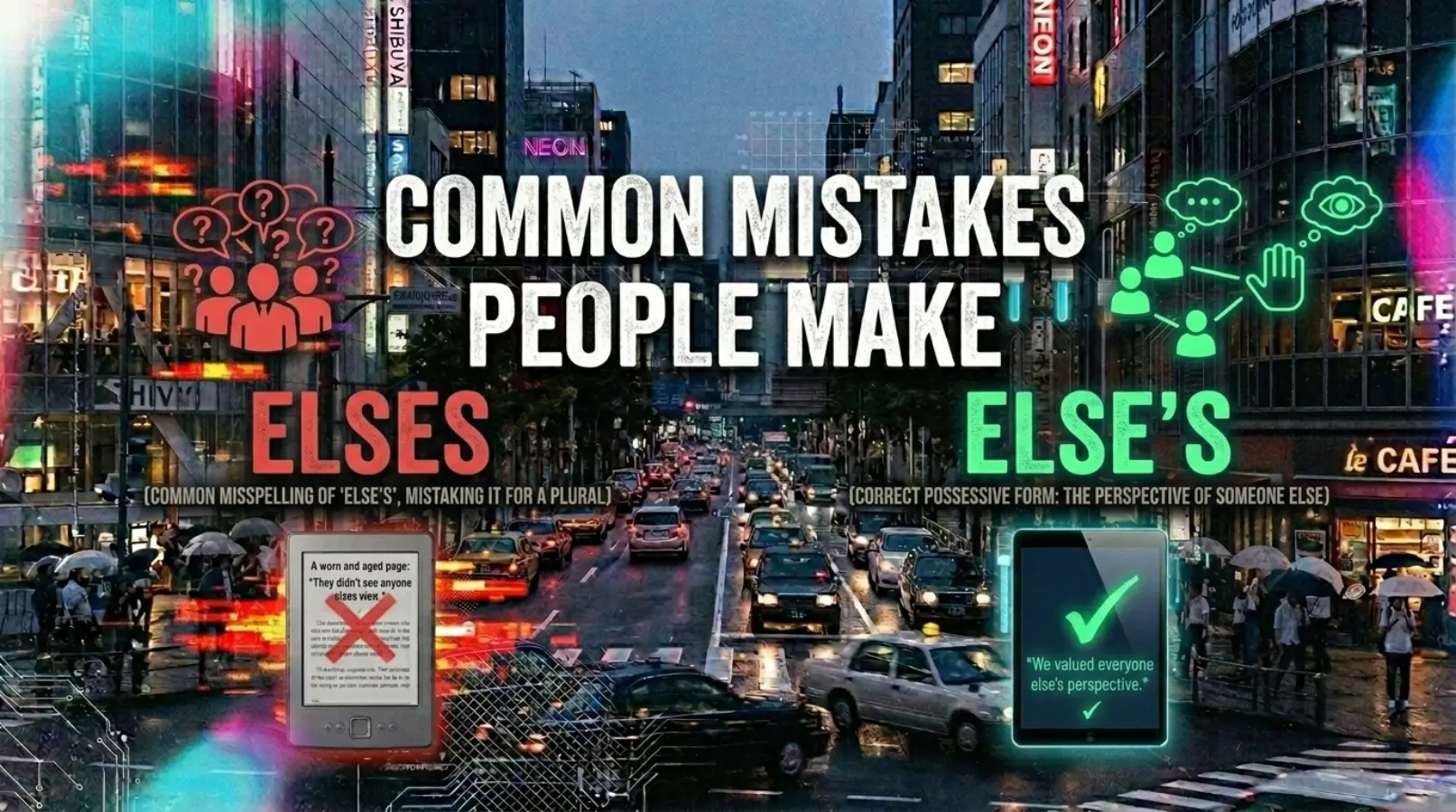
Elses or else’s is a common grammar question that confuses many English writers. At first glance, both forms may seem correct. However, they have different meanings and uses.
Many people struggle when writing phrases like “someone else’s book” or wondering whether “elses” is even a real word. The confusion often comes from possessive rules and unusual word forms.
The good news is that the difference is easy to understand. Once you learn the basic rule, you can avoid this mistake forever.
In this guide, you’ll learn the meaning of elses and else’s, see real-life examples, compare the two forms, and discover simple tricks to remember the correct usage.
Quick Summary Box
Featured Snippet Answer
- Else’s is the possessive form of else.
- It means something belongs to another person or thing.
- Example: That is someone else’s phone.
- Elses is the plural form of else, but it is very rare.
- Most English speakers use else’s far more often than elses.
- If you mean ownership, use else’s.
- If you mean more than one “else,” use elses.
What Do “Elses” and “Else’s” Mean?
Although they look similar, they serve different purposes.
Else’s
Else’s shows possession.
It means something belongs to another person, place, or thing.
Examples:
- That is someone else’s jacket.
- I accidentally took somebody else’s seat.
- We used someone else’s idea.
Elses
Elses is the plural form of else.
It refers to multiple “others” or additional things. However, this form appears very rarely in modern English.
Examples:
- The teacher asked students to list possible elses.
- The discussion focused on many different elses.
Most people rarely need to use elses in everyday writing.
Is “Elses” a Real Word?
Yes, elses is technically a real word.
Many dictionaries recognize it as the plural of else. However, native English speakers seldom use it.
In most situations, writers choose alternative wording such as:
- other options
- alternatives
- additional choices
- other possibilities
For this reason, you may go years without seeing elses in normal conversation.
What Does “Else’s” Mean?
Else’s means ownership or possession.
The apostrophe shows that something belongs to someone else.
Examples:
- This is somebody else’s backpack.
- That was someone else’s responsibility.
- We parked in somebody else’s driveway.
Whenever ownership exists, else’s is usually the correct choice.
Else’s vs Elses: Comparison Table
| Feature | Else’s | Elses |
|---|---|---|
| Part of Speech | Possessive form | Plural form |
| Meaning | Belonging to another person or thing | More than one “else” |
| Common Usage | Very common | Very rare |
| Contains Apostrophe | Yes | No |
| Example | Someone else’s car | Several elses were discussed |
| Used in Daily English | Frequently | Almost never |
When Should You Use “Else’s”?
Use else’s whenever you want to show ownership.
Common Patterns
Someone Else’s
- That’s someone else’s laptop.
- I found someone else’s keys.
Somebody Else’s
- She borrowed somebody else’s notebook.
- We used somebody else’s recipe.
Anyone Else’s
- Is this anyone else’s bag?
- I don’t want anyone else’s opinion.
Nobody Else’s
- This is nobody else’s problem.
- The mistake was nobody else’s fault.
These phrases appear regularly in spoken and written English.
When Should You Use “Elses”?
Use elses only when referring to multiple “elses.”
Examples:
- The author explored several elses in the story.
- The research included many possible elses.
Even in these situations, writers often choose clearer alternatives.
For example:
Instead of:
- There were many elses to consider.
Most writers prefer:
- There were many alternatives to consider.
Real-Life Examples of Else’s
Here are common examples you may hear every day.
At School
- I picked up someone else’s notebook.
- That’s somebody else’s desk.
At Work
- Don’t open someone else’s email.
- We used somebody else’s presentation template.
At Home
- Is this someone else’s charger?
- The dog ate somebody else’s sandwich.
While Shopping
- I accidentally grabbed someone else’s cart.
- That belongs to somebody else’s family.
These examples show why else’s appears much more often than elses.

Common Mistakes People Make
Mistake #1: Using Elses Instead of Else’s
Incorrect:
❌ That’s someone elses phone.
Correct:
✅ That’s someone else’s phone.
Mistake #2: Forgetting the Apostrophe
Incorrect:
❌ I used somebody elses idea.
Correct:
✅ I used somebody else’s idea.
Mistake #3: Adding an Apostrophe to a Plural
Incorrect:
❌ The elses’ were confusing.
Correct:
✅ The elses were confusing.
Remember, apostrophes show possession, not simple plurals.
Easy Trick to Remember the Difference
Try this simple rule:
Ownership = Apostrophe
If something belongs to another person, use else’s.
Example:
- Someone else’s house
- Somebody else’s book
More Than One = No Apostrophe
If you somehow need the plural form, use elses.
Example:
- Several elses were discussed.
Most of the time, you’ll need else’s.
Why Does This Grammar Rule Confuse People?
The word else already feels unusual.
Unlike regular nouns, it often appears after words such as:
- someone
- somebody
- anyone
- everyone
- nobody
When possession enters the sentence, many writers become unsure where to place the apostrophe.
Correct:
- someone else’s car
Incorrect:
- someone’s else car
The apostrophe attaches to else, not to someone.
Synonyms and Related Terms
These words often appear in searches related to elses or else’s:
Synonyms for Else
- other
- additional
- different
- alternative
- remaining
- extra
Related Grammar Terms
- possessive nouns
- apostrophe rules
- English grammar
- plural nouns
- ownership words
- grammar mistakes
- possessive forms
These related terms help writers understand the concept more clearly.
Usage in Daily Life
You will encounter else’s frequently in everyday situations.
Examples:
- someone else’s password
- somebody else’s opinion
- someone else’s property
- someone else’s mistake
- somebody else’s responsibility
By contrast, elses rarely appears in normal conversations.
Most people can speak and write English for years without needing it.
Expert Insight: Why This Difference Matters
Grammar experts recommend learning possessive forms early because they improve writing clarity.
Using else’s correctly helps readers understand ownership instantly.
Incorrect punctuation can create confusion and make writing appear less professional.
For students, bloggers, business professionals, and content creators, mastering small grammar details builds credibility and trust.
Although elses is technically correct in specific situations, most writers should focus on understanding else’s because it appears far more often.FAQs
Is it else’s or elses?
Both exist, but they mean different things. Else’s shows possession, while elses is a rare plural form.
Is “someone else’s” grammatically correct?
Yes. It is the correct possessive form.
Can I write “someone elses”?
No. You need an apostrophe.
Correct: someone else’s
Is “elses” commonly used?
No. It is rare in modern English.
Why does else’s have an apostrophe?
The apostrophe shows ownership or possession.
What is an example of else’s?
Example: That is somebody else’s backpack.
What is an example of elses?
Example: The discussion included several elses.
Which form do native speakers use more?
Native speakers use else’s much more frequently than elses.
Internal Linking Suggestions
Consider linking this article to:
- Apostrophe Rules in English Grammar
- Someone’s vs Someones
- Its vs It’s
- Whose vs Who’s
- Anybody vs Anybody’s
- Possessive Nouns Explained
- Common Grammar Mistakes in English
Conclusion
Understanding elses or else’s becomes simple once you know the difference. Else’s is the possessive form and shows ownership. It appears in common phrases like someone else’s phone or somebody else’s idea. Elses, on the other hand, is the plural form of else, but people rarely use it in everyday English.
If you are talking about something that belongs to another person, choose else’s. If you somehow need the plural form of else, use elses. In most situations, the correct choice will be else’s.
Remember one easy rule: ownership needs an apostrophe. Following this rule will help you write with confidence and avoid one of the most common English grammar mistakes.