
Favorites or favourites is a common spelling question in English. Many people see both words and wonder which one is correct. The simple answer is that both spellings are correct. However, each version belongs to a different type of English.
American English uses favorites, while British English uses favourites. The meaning stays exactly the same. The difference only comes from regional spelling rules.
Understanding this distinction helps you write more clearly. It also helps you match your audience’s expectations. Whether you write blogs, emails, school papers, or social media posts, choosing the right spelling matters.
In this guide, you will learn the meaning, differences, examples, common mistakes, and expert tips for using favorites or favourites correctly.
Quick Summary Box
- Favorites is the American English spelling.
- Favourites is the British English spelling.
- Both words have the same meaning.
- They refer to things or people you like most.
- Choose the spelling based on your audience.
- Do not mix both spellings in one document.
- American websites usually use favorites.
- British, Canadian, Australian, and New Zealand English often use favourites.
What Does Favorites or Favourites Mean?
The words favorites and favourites refer to people, places, things, foods, books, movies, or activities that someone likes best.
Simple Definition
A favorite is something you enjoy more than other options.
Examples
- Pizza is my favorite food.
- This is one of my favorite movies.
- Blue is her favorite color.
- That book is among my favourites.
The meaning remains identical regardless of spelling.
Favorites or Favourites: The Main Difference
The only difference is spelling.
| Word | English Style | Meaning |
|---|---|---|
| Favorites | American English | Things you like best |
| Favourites | British English | Things you like best |
The pronunciation stays the same.
Easy Rule
- Writing for the United States? Use favorites.
- Writing for the United Kingdom? Use favourites.
Why Are There Two Different Spellings?
English evolved differently across countries.
American English simplified many words by removing extra letters. British English kept older spellings.
Examples include:
| American English | British English |
|---|---|
| Favorite | Favourite |
| Color | Colour |
| Honor | Honour |
| Neighbor | Neighbour |
| Flavor | Flavour |
This pattern explains why favorites and favourites both exist today.
How to Use Favorites in American English
Americans prefer the spelling favorites.
Examples
- Add this page to your favorites.
- These are my favorite songs.
- She listed her favorite books.
- The restaurant serves local favorites.
Most American websites, apps, and publications follow this spelling.
How to Use Favourites in British English
British English uses favourites.
Examples
- These are my favourite football teams.
- Fish and chips remain local favourites.
- She shared her favourite recipes.
- The museum displays visitor favourites.
Many British publications use this version consistently.
Real-Life Examples of Favorites and Favourites
Seeing both spellings in context makes the difference easier to understand.
American Examples
- My favorite actor won an award.
- Chocolate is my favorite dessert.
- Save your favorites for later.
British Examples
- My favourite actor won an award.
- Tea is one of my favourite drinks.
- Readers voted for their favourites.
Notice that only the spelling changes.
Favorites vs Favourites Comparison Table
| Feature | Favorites | Favourites |
|---|---|---|
| Correct Spelling | Yes | Yes |
| Meaning | Same | Same |
| Pronunciation | Same | Same |
| Used In | United States | United Kingdom |
| Common Online Usage | American websites | British websites |
| Grammar | Noun | Noun |
| Audience | American readers | British readers |
Common Mistakes People Make
Many writers accidentally misuse these spellings.
1. Mixing Spellings
Incorrect:
- My favorite colour is blue.
Correct:
- My favorite color is blue.
- My favourite colour is blue.
Stay consistent.
2. Assuming One Is Wrong
Both spellings are correct.
3. Ignoring Audience Location
Choose the spelling that matches your readers.
4. Switching Mid-Article
Use one style throughout the entire document.
Tips to Remember the Correct Spelling
Use these simple tricks.
Remember “U” for the UK
British English often includes the letter u.
Examples:
- Favourite
- Colour
- Honour
- Neighbour

Remember Simpler American Spellings
American English often removes the extra u.
Examples:
- Favorite
- Color
- Honor
- Neighbor
This pattern makes the choice easy.
When Should You Use Favorites or Favourites?
The answer depends on your audience.
Use Favorites When:
- Writing for American readers
- Creating U.S.-based websites
- Publishing content for American businesses
- Following American style guides
Use Favourites When:
- Writing for British readers
- Publishing UK content
- Following British style guides
- Creating content for British schools or organizations
Usage in Daily Life
People use these words every day.
Food
- Pizza is my favorite meal.
- Curry is one of my favourite dishes.
Entertainment
- This is my favorite movie.
- These are my favourite TV shows.
Sports
- The team remains a fan favorite.
- Several favourites entered the tournament.
Shopping
- Customers can save favorite products.
- Shoppers often bookmark their favourite items.
Synonyms and Related Words
Using related words improves writing variety and SEO.
Synonyms
- Preferred
- Best-loved
- Top choice
- Most liked
- Beloved
- Popular
- Cherished
- Selected
Related Search Terms
- favorite or favourite
- favorite spelling
- favourite spelling
- American vs British English
- favorite meaning
- favourite meaning
- favorite examples
- favourite examples
- spelling differences in English
- favorite and favourite difference
Why Consistency Matters in Writing
Consistency improves readability.
Readers expect one spelling style throughout a document.
For example:
Consistent American Style
- favorite
- color
- neighbor
Consistent British Style
- favourite
- colour
- neighbour
Mixing styles can make writing look unprofessional.
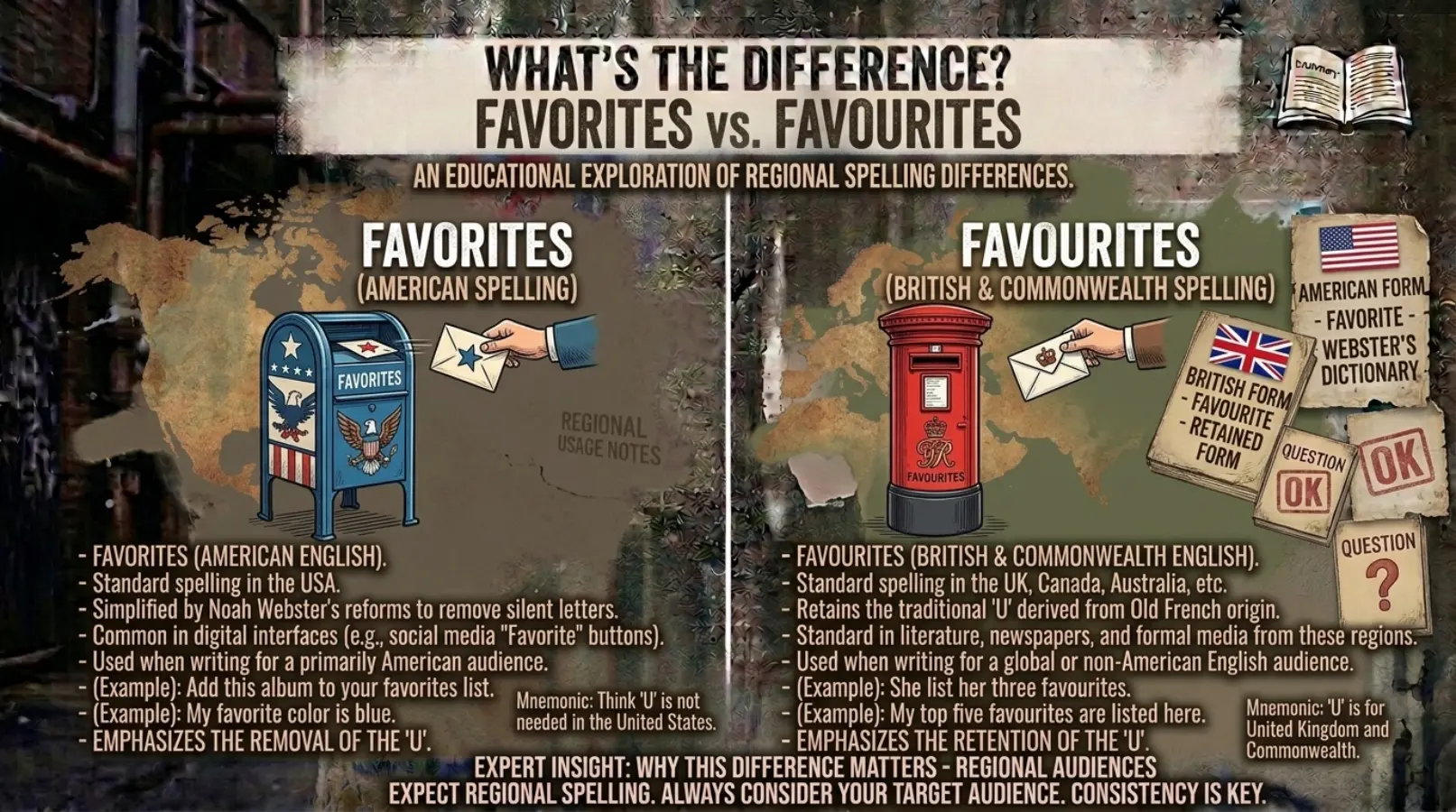
Expert Insight: Why This Difference Matters
Professional writers always consider audience location.
A U.S. audience expects American spelling. A UK audience expects British spelling.
Search engines also recognize regional spelling preferences. Matching your audience can improve user experience and engagement.
For SEO content, use the spelling your target readers search for most often.
If your audience is global, consider mentioning both versions early in the article.
This approach improves relevance and helps readers find answers faster.
FAQs:
Is favorites or favourites correct?
Both are correct. Favorites is American English, while favourites is British English.
What is the difference between favorites and favourites?
The only difference is spelling. Their meaning is identical.
Which spelling should I use?
Use the version that matches your audience.
Is favourites used in Canada?
Yes. Canadian English often follows British spelling patterns, including favourites.
Do favorites and favourites have different pronunciations?
No. Both words sound the same.
Why does British English use “ou”?
British English keeps older spellings that include “ou.”
Can I use both spellings in one article?
It is better to choose one style and stay consistent.
Which spelling is better for SEO?
Use the spelling your target audience searches for most often.
Internal Linking Suggestions
You can internally link this article to:
- Favorite vs Favourite
- Color vs Colour
- Neighbor vs Neighbour
- Honor vs Honour
- American vs British English Differences
- Common English Spelling Mistakes
- English Grammar Rules
- Writing Tips for Beginners
Conclusion
The debate over favorites or favourites is simpler than many people think. Both spellings are correct, and both mean the same thing. The only difference comes from regional English usage. American English prefers favorites, while British English prefers favourites.
The best choice depends on your audience. If you write for American readers, use favorites. If you write for British readers, use favourites. Most importantly, stay consistent throughout your writing.
Understanding these spelling differences helps you communicate clearly and professionally. Now that you know the rule, choosing between favorites or favourites becomes easy every time you write.

Michael Reed is a language content writer and word comparison researcher based in the United States. He studied English Language and Communication and focuses on grammar, spelling differences, and word usage. His work helps readers understand confusing English words through clear comparisons and practical explanations. Michael creates simple, reader-friendly content designed to improve everyday language skills.