
Farthest vs furthest is a common grammar question that confuses many English learners and native speakers. Both words describe distance, but they are not always used in the same way. Knowing the difference helps you write and speak more clearly.
The good news is that the rules are simple. In many cases, people use both words in everyday English. However, each word has its own traditional meaning.
This guide explains everything in simple English. You will learn the meanings, grammar rules, examples, common mistakes, and easy tips to remember the difference. By the end, you will know exactly when to use farthest and when to use furthest.
Quick Summary Box
- Farthest usually refers to physical distance.
- Furthest often refers to figurative or abstract distance.
- Both words are superlative forms of far.
- In modern English, many people use them interchangeably.
- Use farthest for places and measurable distances.
- Use furthest for progress, ideas, goals, or discussions.
- Both forms are grammatically correct.
What Does “Farthest” Mean?
Farthest means the greatest physical distance from a starting point.
It usually describes places, roads, cities, buildings, or objects.
Examples
- Alaska is the farthest state from Florida.
- Which hotel is the farthest from the airport?
- She threw the ball the farthest.
- We walked to the farthest corner of the park.
- His house is the farthest on this street.
What Does “Furthest” Mean?
Furthest often means the greatest degree, progress, or stage instead of physical distance.
It usually describes ideas, goals, learning, or discussions.
Examples
- She is the furthest along in the project.
- Let’s take this idea furthest.
- We need to look into this matter further.
- His research reached the furthest stage.
- Their team made the furthest progress.
Farthest vs Furthest: Key Difference
Although many dictionaries accept both words in most situations, traditional grammar separates them by meaning.
| Feature | Farthest | Furthest |
|---|---|---|
| Main meaning | Physical distance | Figurative distance or progress |
| Used for places | Yes | Sometimes |
| Used for ideas | Rarely | Yes |
| Used in travel | Yes | Less common |
| Used in projects | No | Yes |
| Modern usage | Often interchangeable | Often interchangeable |
Simple Rule
- Physical distance = Farthest
- Ideas, progress, or time = Furthest
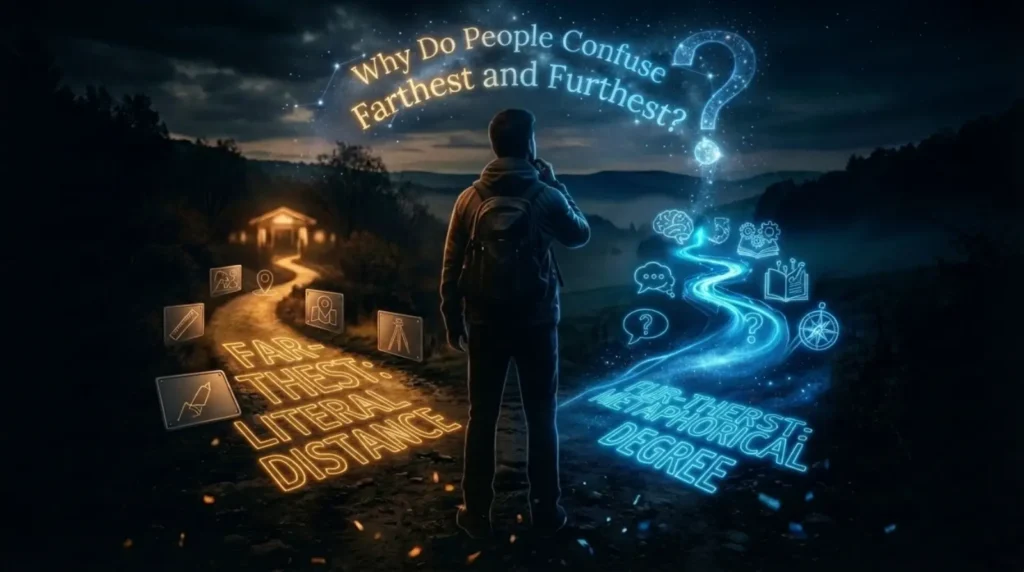
Why Do People Confuse Farthest and Furthest?
There are several reasons.
- Both come from the word far.
- Both are accepted in many dictionaries.
- Native speakers often use them the same way.
- British and American English show little difference today.
Because of this, confusion is very common.
Real-Life Examples of Farthest vs Furthest
At School
Correct:
- Which classroom is the farthest from the library?
- Emily is the furthest ahead in math.
During Travel
Correct:
- Japan was the farthest country I visited.
- Our guide took us to the farthest beach.
At Work
Correct:
- Sarah is the furthest along with the report.
- This idea could take us the furthest.
In Sports
Correct:
- Tom jumped the farthest.
- Lisa advanced the furthest in the tournament.
When Should You Use Farthest?
Use farthest when talking about measurable physical distance.
Examples include:
- Roads
- Cities
- Mountains
- Buildings
- Countries
- Walking distance
- Driving distance
Examples
- That store is the farthest away.
- Which city is the farthest north?
- The runner reached the farthest point.
When Should You Use Furthest?
Use furthest when talking about progress, time, ideas, goals, or development.
Examples
- We took the discussion the furthest.
- She made the furthest progress.
- The project reached its furthest stage.
- This plan goes the furthest toward solving the problem.
Common Mistakes to Avoid
Many writers make these mistakes.
Mistake 1
❌ She is the farthest ahead in her studies.
✅ She is the furthest ahead in her studies.
Mistake 2
❌ Which city is the furthest from London?
✅ Which city is the farthest from London?
Mistake 3
Thinking the words always have different meanings.
Modern English allows both in many situations.
Easy Trick to Remember
Remember this simple tip.
Farthest = Feet
Feet travel physical distances.
Furthest = Future
Future means progress or development.
This memory trick helps many learners.
Farthest vs Furthest in Daily Conversations
People often use both words naturally.
Examples:
- That’s the farthest I’ve ever driven.
- This is the furthest I’ve gone in my career.
- Which restaurant is the farthest away?
- We’ve gone the furthest we can today.
In casual speech, most people understand either word.
Synonyms and Related Words
Farthest
- Most distant
- Remote
- Furthest
- Outermost
- Extreme
Furthest
- Greatest
- Most advanced
- Highest
- Most developed
- Most distant
Related LSI Keywords
- difference between farthest and furthest
- farthest meaning
- furthest meaning
- far vs farther vs further
- farther vs further
- grammar rules
- English vocabulary
- common grammar mistakes
- physical distance
- figurative distance
- superlative of far
- English writing tips
Expert Insights
Grammar experts agree that both words are correct.
Traditional English uses:
- Farthest for measurable distance.
- Furthest for figurative meaning.
However, modern dictionaries accept overlap because language changes over time.
For formal writing, following the traditional distinction makes your writing clearer and more professional.
Writers, students, and professionals benefit from using each word in its strongest context.
FAQs:
Is farthest or furthest correct?
Both are correct. Their traditional uses differ slightly.
What is the difference between farthest and furthest?
Farthest usually refers to physical distance. Furthest often refers to progress or abstract ideas.
Can I use furthest for distance?
Yes. Modern English often allows it. However, farthest is still preferred for measurable distance.
Which is more common in American English?
Both appear frequently. Many style guides still recommend using farthest for physical distance.
Is farthest more formal?
No. Both words are equally acceptable in formal writing.
Which word should students use?
Follow the traditional rule:
- Physical distance → Farthest
- Figurative meaning → Furthest
This keeps your writing clear.
Is “furthest away” correct?
Yes. It is grammatically correct, although “farthest away” may sound more natural when discussing actual locations.
Are farthest and furthest interchangeable?
Often, yes. Still, choosing the traditional form improves precision.
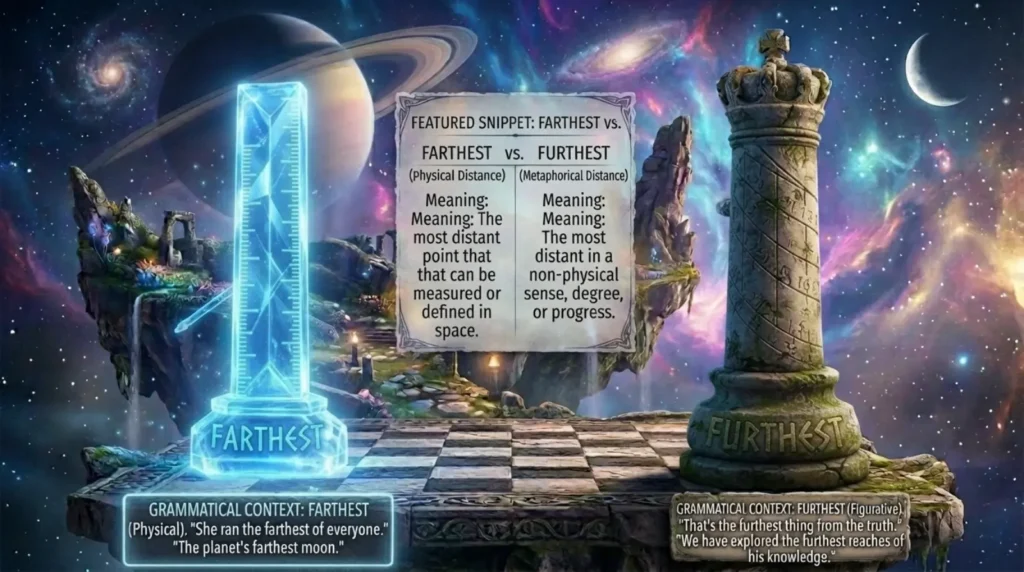
Featured Snippet: Farthest vs Furthest
Farthest usually refers to the greatest physical distance, while furthest often refers to the greatest degree, progress, or abstract distance. Although modern English frequently uses them interchangeably, using farthest for measurable distance and furthest for figurative meaning makes your writing more accurate.
Internal Linking Suggestions
To build topical authority, link this article to:
- Farther vs Further: What’s the Difference?
- Then vs Than Explained
- Affect vs Effect
- Who vs Whom
- Less vs Fewer
- Lay vs Lie
- Toward vs Towards
- Common English Grammar Mistakes
Conclusion
Understanding farthest vs furthest is easier than it first appears. Both words come from far, and modern English often treats them as interchangeable. Still, following the traditional distinction improves clarity. Use farthest when talking about measurable physical distance, such as roads, cities, or travel. Choose furthest when discussing progress, ideas, goals, or stages of development. This simple habit makes your writing more precise and professional. Whether you are writing essays, emails, blog posts, or everyday messages, selecting the right word helps readers understand your meaning immediately. Keep the easy memory trick in mind—feet travel the farthest, while the future reaches the furthest—and you’ll use both words with confidence.

Michael Reed is a language content writer and word comparison researcher based in the United States. He studied English Language and Communication and focuses on grammar, spelling differences, and word usage. His work helps readers understand confusing English words through clear comparisons and practical explanations. Michael creates simple, reader-friendly content designed to improve everyday language skills.