
Fiend vs feen is a common search because many people see both words online and wonder if they mean the same thing. The answer depends on the context. Fiend is a real English word found in dictionaries. Feen is mainly internet slang or a shortened form of another slang word. Many people use it on social media, in text messages, and in song lyrics.
Knowing the difference helps you write clearly and understand modern conversations. It also prevents spelling mistakes in school, work, and daily life. In this guide, you will learn the meaning of each word, when to use it, and why people often confuse them. You will also see easy examples, a comparison table, common mistakes, and helpful tips.
Quick Summary (Featured Snippet)
- Fiend is a standard English word.
- Fiend means an evil person or someone strongly addicted to something.
- Feen is internet slang.
- Feen often means to crave or want something badly.
- Use fiend in formal writing.
- Use feen only in casual conversations or online slang.
- The words have different meanings and different levels of formality.
What Does “Fiend” Mean?
The word fiend has been part of English for centuries.
It usually has two meanings.
1. An Evil or Cruel Person
A fiend can describe someone who behaves in a very cruel or wicked way.
Examples
- The story’s villain was a true fiend.
- The movie showed a dangerous fiend.
2. Someone Who Loves Something Too Much
Today, people often use fiend to describe someone with a strong passion or addiction.
Examples
- She is a coffee fiend.
- He is a video game fiend.
- My brother is a chocolate fiend.
In these examples, the word is not always negative. It simply means someone enjoys something a lot.
What Does “Feen” Mean?
Feen is not considered a standard English word.
It is mostly internet slang. People often use it in social media posts, music, and casual chats.
Many people use feen to mean:
- Want something badly
- Crave something
- Feel desperate for something
Examples
- I’m feening for pizza.
- He’s feening to play basketball.
- They were feening for the new game release.
Some people shorten feening to feen in text messages.
Because it is slang, you should avoid using it in formal writing, business emails, or school assignments.

Fiend vs Feen Comparison Table
| Feature | Fiend | Feen |
|---|---|---|
| Dictionary word | ✅ Yes | ❌ No (slang) |
| Formal writing | ✅ Yes | ❌ No |
| Internet slang | Sometimes | ✅ Yes |
| Main meaning | Evil person or enthusiast | Strong craving or desire |
| Common use | Books, articles, daily English | Social media, texting, music |
| Grammar status | Standard English | Informal slang |
Fiend vs Feen in Simple Words
The easiest way to remember the difference is this:
- Fiend = Real English word.
- Feen = Internet slang.
Think of it this way.
If you are writing an essay, choose fiend.
If you are chatting with friends online, you may see feen.
Why Do People Confuse Fiend and Feen?
Several reasons cause confusion.
Similar Sound
Both words sound almost the same.
Social Media
TikTok, Instagram, and X often use slang.
Many users type feen instead of feening.
Music Lyrics
Hip-hop and rap songs often include slang expressions.
Fans copy these spellings into everyday conversations.
Fast Texting
People shorten words while texting.
That makes slang spread quickly.
Real-Life Examples of Fiend vs Feen
Using Fiend Correctly
- My uncle is a fishing fiend.
- She became a fitness fiend.
- The detective chased a dangerous fiend.
Using Feen Correctly
- I’m feening for ice cream.
- He’s feening to watch the new movie.
- They are feening for concert tickets.
Incorrect Examples
❌ I am a pizza feen.
✅ I am a pizza fiend.
OR
✅ I’m feening for pizza.
When Should You Use Fiend?
Use fiend when writing:
- School essays
- College papers
- News articles
- Books
- Business emails
- Professional websites
It is accepted in dictionaries and formal English.
When Should You Use Feen?
Use feen only in informal settings.
Examples include:
- Text messages
- TikTok comments
- Instagram captions
- Gaming chats
- Casual conversations
- Song lyrics
Avoid it in professional communication.
Common Mistakes People Make
Many writers mix these words.
Here are common errors.
Mistake 1
❌ He is a coffee feen.
✅ He is a coffee fiend.
Mistake 2
❌ The evil feen escaped.
✅ The evil fiend escaped.
Mistake 3
Using feen in formal writing.
Replace it with:
- crave
- desire
- want badly
- fiend (only when appropriate)
Easy Trick to Remember the Difference
Use this simple memory trick.
Remember “D”
Fiend has a D.
Think of:
- Dictionary
- Document
- Formal English
No D?
Then feen is probably internet slang.
This trick works well during writing.
Fiend vs Feen in Daily Conversations
Here are everyday examples.
Friends
“I’m feening for burgers.”
Family
“My dad is a football fiend.”
School
“Our teacher is a history fiend.”
Social Media
“I’m feening for vacation.”
Workplace
Avoid feen.
Instead say:
- I’m eager.
- I’m excited.
- I’m looking forward to it.
Synonyms and Related Words
Fiend
- Enthusiast
- Fanatic
- Devotee
- Zealot
- Obsessive fan
- Junkie (informal)
Feen
- Crave
- Desire
- Long for
- Need badly
- Want badly
- Hunger for
- Yearn for
LSI Keywords
- fiend meaning
- feen meaning
- fiend slang
- feening meaning
- fiend definition
- internet slang words
- English vocabulary
- texting slang
- fiend examples
- feen examples
Expert Insights
Language changes every year.
Social media creates new slang quickly.
However, dictionaries do not always accept these words.
Professional writers should know the difference between standard English and internet slang.
Using the correct word builds trust with readers.
It also improves grammar and writing quality.
Choose fiend for formal content.
Reserve feen for casual online conversations.
FAQs:
Is “feen” a real English word?
No. It is mainly internet slang and is not considered standard English.
Is “fiend” a bad word?
Not always.
It can describe an evil person or someone who strongly enjoys something.
Can I use “feen” in school writing?
No.
Use standard English words instead.
What does “feening” mean?
It usually means craving or wanting something very badly.
Why do rappers use “feen”?
Many artists use slang to match everyday speech and modern culture.
Which spelling is correct: fiend or feen?
If you mean the dictionary word, fiend is correct.
Can “fiend” describe hobbies?
Yes.
Examples include:
- coffee fiend
- sports fiend
- movie fiend
Featured Snippet: Fiend vs Feen
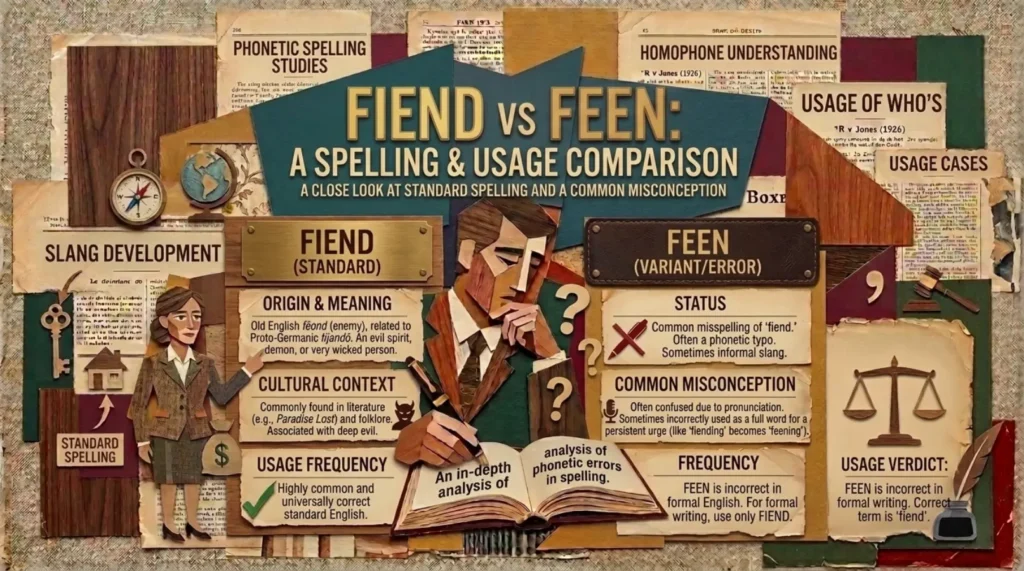
Fiend is a standard English word that means an evil person or someone with a strong obsession. Feen is informal internet slang that usually means craving something badly. Use fiend in formal writing and feen only in casual conversations or social media.
Internal Linking Suggestions
To improve SEO and user experience, link this article to related grammar guides such as:
- Lose vs Loose
- Principal vs Principle
- Weather vs Whether
- Gray vs Grey
- Who’s vs Whose
- Then vs Than
- Affect vs Effect
Conclusion
Understanding fiend vs feen is simple once you know their meanings. Fiend is a proper English word with dictionary support. It can describe an evil person or someone with a strong passion for something. Feen, on the other hand, is modern internet slang that usually means craving or wanting something badly. While both words sound alike, they belong in different situations. Use fiend in formal writing, professional communication, and academic work. Save feen for casual chats, social media, and texting. Choosing the correct word makes your writing clearer, more accurate, and easier to understand. The next time you see these words, you will know exactly which one fits the context.

Emma Collins is a language writer and grammar enthusiast specializing in English vocabulary, spelling comparisons, and word usage guides. She creates easy-to-understand content that helps readers improve their writing, communication, and language skills with confidence.