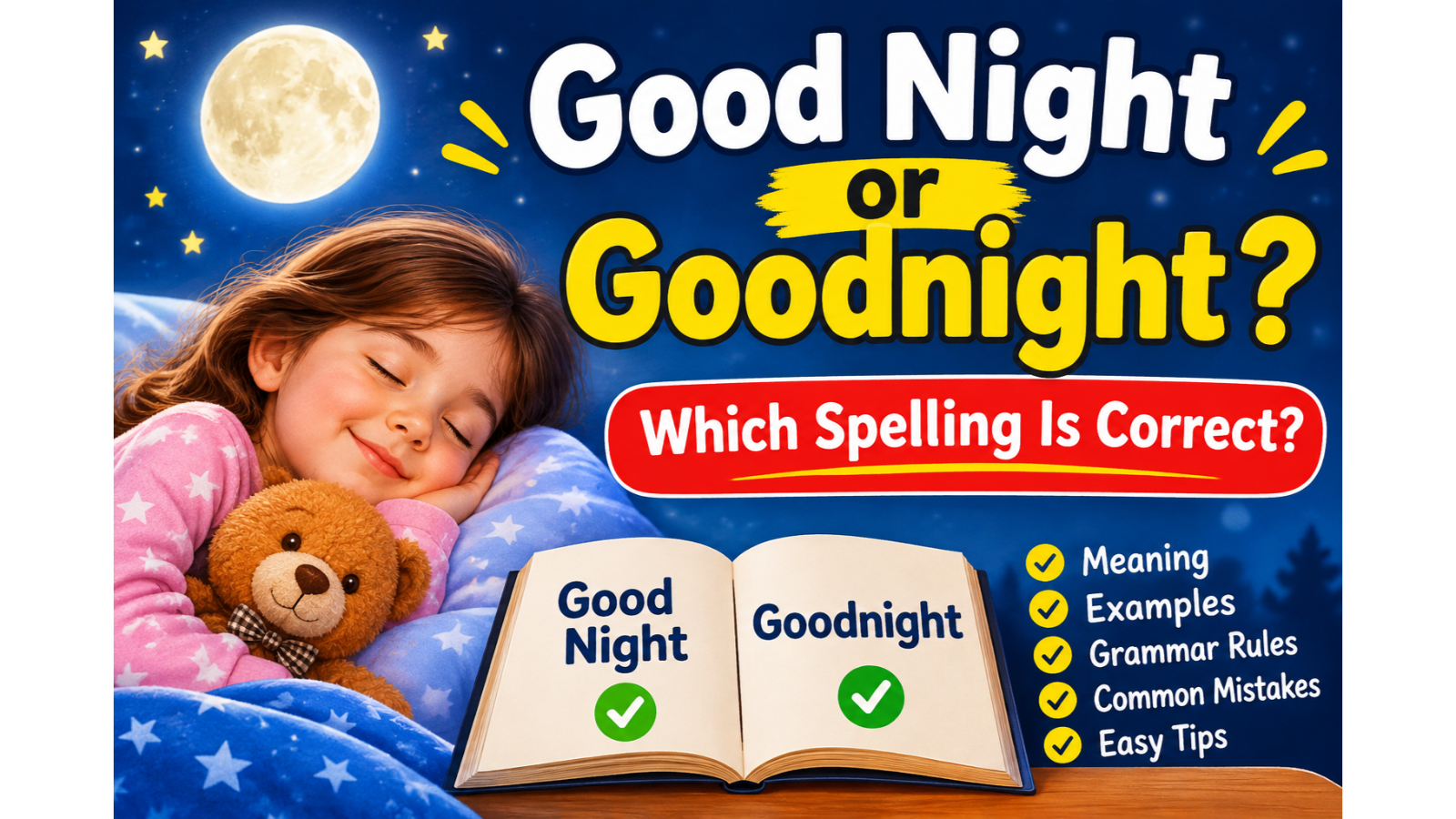
Good night or goodnight is a common spelling question in English. Many people use these two forms in messages, conversations, and everyday writing. However, they often wonder which spelling is correct. The good news is that both forms exist in English. Still, they do not always serve the same purpose.
Understanding their meanings can help you avoid common grammar mistakes. It can also make your writing clearer and more natural. In this guide, you will learn the difference between good night and goodnight. We will explain their meanings, grammar rules, and correct usage. You will also find simple examples from daily life. Whether you write school assignments or friendly messages, these tips will help. Let’s explore which form you should use and when.
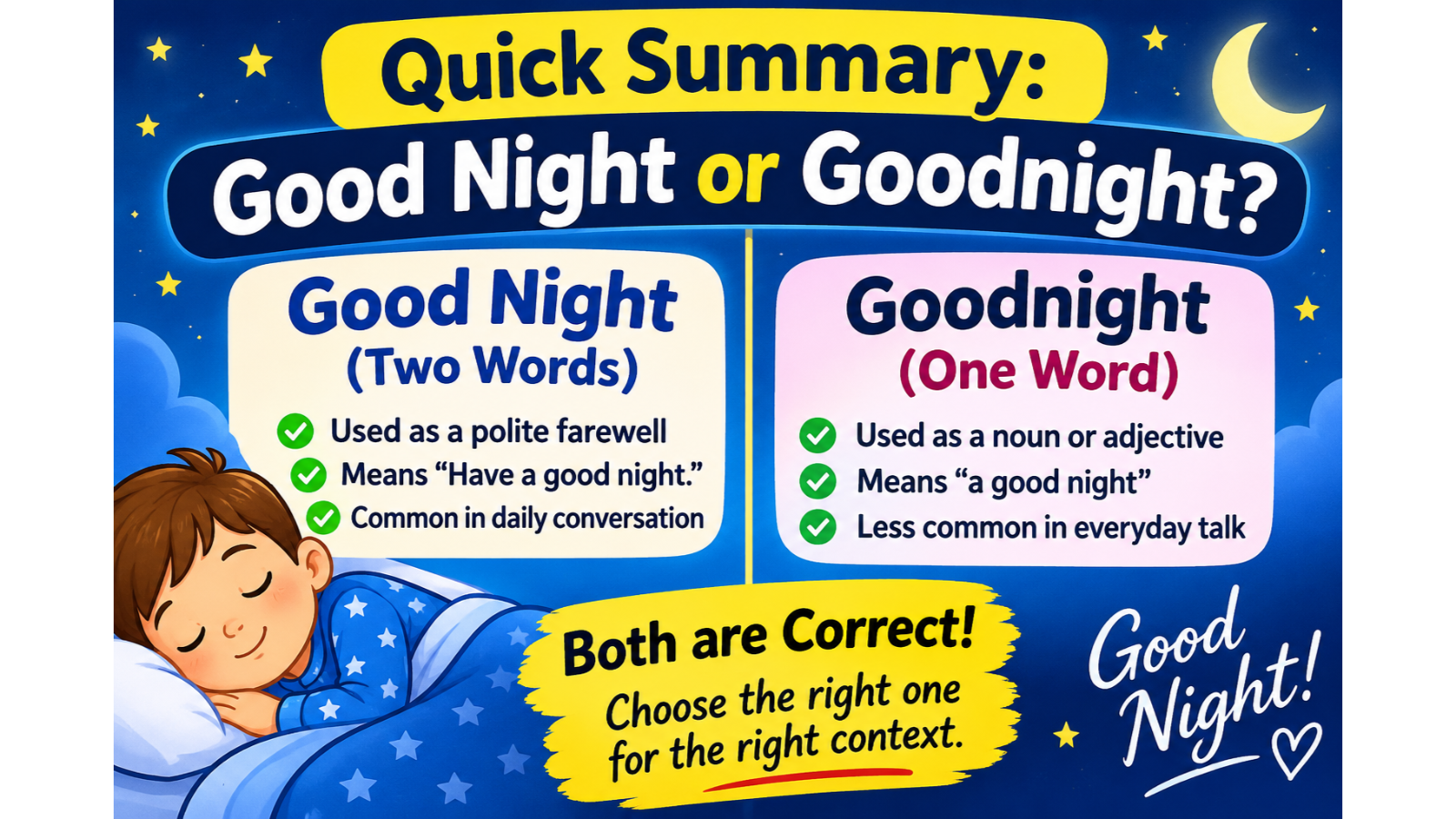
Quick Summary: Good Night or Goodnight?
- Good night is the standard two-word expression.
- People use it to say goodbye before sleeping.
- Goodnight is also a recognized one-word form.
- It commonly appears as a noun, as in “a goodnight kiss.”
- Use “good night” when you want a safe, standard farewell.
- Both forms can appear in casual messages, depending on context.
- Remember that “good evening” and “good night” have different purposes.
What Does Good Night Mean?
Good night is a common English expression. People use it when they say goodbye in the evening or before going to bed.
It is made of two words:
- Good: Something pleasant, positive, or enjoyable.
- Night: The dark part of the day after evening.
Together, these words create a friendly farewell. They can express kindness, care, and good wishes.
Examples:
- Good night! Sleep well.
- I am going to bed. Good night, everyone.
- Good night, Mom. See you tomorrow.
- Have a good night with your family.
The expression is common in homes, schools, workplaces, and text messages.
What Does Goodnight Mean?
Goodnight is the one-word form of the expression. It also appears as a noun in English.
For example, people use it in phrases such as:
- A goodnight kiss.
- A sweet goodnight message.
- Their final goodnight.
In casual writing, some people also use “goodnight” as a one-word farewell. However, good night remains the safest standard choice for formal and general writing.
Examples:
- She gave her son a goodnight kiss.
- He sent a sweet goodnight message.
- Their goodnight was short and simple.
The meaning depends on how the word appears in a sentence.
Good Night vs Goodnight: What Is the Difference?
The main difference is spelling and grammatical use. Both forms relate to nighttime wishes and farewells.
However, their use depends on the sentence.
| Good Night | Goodnight |
|---|---|
| Two separate words | One combined word |
| Standard farewell expression | Commonly used as a noun |
| Suitable for formal writing | Often used in informal contexts |
| Example: Good night, Dad. | Example: A goodnight kiss |
| Used before sleeping | Used in phrases describing a farewell |
Easy rule to remember:
Use “good night” when saying goodbye to someone. Use “goodnight” as one word in expressions such as “goodnight kiss.”
This simple rule will help you choose the right spelling in most situations.
Why Do People Confuse Good Night and Goodnight?
Many English learners confuse these spellings because they sound exactly the same.
When people speak, they cannot see the space between words. As a result, both forms can sound identical.
There are several reasons behind this confusion:
1. Similar pronunciation
Both forms have the same pronunciation in everyday English.
2. Social media habits
People often write short messages without following formal spelling rules.
3. Text messaging
Friends may write “goodnight” instead of “good night” in casual chats.
4. Different grammar uses
The one-word form can work as a noun, while the two-word form works as a farewell.
Therefore, understanding sentence structure is more helpful than memorizing spelling alone.
When Should You Use Good Night?
Use “good night” when you want to end a conversation or wish someone a peaceful night.
It is suitable for both formal and informal situations.
Here are some common situations:
1. Before going to sleep
You can say good night before leaving for bed.
Example: I feel tired. Good night, everyone!
2. When ending a phone call
You can use it when finishing an evening phone conversation.
Example: It was nice talking to you. Good night!
3. When leaving someone’s home
You can say it when leaving friends or family at night.
Example: Thank you for dinner. Good night!
4. When sending a text message
It is a friendly way to end an evening conversation.
Example: Good night! Talk to you tomorrow.
5. When saying goodbye to children
Parents often use this expression to wish their children a peaceful sleep.
Example: Good night, sweetheart. Have sweet dreams!
When Should You Use Goodnight?
Use “goodnight” as a noun when describing a nighttime farewell.
It often appears with other words in a sentence.
Here are some useful examples:
- Goodnight kiss: She gave her daughter a goodnight kiss.
- Goodnight message: I received a lovely goodnight message.
- Goodnight wish: His goodnight wish made me smile.
- Final goodnight: They shared one final goodnight.
- Sweet goodnight: She sent him a sweet goodnight.
These examples show how the one-word form works in everyday English.
Remember, you should consider the sentence’s meaning before choosing either spelling.
Good Night or Goodnight in Text Messages
Text messages often use shorter and more relaxed language.
That is why you may see both spellings in online conversations.
For example:
| Message | Usage |
|---|---|
| Good night! Sleep well. | Standard spelling |
| Goodnight! Sweet dreams. | Informal farewell |
| Sending you a goodnight kiss. | Noun |
| Have a good night. | Standard expression |
| Goodnight, my friend! | Casual spelling |
Both forms are easy to understand in friendly conversations.
However, “good night” is the better choice when you want standard English.
For schoolwork, professional messages, and formal writing, prefer the two-word form as a farewell.
Common Mistakes When Using Good Night and Goodnight
English learners sometimes make simple mistakes with these expressions.
Let’s understand the most common ones.
Mistake 1: Using goodnight in every situation
Incorrect or less standard: Goodnight, teacher. I am leaving now.
Better: Good night, teacher. I am leaving now.
The two-word form is the standard farewell.
Mistake 2: Writing good night as one word in formal work
Incorrect for the standard farewell: I said goodnight to my parents.
Better: I said good night to my parents.
Mistake 3: Confusing good evening with good night
These expressions have different purposes.
- Good evening is a greeting.
- Good night is usually a farewell.
Mistake 4: Forgetting the space between words
When writing the standard farewell, keep both words separate.
Correct: Good night, everyone!
Mistake 5: Using the wrong expression in a greeting
You should not normally say “good night” when meeting someone in the evening.
Better: Good evening! How are you?
Learning these small differences can improve your English writing.
Good Evening vs Good Night: What’s the Difference?
Good evening and good night are both common English expressions.
However, people use them in different situations.
| Expression | Meaning | When to Use | Example |
|---|---|---|---|
| Good evening | Evening greeting | When meeting someone | Good evening, everyone! |
| Good night | Evening farewell | When leaving someone | Good night! See you tomorrow. |
| Good morning | Morning greeting | When meeting someone in the morning | Good morning, teacher! |
| Good afternoon | Afternoon greeting | When meeting someone in the afternoon | Good afternoon, sir! |
Remember this simple trick:
Use “good evening” to start an evening conversation. Use “good night” to end it.
For example:
You meet your friend at 7 PM and say, “Good evening!”
After dinner, you leave and say, “Good night!”
This is a simple way to remember the difference.
Real-Life Examples of Good Night and Goodnight
Examples make English grammar easier to understand.
Here are some everyday situations where you can use these expressions.
At home
- Good night, Mom. I am going to sleep.
- Dad gave me a goodnight kiss.
- Good night, everyone. See you tomorrow.
With friends
- Good night, buddy. Take care!
- I sent my friend a goodnight message.
- Good night! Let’s talk tomorrow.
At school
- Good night, teacher. See you tomorrow.
- The children said good night before leaving.
In romantic messages
- Good night, my love. Sweet dreams!
- Sending you a sweet goodnight kiss.
- Have a peaceful night, sweetheart.
At work
- Good night, everyone. See you in the morning.
- She wished her colleagues a good night.
These examples show how the expressions fit different conversations.
Other Ways to Say Good Night
Sometimes, you may want to use different words instead of repeating “good night.”
These alternatives can make your messages sound more natural and friendly.
| Alternative | Meaning or Use |
|---|---|
| Sweet dreams | Wish someone pleasant dreams |
| Sleep well | Wish someone peaceful sleep |
| Nighty night | A cute, informal farewell |
| Have a peaceful night | Wish someone a calm night |
| Rest well | Encourage someone to relax |
| See you tomorrow | Say goodbye until the next day |
| Take care | Express kindness before leaving |
| Pleasant dreams | Wish someone lovely dreams |
| Sleep tight | A friendly bedtime expression |
| Have a restful night | Wish someone a relaxing night |
Example sentences:
- Sleep well! You deserve some rest.
- Sweet dreams, my dear.
- Nighty night! See you tomorrow.
- Rest well and take care.
- Have a peaceful night with your family.
These phrases are useful in daily conversations, greeting cards, and text messages.
Expert Tips to Remember the Correct Spelling
Learning the difference between these expressions does not need to be difficult.
Use these simple tips to improve your English.
Tip 1: Remember the farewell rule
When saying goodbye at night, write “good night” as two words.
Tip 2: Look at the sentence structure
If the expression describes a kiss or message, “goodnight” can work as a noun.
Tip 3: Practice with simple sentences
Write five sentences using both forms. This will help you remember their uses.
Tip 4: Read English regularly
Books, articles, and quality learning websites can improve your spelling skills.
Tip 5: Check formal writing
Use standard spelling in school assignments, emails, and professional documents.
Expert insight: Good grammar depends on context, not just spelling. Understanding how a word works in a sentence helps you communicate clearly. Therefore, focus on meaning and sentence structure instead of memorizing isolated words.
FAQs
Here are answers to common questions about good night or goodnight.
1. Is good night one word or two words?
“Good night” is two words when used as a standard farewell. “Goodnight” is also a recognized one-word form, especially as a noun.
2. Is goodnight grammatically correct?
Yes. Goodnight is grammatically correct as a noun. For example, “She gave him a goodnight kiss.”
3. Should I write good night or goodnight in a text?
Both appear in casual text messages. However, “good night” is the standard spelling and the safest choice.
4. Is good night a greeting or a goodbye?
Good night is mainly a farewell. People use it when leaving someone or going to bed.
5. What is the difference between good evening and good night?
Good evening is a greeting used when meeting someone. Good night is a farewell used when ending a conversation.
6. Can I write goodnight in formal English?
You can use “goodnight” as a noun in formal English. However, use “good night” for a standard farewell.
7. Which spelling is better for students?
Students should use “good night” when writing a farewell. They can use “goodnight” in suitable noun phrases.
8. Is goodnight one word in British and American English?
Both British and American English recognize “goodnight.” However, “good night” remains the standard farewell spelling in general writing.
Conclusion
Understanding good night or goodnight is easy when you know their different uses. Both forms are correct, but they serve different grammatical purposes. Good night is the standard two-word expression for saying goodbye before sleep. Goodnight commonly works as a noun in phrases like “goodnight kiss.” You may also see the one-word form in casual messages. However, the two-word spelling is the safest choice for formal writing. Remember to use good evening when greeting someone at night. Use good night when ending your conversation. These simple rules can improve your English spelling and communication. Keep practicing with everyday examples, and you will remember the difference easily.

Emma Collins is a language writer and grammar enthusiast specializing in English vocabulary, spelling comparisons, and word usage guides. She creates easy-to-understand content that helps readers improve their writing, communication, and language skills with confidence.