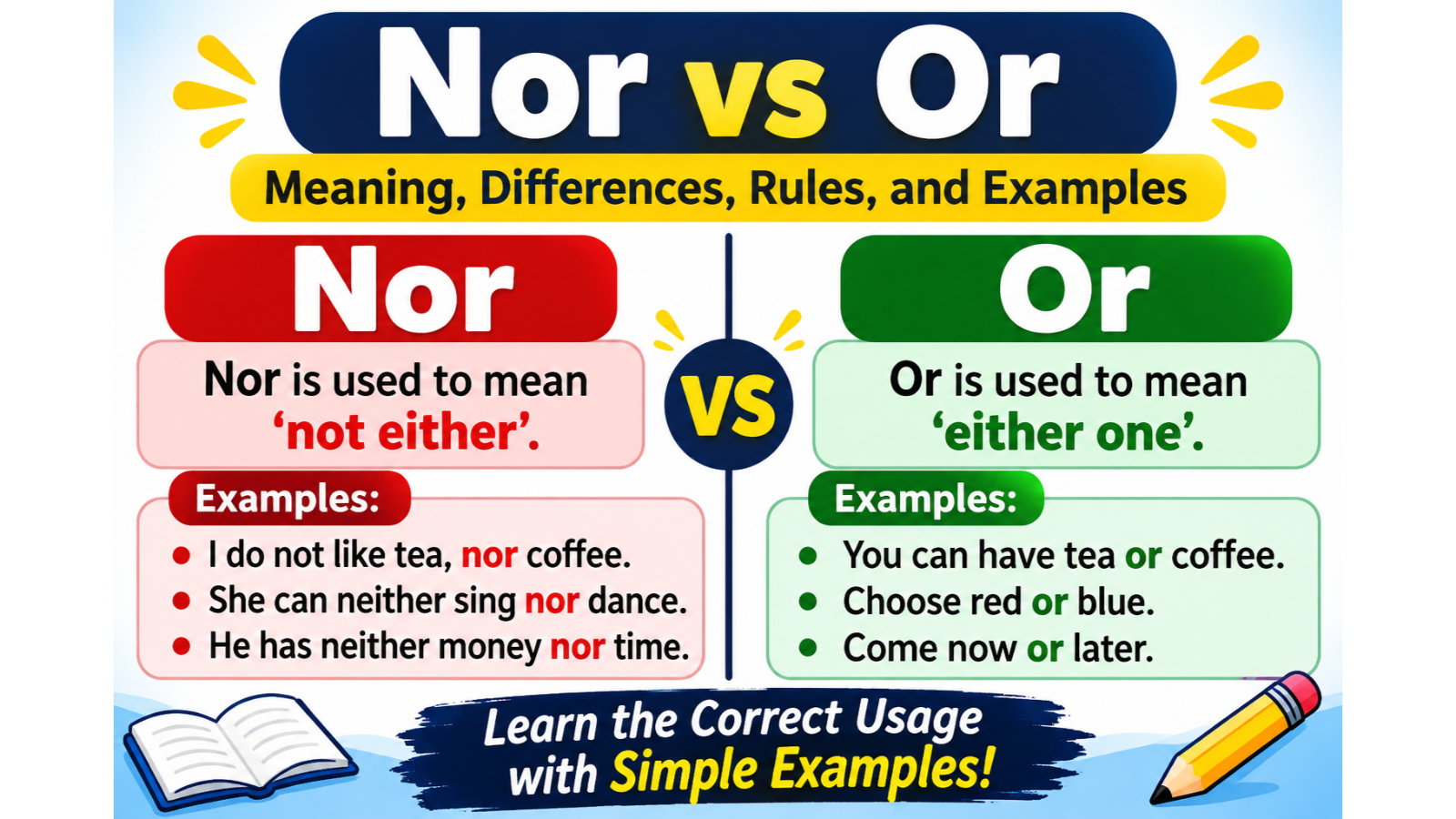
Have you ever wondered about nor vs or and when to use each word? Both words help connect ideas in English. However, they serve different purposes. Or presents choices, options, or alternatives. Nor adds another negative idea to a sentence. Knowing the difference can make your writing clearer and more natural.
Many students confuse these words because both connect words and phrases. However, their grammar rules are not the same. Using the wrong word can change your sentence’s meaning. The good news is that learning these rules is easy. You only need a few simple examples and practice.
In this guide, you will learn the meaning of nor and or. You will also discover their differences, grammar rules, and common mistakes. By the end, you will know exactly when to use each word.
Quick Summary: Nor vs Or
- Or connects choices, alternatives, and possibilities.
- Nor connects two or more negative ideas.
- Use or when offering a choice between options.
- Use nor when adding another negative statement.
- Neither…nor connects two negative choices.
- Either…or connects two possible choices.
- Or often appears in questions and positive sentences.
- Nor commonly follows neither or a negative expression.

What Does Or Mean?
Or is a conjunction that connects two or more choices, ideas, or alternatives. It helps readers understand that someone must choose between different options.
We use or in everyday conversations, questions, and written sentences. It makes choices easy to understand.
Examples of Or
- Would you like tea or coffee?
- You can walk or take a bus.
- Is your bag red or blue?
- We can study today or tomorrow.
- Do you want rice or bread?
In these examples, or connects different options.
When Should You Use Or?
Use or in these situations:
1. To offer choices
- Would you like juice or water?
- Should we watch a movie or play a game?
2. To show alternatives
- You can call me or send a message.
- We can travel by car or train.
3. To ask questions
- Is he your brother or cousin?
- Are you going today or tomorrow?
4. To show possibilities
- It may rain tonight or tomorrow.
- She might visit us or stay home.
What Does Nor Mean?
Nor is a conjunction that connects negative words, phrases, or ideas. It means something similar to “and not.”
We commonly use nor with neither. It can also follow negative expressions such as not, never, and neither.
Nor adds another negative idea without repeating the same negative structure.
Examples of Nor
- Neither Ali nor Ahmed likes coffee.
- She does not sing, nor does she dance.
- He neither called nor texted me.
- I have neither time nor money.
- They did not complain, nor did they argue.
These examples show how nor connects negative ideas.
When Should You Use Nor?
Use nor in these situations:
1. With neither
- Neither John nor Mike came today.
- She likes neither tea nor coffee.
2. After a negative statement
- He does not play football, nor does he watch it.
- I cannot swim, nor can my brother.
3. To connect negative actions
- She neither laughed nor smiled.
- He neither studied nor worked.
4. To show two unavailable options
- We have neither food nor water.
- They found neither the keys nor the wallet.
Nor vs Or: What Is the Main Difference?
The main difference between nor and or is their meaning.
Or introduces choices and alternatives. Nor connects negative ideas.
Although both words work as conjunctions, they do not have the same purpose.
Simple Comparison
| Feature | Or | Nor |
|---|---|---|
| Meaning | A choice or alternative | An additional negative idea |
| Main purpose | Connect options | Connect negative ideas |
| Common pair | Either…or | Neither…nor |
| Sentence type | Questions and positive statements | Negative statements |
| Example | Tea or coffee? | Neither tea nor coffee |
| Usage | Everyday English | Negative expressions |
Compare These Sentences
Using Or:
- Do you want pizza or burgers?
- You can study English or mathematics.
Using Nor:
- I want neither pizza nor burgers.
- She studies neither English nor mathematics.
Notice how the meaning changes. Or presents choices, while nor connects negative options.
Nor vs Or Grammar Rules
Understanding a few grammar rules can help you use both words correctly.
Rule 1: Use Or for Choices
Use or when someone must choose between two or more things.
Examples:
- Would you like an apple or a banana?
- Should I call you or visit you?
Rule 2: Use Nor After Neither
The most common structure is neither…nor.
Examples:
- Neither Sam nor Jack is ready.
- She likes neither milk nor juice.
Rule 3: Use Nor After a Negative Statement
Nor can introduce another negative idea. However, the sentence usually requires inverted word order.
Examples:
- He did not call, nor did he send a message.
- She cannot drive, nor can she ride a bike.
Notice the structure:
Nor + helping verb + subject + main verb
Rule 4: Use Either…Or for Two Options
Either…or introduces two possible choices.
Examples:
- Either Sara or Maria will help us.
- You can either stay or leave.
Rule 5: Avoid Double Negatives
Standard English usually avoids using another negative word with nor.
Incorrect: I don’t want neither tea nor coffee.
Correct: I want neither tea nor coffee.
Correct: I don’t want tea or coffee.
Nor vs Or Examples in Real Life
Real-life examples make grammar easier to understand. Here are some situations where you can use both words.
At Home
Or:
- Should we cook rice or pasta?
- Do you want to watch TV or read a book?
Nor:
- Neither my father nor my mother is home.
- I have neither milk nor sugar.
At School
Or:
- Will you study English or science?
- Should we write with a pen or pencil?
Nor:
- Neither Ali nor Hamza completed the homework.
- The student neither asked nor answered questions.
At Work
Or:
- Should we send an email or make a phone call?
- Do you want a meeting today or tomorrow?
Nor:
- Neither the manager nor the assistant attended.
- The team neither agreed nor disagreed.
During Conversations
Or:
- Are you happy or sad?
- Would you like to walk or drive?
Nor:
- I neither know nor understand the answer.
- She neither called nor replied.
Either…Or vs Neither…Nor
Many English learners confuse either…or with neither…nor.
Both structures connect two options. However, their meanings are different.
| Either…Or | Neither…Nor |
|---|---|
| Shows two possible choices | Shows two negative choices |
| Has a positive or neutral meaning | Has a negative meaning |
| Presents alternatives | Rejects both alternatives |
| Either tea or coffee | Neither tea nor coffee |
| Either Ali or Ahmed will come. | Neither Ali nor Ahmed will come. |
Examples of Either…Or
- You can either sleep or study.
- Either my brother or my sister will help.
- We can either walk or take a taxi.
Examples of Neither…Nor
- Neither my brother nor my sister is here.
- She likes neither cats nor dogs.
- He speaks neither French nor German.
Easy Trick: Either…or means one choice is possible. Neither…nor means both choices are rejected.
Common Mistakes When Using Nor and Or
Even advanced English learners sometimes confuse these conjunctions. Here are common mistakes and their correct forms.
Mistake 1: Using Nor for Positive Choices
Incorrect: Would you like tea nor coffee?
Correct: Would you like tea or coffee?
Why? Or introduces choices in a regular question.
Mistake 2: Using Or After Neither
Incorrect: Neither Ali or Ahmed came.
Correct: Neither Ali nor Ahmed came.
Why? Neither normally pairs with nor.
Mistake 3: Using Double Negatives
Incorrect: I don’t like neither apples nor oranges.
Correct: I like neither apples nor oranges.
Why? Neither already gives the sentence a negative meaning.
Mistake 4: Forgetting Inversion After Nor
Incorrect: She did not call, nor she sent a message.
Correct: She did not call, nor did she send a message.
Why? Nor introducing a separate negative clause usually requires subject-auxiliary inversion.
Mistake 5: Confusing Either and Neither
Incorrect: Neither you or I can attend.
Correct: Neither you nor I can attend.
Why? Neither pairs with nor, while either pairs with or.
Easy Tips to Remember Nor vs Or
Learning simple tricks can help you remember these words.
Tip 1: Remember Choices
Think of or whenever you see different options.
Example: Tea or coffee?
Tip 2: Remember Negatives
Think of nor when connecting negative ideas.
Example: Neither tea nor coffee.
Tip 3: Learn Common Word Pairs
Memorize these two structures:
- Either…or
- Neither…nor
Tip 4: Read Your Sentence Aloud
Reading helps you notice incorrect word combinations.
Tip 5: Practice With Short Sentences
Start with simple examples before writing longer sentences.
For example:
- Do you want rice or bread?
- I want neither rice nor bread.
These small exercises can improve your grammar skills.
Nor vs Or: Synonyms and Related Grammar Words
Understanding related words can improve your English vocabulary.
However, remember that these words do not always replace nor or or.
| Word or Phrase | Meaning | Example |
|---|---|---|
| Or | A choice | Tea or coffee |
| Nor | An additional negative idea | Neither tea nor coffee |
| Either | One of two choices | Either option works |
| Neither | Not one and not the other | Neither answer is correct |
| Alternatively | Another possible choice | Alternatively, take a bus |
| Otherwise | If not | Hurry, otherwise you may miss it |
| And | Adds information | Ali and Ahmed came |
| But | Shows contrast | Small but useful |
Related Search Terms
These related grammar terms can help you understand the topic:
- Nor and or difference
- Neither nor meaning
- Either or grammar rules
- How to use nor in a sentence
- How to use or in English
- Nor vs or examples
- English conjunctions
- Negative conjunctions
- Coordinating conjunctions
- English grammar rules
How to Use Nor and Or in Daily English
Both words are useful in everyday communication.
Learning their correct usage can improve your speaking, reading, and writing.
In Daily Questions
Use or to ask someone about their preferences.
Examples:
- Are you coming today or tomorrow?
- Do you prefer tea or coffee?
- Should we eat outside or at home?
In Daily Statements
Use nor to connect negative ideas.
Examples:
- I have neither time nor energy.
- He neither eats meat nor drinks milk.
- She does not cook, nor does she clean.
In School Writing
Use these conjunctions to create clear sentences.
Examples:
- Students can choose English or Urdu.
- Neither the teacher nor the students were ready.
In Professional Writing
Use or to explain alternatives and nor to add negative information.
Examples:
- Please submit your work online or in person.
- The company neither accepted nor rejected the proposal.
Expert Insights: Why Does the Difference Matter?
Understanding nor vs or is important for clear English communication.
These small words can change the meaning of an entire sentence. Therefore, choosing the correct conjunction matters.
Here are some useful grammar tips:
1. Focus on Sentence Meaning
Always understand what your sentence communicates. Use or for alternatives and nor for additional negative ideas.
2. Learn Common Structures
Practice either…or and neither…nor. These structures appear frequently in English writing.
3. Check Subject-Verb Agreement
With neither…nor, the verb often agrees with the subject closest to it.
Examples:
- Neither Ali nor his friends are ready.
- Neither the students nor the teacher is present.
4. Avoid Unnecessary Complexity
Use simple sentences when possible. Clear writing helps readers understand your message quickly.
5. Practice Consistently
Read English books, write short sentences, and notice conjunctions in everyday conversations.
These habits can help students, writers, and English learners improve their grammar.
Frequently Asked Questions About Nor vs Or
1. What is the difference between nor and or?
Or connects choices and alternatives. Nor connects negative ideas. For example, “tea or coffee” presents choices, while “neither tea nor coffee” rejects both.
2. When should I use nor instead of or?
Use nor when connecting negative ideas. It commonly follows neither or another negative expression.
Example: She likes neither apples nor bananas.
3. Is nor always used with neither?
No. Nor often appears with neither, but it can also follow other negative expressions.
Example: He did not call, nor did he text.
4. Can I use or in a negative sentence?
Yes. Or can appear in negative sentences to connect alternatives.
Example: I don’t want tea or coffee.
5. What is the correct form: neither nor or neither or?
The correct standard structure is neither…nor.
Example: Neither Ali nor Ahmed came to school.
6. Is neither…nor positive or negative?
Neither…nor has a negative meaning. It shows that neither of the two options applies.
Example: Neither answer is correct.
7. What is the difference between either…or and neither…nor?
Either…or presents two possible choices. Neither…nor means both choices are rejected.
Example: Either Ali or Ahmed can help. Neither Ali nor Ahmed can help.
8. Can nor start a sentence?
Yes. Nor can start a sentence when it adds another negative point to a previous statement.
Example: He never visits us. Nor does he call.
Conclusion
Understanding nor vs or can make your English grammar stronger. Both words connect ideas, but they have different meanings. Use or when presenting choices, options, or alternatives. Use nor when adding another negative idea to a sentence.
Remember these two important structures: either…or and neither…nor. They make it easier to choose the correct conjunction. Also, avoid double negatives and follow the correct grammar rules.
Practice these words in daily conversations and simple writing exercises. Read your sentences carefully before using them. With regular practice, you can use both conjunctions naturally and confidently. The easiest rule to remember is simple: or means a choice, while nor connects negative ideas.

Emma Collins is a language writer and grammar enthusiast specializing in English vocabulary, spelling comparisons, and word usage guides. She creates easy-to-understand content that helps readers improve their writing, communication, and language skills with confidence.