
Grateful vs greatful is a common spelling question that confuses many English learners and native speakers alike. At first glance, both words seem correct. After all, “greatful” looks like it comes from the word “great.”
However, only one spelling is accepted in standard English. Knowing the difference helps you write clearly and avoid mistakes in emails, essays, social media posts, and professional documents.
In this guide, you will learn the meaning of grateful, why greatful is incorrect, and how to remember the right spelling. You will also see real-life examples, common mistakes, expert tips, and answers to frequently asked questions.
By the end, you will never confuse grateful and greatful again.
Quick Summary Box
- Grateful is the correct spelling.
- Greatful is a misspelling.
- Grateful means feeling thankful or appreciative.
- Use grateful in formal and informal writing.
- Remember: gratitude and grateful share the same root.
- Greatful does not appear in standard dictionaries.
What Does Grateful Mean?
Grateful is an adjective that means feeling thankful, appreciative, or pleased because of someone’s kindness or help.
Simple Definition
A grateful person feels thankful for something good.
Examples
- I am grateful for your support.
- She felt grateful after receiving help.
- We are grateful for this opportunity.
- He was grateful for the kind words.
The word often expresses appreciation toward people, events, or circumstances.
What Does Greatful Mean?
Greatful is not a standard English word.
Many people assume it is correct because it looks like a combination of “great” and “-ful.” However, English dictionaries recognize only grateful.
Example of Incorrect Usage
❌ I am greatful for your help.
Correct Version
✅ I am grateful for your help.
Whenever you write “greatful,” replace it with “grateful.”
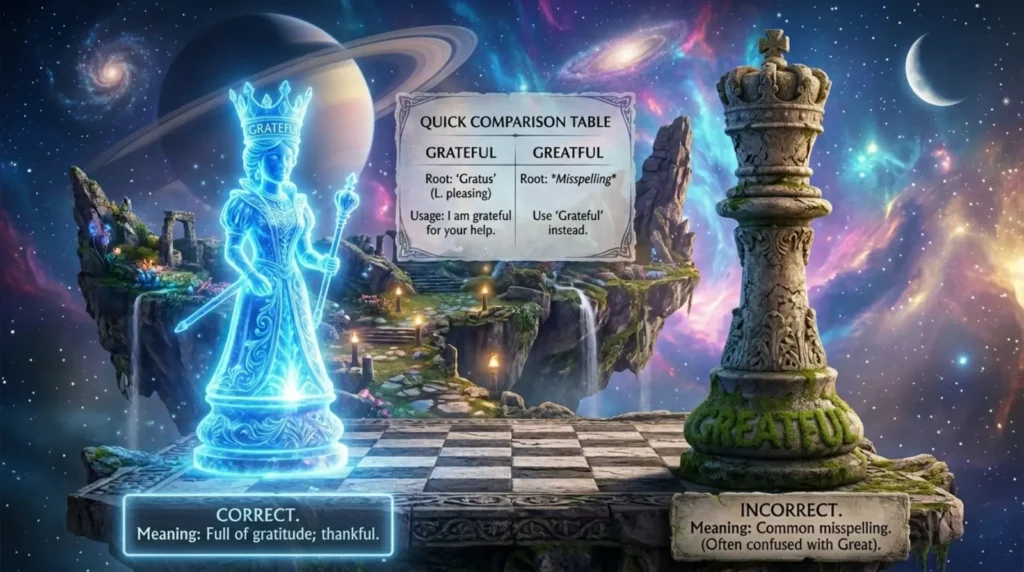
Grateful vs Greatful: Quick Comparison Table
| Feature | Grateful | Greatful |
|---|---|---|
| Correct spelling | Yes | No |
| Dictionary word | Yes | No |
| Meaning | Thankful or appreciative | No accepted meaning |
| Used in professional writing | Yes | No |
| Accepted in English grammar | Yes | No |
| Common spelling mistake | No | Yes |
Winner
✅ Grateful is always the correct choice.
Why Do People Write Greatful Instead of Grateful?
Many writers make this mistake because of the word great.
People often think:
- Great + ful = Greatful
This seems logical. However, English spelling does not follow that pattern here.
The word grateful comes from the older word grate, which relates to thankfulness and appreciation.
That is why the correct spelling is grateful, not greatful.
The Origin of the Word Grateful
Understanding the origin helps you remember the correct spelling.
The word grateful comes from:
- Latin: gratus
- Meaning: pleasing, thankful, welcome
The same root also appears in:
- Gratitude
- Gratify
- Gracious
Notice that all these words begin with grat- rather than great-.
This connection explains why grateful is the correct spelling.
How to Remember the Correct Spelling
Spelling tricks make learning easier.
Trick #1: Think of Gratitude
Grateful and gratitude share the same root.
- Gratitude = thankfulness
- Grateful = thankful
If you remember gratitude, you can remember grateful.
Trick #2: Use This Phrase
“Gratitude makes you grateful.”
Both words start with “grat.”
Trick #3: Ignore the Word Great
Although grateful sounds similar to great, they are not connected in spelling.
Real-Life Examples of Grateful
Here are common situations where people use grateful.
At Work
- I am grateful for the promotion.
- We are grateful for your dedication.
At School
- Students felt grateful for their teacher’s guidance.
- I am grateful for the scholarship.
In Relationships
- She felt grateful for her friend’s support.
- We are grateful for our family.
In Daily Conversations
- Thank you. I am truly grateful.
- I feel grateful for everything I have.
Common Mistakes People Make
Many writers accidentally use the wrong spelling.
Mistake 1: Writing Greatful
❌ I am greatful for your kindness.
✅ I am grateful for your kindness.
Mistake 2: Using Spellings Based on Sound
English spelling does not always match pronunciation.
The word sounds similar to “great,” but the spelling differs.
Mistake 3: Ignoring Spell Check
Modern spelling tools usually flag “greatful” as incorrect.
Always review your writing before publishing.
Grateful in Sentences
Here are more examples of correct usage.
- I am grateful for your friendship.
- She felt grateful after receiving support.
- We are grateful for the opportunity.
- They remain grateful for the experience.
- He was grateful for the advice.
These examples work in both formal and casual settings.
Grateful vs Thankful: Are They the Same?
Many people use these words interchangeably.
Grateful
Usually describes a deeper feeling of appreciation.
Example:
- I am grateful for everything my parents did.
Thankful
Often describes appreciation for a specific event.
Example:
- I am thankful that everyone arrived safely.
Comparison
| Word | Meaning |
|---|---|
| Grateful | Deep appreciation |
| Thankful | Appreciation for a particular situation |
In most situations, either word works well.

Synonyms of Grateful
Using synonyms improves your writing.
Common Synonyms
- Thankful
- Appreciative
- Obliged
- Indebted
- Blessed
- Acknowledging
- Respectful
- Gratified
Example
Original:
- I am grateful for your help.
Alternative:
- I am appreciative of your help.
Usage of Grateful in Daily Life
You can use grateful almost anywhere.
Emails
- We are grateful for your continued support.
Business Communication
- The company is grateful to its customers.
Social Media
- Feeling grateful today.
Personal Messages
- I am grateful to have you in my life.
Because the word expresses positivity, it appears frequently in everyday communication.
Expert Insights: Why Correct Spelling Matters
Correct spelling improves communication.
When you write “grateful” correctly:
- Your writing looks professional.
- Readers understand your message instantly.
- Search engines recognize quality content better.
- You avoid grammar and spelling errors.
Many hiring managers, teachers, and clients notice spelling mistakes. Using the correct form helps build credibility.
Small details often create a strong impression.
Related Words You Should Know
Learning related vocabulary strengthens your understanding.
Gratitude
The feeling of being thankful.
Example:
- She expressed gratitude for the support.
Gracious
Kind and courteous.
Example:
- He was gracious toward his guests.
Gratify
To give pleasure or satisfaction.
Example:
- The result gratified the team.
All these words share the same historical root as grateful.
Internal Linking Suggestions
For better SEO, link this article to related topics such as:
- Thankful vs Grateful
- Common English Spelling Mistakes
- Affect vs Effect
- Their vs There vs They’re
- Lose vs Loose
- Accept vs Except
- Principal vs Principle
These topics help readers continue learning.
FAQs
Is grateful or greatful correct?
Grateful is correct. Greatful is a misspelling.
Why is greatful wrong?
Standard English dictionaries do not recognize greatful as a valid word.
What does grateful mean?
Grateful means feeling thankful or appreciative.
Is greatful ever acceptable?
No. Professional and academic writing always uses grateful.
How do you remember the spelling of grateful?
Think of the word gratitude. Both begin with “grat.”
Can I use grateful in formal writing?
Yes. Grateful is appropriate in professional, academic, and casual writing.
What is the opposite of grateful?
Common opposites include ungrateful, unappreciative, and thankless.
Is grateful an adjective?
Yes. Grateful is an adjective that describes a feeling of appreciation.
Conclusion
The debate between grateful vs greatful has a simple answer. Grateful is the only correct spelling in English. It means feeling thankful, appreciative, or pleased because of someone’s kindness or help. In contrast, greatful is a common misspelling that should be avoided.
A simple way to remember the correct form is to connect grateful with gratitude. Both words share the same root and meaning. Whether you are writing an email, school assignment, social media post, or business message, always choose grateful.
The next time you hesitate between grateful and greatful, remember this rule: grateful is correct, greatful is not.

Emma Collins is a language writer and grammar enthusiast specializing in English vocabulary, spelling comparisons, and word usage guides. She creates easy-to-understand content that helps readers improve their writing, communication, and language skills with confidence.