
Is it dogs or dog’s? This is one of the most common grammar questions in English. Many people mix these words because they look almost the same. However, they have different meanings. Knowing the correct form helps you write clearly and avoid mistakes.
The good news is that the rule is very simple. Once you understand when to use an apostrophe, you will rarely get confused again. Whether you are writing emails, school assignments, blog posts, or social media captions, using the correct form makes your writing look more professional.
In this guide, you will learn the meaning of dogs and dog’s, see real-life examples, compare both forms, and discover easy tricks to remember the correct usage.
Quick Summary Box (Featured Snippet)
- Dogs is the plural form of dog.
- Dog’s is the singular possessive form.
- Use dogs when talking about more than one dog.
- Use dog’s when something belongs to one dog.
- Use dogs’ when something belongs to multiple dogs.
- Apostrophes show ownership, not plurals.
- Remember: Plural = Dogs | Possession = Dog’s
What Does “Dogs” Mean?
The word dogs is simply the plural form of dog.
Use it when talking about two or more dogs.
Examples
- The dogs are playing outside.
- Three dogs barked all night.
- My neighbor owns six dogs.
- Those dogs love running in the park.
- The dogs waited patiently.
There is no apostrophe because nothing belongs to the dogs.

What Does “Dog’s” Mean?
Dog’s shows possession.
It means something belongs to one dog.
Examples
- The dog’s collar is blue.
- The dog’s tail is wagging.
- I cleaned the dog’s bed.
- The dog’s owner arrived.
- The dog’s toy rolled away.
The apostrophe replaces the missing letters in ownership.
Think of it as:
Dog + owns something = Dog’s
Dogs vs Dog’s Comparison Table
| Dogs | Dog’s |
|---|---|
| Plural noun | Singular possessive noun |
| Means more than one dog | Means something belongs to one dog |
| No apostrophe | Apostrophe before “s” |
| Dogs bark loudly. | The dog’s leash is red. |
| Refers to quantity | Refers to ownership |
Is There Also a “Dogs'”?
Yes.
Many people forget this third form.
Dogs’ means something belongs to multiple dogs.
Examples
- The dogs’ toys are everywhere.
- The dogs’ food bowls are clean.
- We washed the dogs’ blankets.
Quick comparison:
- Dog = one dog
- Dogs = many dogs
- Dog’s = one dog’s possession
- Dogs’ = many dogs’ possession
How to Know Which One to Use
Ask yourself one simple question.
Are you talking about more than one dog?
Use dogs.
Example:
- Two dogs ran across the field.
Does something belong to one dog?
Use dog’s.
Example:
- The dog’s bone disappeared.
Does something belong to many dogs?
Use dogs’.
Example:
- The dogs’ kennel is large.
Real-Life Examples
Home
- Our dogs sleep indoors.
- Our dog’s favorite toy is missing.
The Park
- Several dogs chased a ball.
- The dog’s leash snapped.
The Vet
- Many dogs need yearly checkups.
- The dog’s vaccination record is complete.
In School Writing
Correct:
- The dogs barked loudly.
Correct:
- The dog’s owner smiled.
Incorrect:
- The dog’s barked loudly.
Common Mistakes People Make
Mistake 1: Using an apostrophe for plurals
❌ Five dog’s
✅ Five dogs
Mistake 2: Forgetting the apostrophe for possession
❌ The dogs collar
✅ The dog’s collar
Mistake 3: Mixing singular and plural possession
❌ The dogs bone
If one dog owns it:
✅ The dog’s bone
If several dogs own it:
✅ The dogs’ bone
Mistake 4: Adding apostrophes everywhere
Many learners think every word ending in s needs an apostrophe.
It doesn’t.
Apostrophes show ownership or contractions—not plurals.
Easy Tricks to Remember
Trick 1
If something belongs to someone, use an apostrophe.
Example:
- Dog’s bed
- Cat’s toy
- Boy’s backpack
Trick 2
If you’re counting animals, never use an apostrophe.
Example:
- Five dogs
- Ten cats
- Three horses
Trick 3
Remember this sentence:
Plural means more. Possession means ownership.
Everyday Usage of Dogs and Dog’s
You will see these words everywhere.
Pet Stores
- Dogs welcome.
- Dog’s food section.
Veterinary Clinics
- Dogs need vaccinations.
- Dog’s medical history.
Social Media
- Cute dogs playing together.
- My dog’s first birthday.
News Articles
- Rescue dogs helped firefighters.
- The dog’s owner thanked everyone.
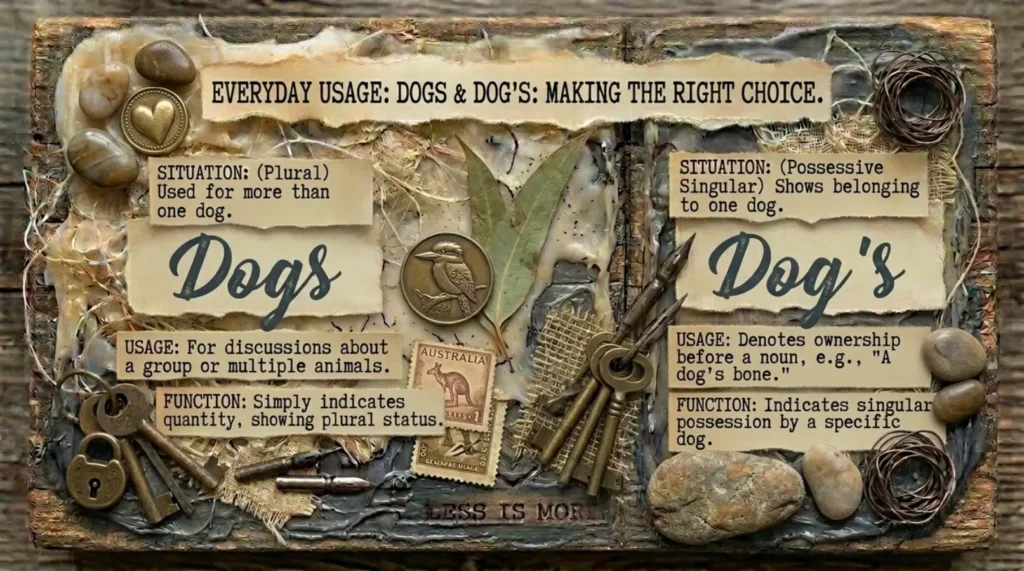
Grammar Rule Behind Dogs and Dog’s
English follows one simple rule.
For Regular Plurals
Add -s
- Dog → Dogs
- Cat → Cats
- Bird → Birds
For Singular Possession
Add ‘s
- Dog’s leash
- Cat’s bowl
- Bird’s nest
For Plural Possession
Add only ‘
- Dogs’ toys
- Cats’ food
- Birds’ nests
Similar Grammar Words
Learning similar words makes grammar easier.
| Singular | Plural | Singular Possessive | Plural Possessive |
|---|---|---|---|
| Dog | Dogs | Dog’s | Dogs’ |
| Cat | Cats | Cat’s | Cats’ |
| Teacher | Teachers | Teacher’s | Teachers’ |
| Student | Students | Student’s | Students’ |
| Parent | Parents | Parent’s | Parents’ |
Synonyms and Related Grammar Terms
LSI Keywords
- plural vs possessive
- apostrophe rules
- English grammar
- possessive nouns
- plural nouns
- grammar examples
- punctuation rules
- apostrophe examples
- dog’s meaning
- dogs grammar
- singular possessive
- plural possessive
- grammar mistakes
- English writing tips
These related terms help readers understand the topic better and improve topical relevance.
Expert Insights
Grammar mistakes often happen because apostrophes look small but change meaning.
Professional editors always check whether a noun shows quantity or ownership before adding an apostrophe.
A simple proofreading habit can prevent most punctuation errors.
Writers, students, bloggers, and business professionals benefit from learning this rule because clear grammar builds trust and improves readability.
Search engines also favor high-quality, easy-to-read content that answers users’ questions directly.
Real-Life Scenarios
Scenario 1
You own three pets.
Correct:
“We have three dogs.”
Scenario 2
One pet has a new toy.
Correct:
“The dog’s toy is new.”
Scenario 3
Three pets share one yard.
Correct:
“The dogs’ yard is large.”
Featured Snippet Answer
Is it dogs or dog’s?
Use dogs when referring to more than one dog. Use dog’s when something belongs to one dog. If something belongs to multiple dogs, use dogs’. The apostrophe shows possession, not plurality.
Frequently Asked Questions
Is dogs or dog’s correct?
Both are correct, but they have different meanings. Dogs is plural, while dog’s shows ownership.
What does dog’s mean?
It means something belongs to one dog.
Example:
The dog’s leash.
What does dogs mean?
It refers to more than one dog.
Example:
The dogs are sleeping.
Is dogs’ correct?
Yes. It shows possession for multiple dogs.
Example:
The dogs’ kennel.
Why doesn’t dogs need an apostrophe?
Because plurals do not use apostrophes. Apostrophes show possession.
How do I remember the difference?
Remember:
- More than one = Dogs
- Belongs to one = Dog’s
- Belongs to many = Dogs’
Can I use dog’s for two dogs?
No. Use dogs’ if two or more dogs own something together.
Why do people confuse dogs and dog’s?
They look similar, but the apostrophe changes the meaning from plural to possessive.
Internal Linking Suggestions
Consider linking this article to related grammar guides such as:
- Apostrophe Rules Explained
- Its vs It’s
- Whose vs Who’s
- Teachers or Teacher’s
- Cats or Cat’s
- Plural vs Possessive Nouns
- Common English Grammar Mistakes
- Singular and Plural Nouns Guide
Conclusion
Understanding is it dogs or dog’s becomes easy once you know the difference between plurals and possessives. Dogs simply means more than one dog, while dog’s shows that something belongs to one dog. If several dogs share ownership, use dogs’. These small punctuation marks can completely change the meaning of a sentence.
The easiest way to choose the correct form is to ask whether you are talking about quantity or ownership. If you are counting dogs, use dogs. If an item belongs to one dog, write dog’s. When something belongs to several dogs, write dogs’. Practice these simple rules in everyday writing, and you’ll avoid one of the most common English grammar mistakes with confidence.

James Carter is a comparison writer and research specialist with over 10 years of experience in digital publishing. With a background in business communication and consumer research, he creates detailed comparison articles, buying guides, and reviews that help readers make informed decisions with confidence. “Every comparison should help readers make better decisions. My goal is to turn complex information into clear, practical guidance that people can trust.” — James Carter