
How to spell nosy or nosey is a common question for English learners and native speakers alike. Both words appear in books, websites, and daily conversations. That often creates confusion. Many people wonder which spelling is correct and when to use each one.
The good news is that both spellings are accepted. However, one spelling is much more common today. The right choice also depends on your audience and writing style.
In this guide, you will learn the meaning of nosy and nosey, their differences, examples, grammar tips, and simple tricks to remember the preferred spelling. By the end, you will know exactly which version to use in school, work, and everyday writing.
Quick Summary Box
- Nosy and nosey have the same meaning.
- Both describe someone who is too curious about other people’s lives.
- Nosy is the preferred modern spelling.
- Nosey is an accepted alternative spelling.
- Most dictionaries list nosy first.
- Use nosy in formal writing and professional content.
- Both are pronounced the same way.
Featured Snippet Answer
How do you spell nosy or nosey?
Both nosy and nosey are correct spellings. However, nosy is the preferred and more common spelling in modern English. It appears more often in books, newspapers, schools, and professional writing. Nosey is an alternative spelling that is still accepted, especially in informal writing.
What Does Nosy or Nosey Mean?
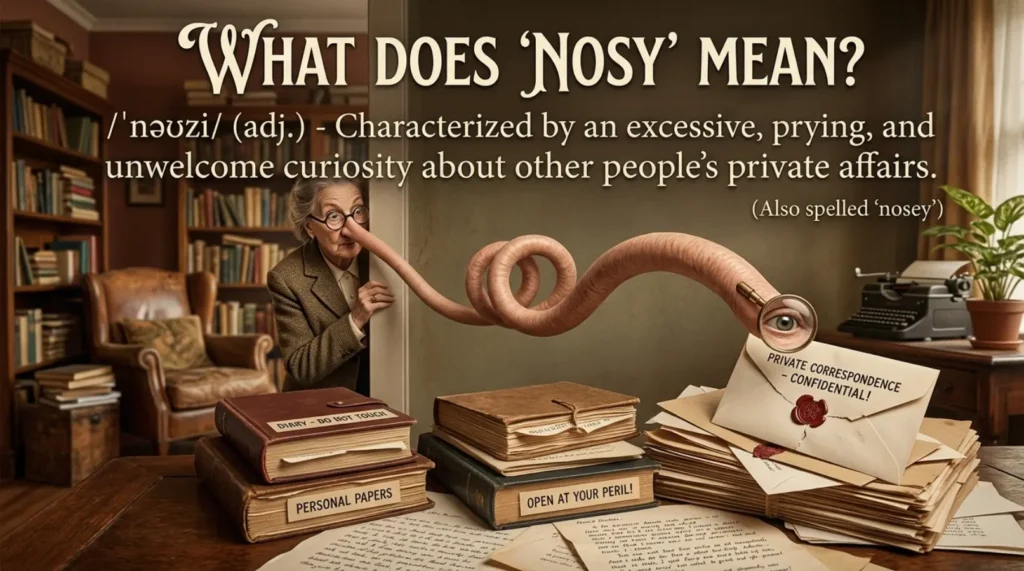
Nosy means being too interested in other people’s private matters.
A nosy person often asks personal questions or tries to learn information that does not concern them.
Simple definition
Nosy: Too curious about other people’s business.
Example
- My neighbor is very nosy.
- Stop being so nosy about my plans.
Is It Nosy or Nosey?
The answer is simple.
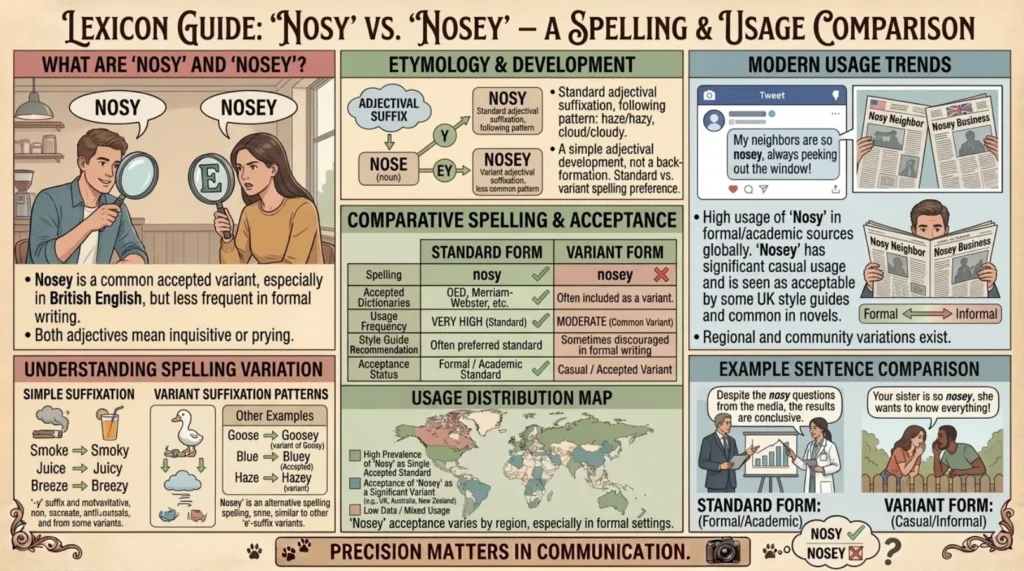
| Feature | Nosy | Nosey |
|---|---|---|
| Correct spelling | ✅ Yes | ✅ Yes |
| Preferred spelling | ✅ Yes | No |
| Used in formal writing | ✅ Yes | Sometimes |
| Common in books | ✅ Very common | Less common |
| Accepted by dictionaries | ✅ Yes | ✅ Yes |
Which should you use?
Choose nosy if you want the safest and most professional option.
Use nosey only if your audience prefers it or you are following a specific style guide.
Why Are There Two Spellings?
English has many words with more than one accepted spelling.
The word comes from nose, suggesting someone puts their “nose” into other people’s business.
Over time, nosy became the shorter and more popular spelling.
Today:
- Schools usually teach nosy.
- Publishers prefer nosy.
- Many dictionaries list nosey as a variant.
How to Remember the Correct Spelling
Remember this easy trick.
Think of “busy.”
Both words end in -sy.
- busy
- easy
- rosy
- nosy
This makes nosy easier to remember.
Another trick:
If you are writing an email, article, report, or school assignment, choose nosy.
Real-Life Examples of Nosy and Nosey
Here are examples you may hear every day.
Using Nosy
- My little brother is very nosy.
- Don’t be nosy about their salary.
- She asked too many nosy questions.
- My friend can be a little nosy sometimes.
- The reporter sounded nosy.
Using Nosey
- My aunt is a bit nosey.
- Stop asking nosey questions.
- The kids became nosey after hearing the noise.
Although both work, most editors would change nosey to nosy.
Nosy vs Nosey Comparison Table
| Feature | Nosy | Nosey |
|---|---|---|
| Meaning | Too curious | Too curious |
| Pronunciation | Same | Same |
| Dictionary accepted | Yes | Yes |
| Preferred today | Yes | Less preferred |
| Best for essays | Yes | Usually no |
| Professional writing | Recommended | Less common |
| Informal writing | Yes | Yes |
Common Mistakes People Make
Many writers make these mistakes.
Mistake 1
Thinking nosey is wrong.
Correct: It is an accepted alternative spelling.
Mistake 2
Using nosey in formal business writing.
Better choice: Use nosy.
Mistake 3
Believing they have different meanings.
Both words mean exactly the same thing.
Mistake 4
Changing spellings in one article.
Stay consistent.
If you choose nosy, use it throughout your writing.
Nosy in Daily Conversations
You will often hear this word in casual conversations.
Examples:
- Don’t be so nosy.
- That’s a nosy question.
- Our neighbor is very nosy.
- My cat is surprisingly nosy.
- Kids become nosy when adults whisper.
The word usually has a negative meaning, but sometimes people use it playfully.
Grammar Tips for Using Nosy
Nosy is an adjective.
It describes a person or a question.
Correct:
- a nosy neighbor
- a nosy reporter
- a nosy child
Incorrect:
- He is nosily asking questions.
Instead write:
- He asked questions nosily.
Notice that nosily is the adverb form.
Synonyms and Related Words
Here are useful alternatives.
Synonyms
- Curious
- Inquisitive
- Prying
- Meddlesome
- Intrusive
- Snoopy
- Interfering
- Busybody
Opposites
- Respectful
- Private
- Reserved
- Discreet
LSI Keywords
- nosy meaning
- nosey meaning
- how to spell nosy
- nosy spelling
- nosey spelling
- nosy definition
- curious person
- prying person
- spelling differences
- English spelling guide
Expert Insights
Language experts agree that both spellings are correct.
However, nosy has become the standard spelling in modern English.
If you write blogs, business emails, school assignments, or website content, choose nosy.
Consistency also matters.
Using one spelling throughout your writing improves readability and professionalism.
Professional editors often replace nosey with nosy during editing.
Real-Life Scenarios
At School
Teacher:
“Please use nosy in your essay.”
At Work
Manager:
“That question sounds a little nosy.”
On Social Media
“My friends are so nosy today.”
Family Conversation
“My little sister is always nosy.”
Should You Ever Use Nosey?
Yes.
You may see nosey in:
- Older books
- Personal blogs
- Informal writing
- Regional preferences
- Creative writing
Still, nosy remains the better choice for most situations.
Frequently Asked Questions
Is nosy or nosey correct?
Both are correct. Nosy is the preferred spelling today.
Which spelling is more common?
Nosy appears more often in modern English.
Is nosey incorrect?
No. It is an accepted alternative spelling.
Should I use nosy in school essays?
Yes. Teachers generally prefer nosy.
Why are there two spellings?
English often has accepted spelling variations that developed over time.
Is nosy American or British English?
Both American and British English commonly use nosy.
What part of speech is nosy?
It is an adjective.
Does nosy have a negative meaning?
Usually yes. It describes someone who interferes in other people’s private matters.
Internal Linking Suggestions
Consider linking this article to related grammar guides such as:
- Nosy vs Nosey Meaning Explained
- Curious vs Nosy: What’s the Difference?
- How to Spell Judgment or Judgement
- Gray or Grey: Which Spelling Is Correct?
- Stationary vs Stationery Explained
- Principal vs Principle Guide
Conclusion
Knowing how to spell nosy or nosey is easier than many people think. Both spellings are correct and carry the same meaning. They describe someone who is overly interested in other people’s private affairs. However, nosy is the preferred spelling in modern English. It appears more often in dictionaries, schools, professional writing, and online content. Choosing nosy helps your writing look more polished and consistent. While nosey remains an accepted alternative, it is less common today. Whenever you are unsure, use nosy for essays, blogs, emails, and business communication. This simple choice keeps your writing clear, accurate, and easy for readers to understand.

Michael Reed is a language content writer and word comparison researcher based in the United States. He studied English Language and Communication and focuses on grammar, spelling differences, and word usage. His work helps readers understand confusing English words through clear comparisons and practical explanations. Michael creates simple, reader-friendly content designed to improve everyday language skills.