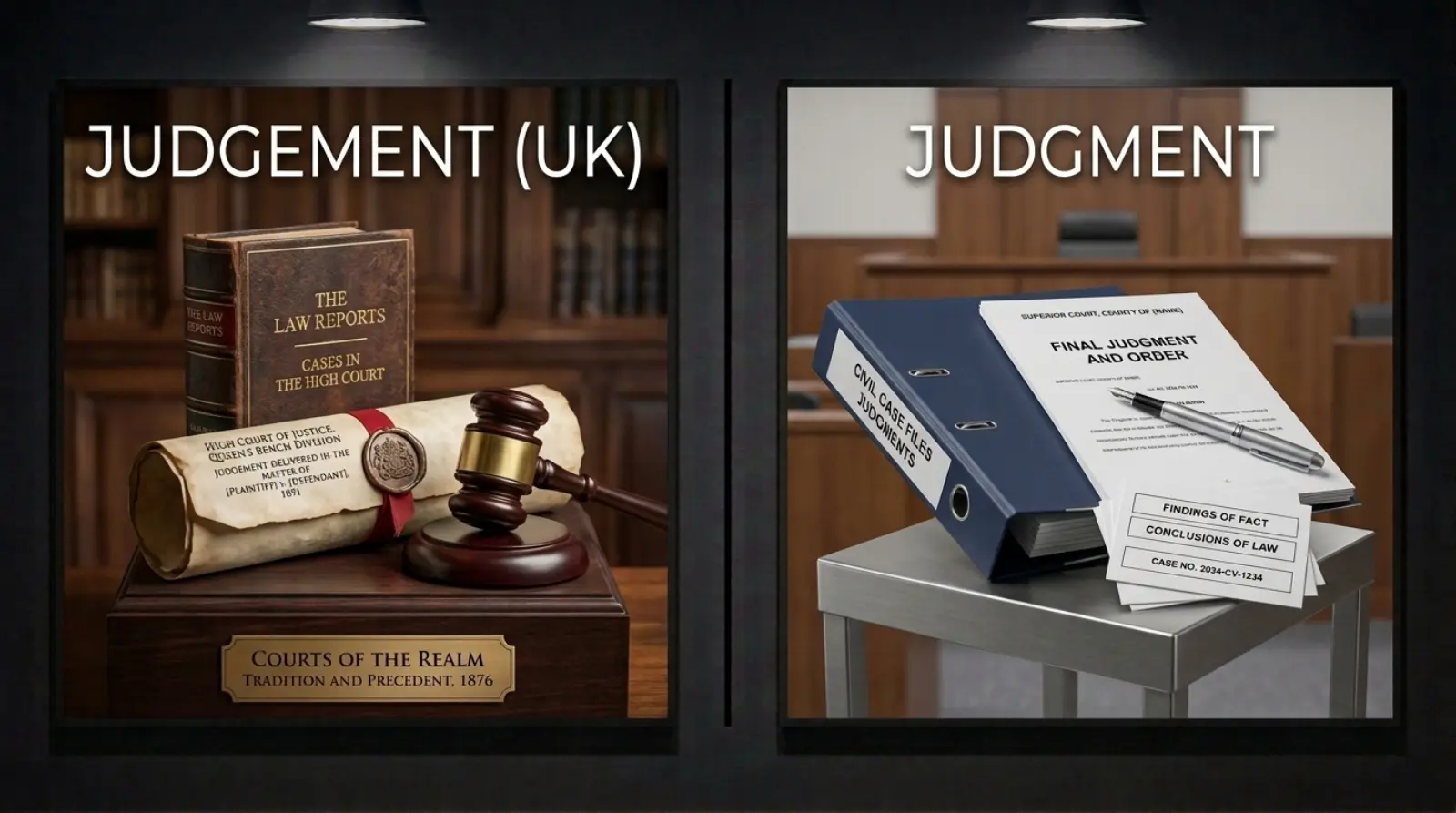
Judgment or judgement UK is a common spelling question for English learners and writers. Many people wonder which spelling is correct. The answer depends on where you write and the style guide you follow.
Both spellings appear in English. However, they are not always used the same way. British English accepts both forms in many cases. American English almost always uses judgment.
Knowing the correct spelling helps you write clearly. It also makes your work look more professional. This guide explains the difference in simple words. You will learn the meanings, spelling rules, examples, and common mistakes. By the end, you will know exactly when to use judgment or judgement.
Quick Summary Box (Featured Snippet)
- Judgment and judgement have the same meaning.
- Both refer to an opinion, decision, or legal ruling.
- Judgment is the standard spelling in American English.
- Judgement is accepted in British English but is less common.
- UK legal documents often use judgment.
- Always follow one spelling style throughout your writing.
What Does Judgment Mean?
Judgment is a noun.
It means:
- The ability to make good decisions.
- A personal opinion.
- A decision made by a court.
- The act of judging something.
Examples
- She showed good judgment during the meeting.
- The judge announced the judgment.
- Trust your own judgment.
- His judgment helped the team succeed.
What Does Judgement Mean?
Judgement has the same meaning as judgment.
The extra “e” does not change the definition.
Many British writers still use judgement in everyday writing. However, many publishers now prefer judgment, especially in formal writing.
Examples
- Her judgement impressed everyone.
- The teacher praised his judgement.
- Good judgement comes from experience.
Judgment vs Judgement UK: What’s the Difference?
The biggest difference is spelling.
| Feature | Judgment | Judgement |
|---|---|---|
| Meaning | Opinion or decision | Opinion or decision |
| American English | ✅ Standard | ❌ Rare |
| British English | ✅ Accepted | ✅ Accepted |
| UK Legal Writing | ✅ Preferred | ❌ Less common |
| Modern Publishing | More common | Less common |
Quick Answer
If you write for an international audience, choose judgment.
If you write informal British English, judgement is also acceptable.
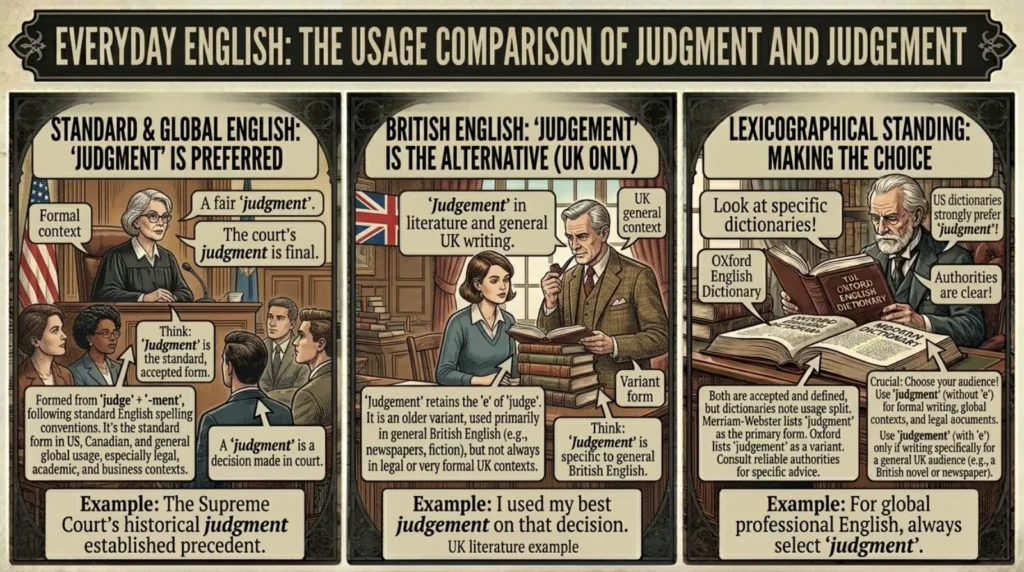
Why Are There Two Spellings?
English spelling has changed over hundreds of years.
Many words developed different forms in Britain and America.
The word comes from Old French and Latin. Early English writers used both spellings.
Later, American English standardized judgment.
British English kept both forms for many years.
Today, dictionaries recognize both spellings in the UK.
Is Judgment or Judgement Correct in the UK?
Yes.
Both spellings are correct in British English.
However, usage depends on context.
Use judgment when:
- Writing legal documents.
- Following Oxford style.
- Writing for international readers.
- Following modern publishing standards.
Use judgement when:
- Following traditional British spelling.
- Your organization prefers it.
- Maintaining consistency with older documents.
Judgment or Judgement in Legal English
Legal English has its own rules.
In courts across the UK, judgment is normally the preferred spelling.
For example:
- Court judgment
- Final judgment
- Judgment order
Legal professionals usually avoid judgement.
If you write legal content, choose judgment.
Real-Life Examples
At School
Correct:
Use your best judgment before answering.
Also acceptable in Britain:
Use your best judgement before answering.
At Work
- Her judgment helped solve the problem.
- Good judgment is important for managers.
In Court
- The judge delivered the final judgment.
- Everyone waited for the court’s judgment.
Daily Conversation
- I trust your judgment.
- That was good judgement.
Common Mistakes
Many writers make these errors.
1. Mixing Both Spellings
❌ The judgment showed excellent judgement.
✅ Choose one spelling and stay consistent.
2. Using “Judgement” in American English
American English almost always uses:
✅ Judgment
3. Using Different Spellings in One Article
Always keep one style.
Consistency improves readability.
Easy Trick to Remember
Think about your audience.
Writing for the USA?
Use:
✅ Judgment
Writing for the UK?
Both work.
For formal writing, choose:
✅ Judgment
For traditional British writing:
✅ Judgement
Judgment or Judgement in Daily Life
You see this word often.
Examples include:
- Business reports
- Court decisions
- News articles
- School essays
- Emails
- Books
- Academic papers
Most international companies now prefer judgment.
Synonyms and Related Words
Here are useful alternatives.
Synonyms
- Decision
- Opinion
- Assessment
- Evaluation
- Conclusion
- Verdict
- Determination
- Choice
- Wisdom
- Insight
Related Keywords
- judgment meaning
- judgement meaning
- judgment vs judgement
- UK spelling
- American spelling
- legal judgment
- British English spelling
- English grammar
- spelling differences
Judgment vs Judgement Comparison Table
| Question | Judgment | Judgement |
|---|---|---|
| Same meaning? | ✅ Yes | ✅ Yes |
| American English | ✅ Yes | ❌ No |
| British English | ✅ Yes | ✅ Yes |
| Legal writing | ✅ Preferred | Rare |
| Modern style guides | ✅ Preferred | Sometimes accepted |
| International writing | ✅ Recommended | Less common |
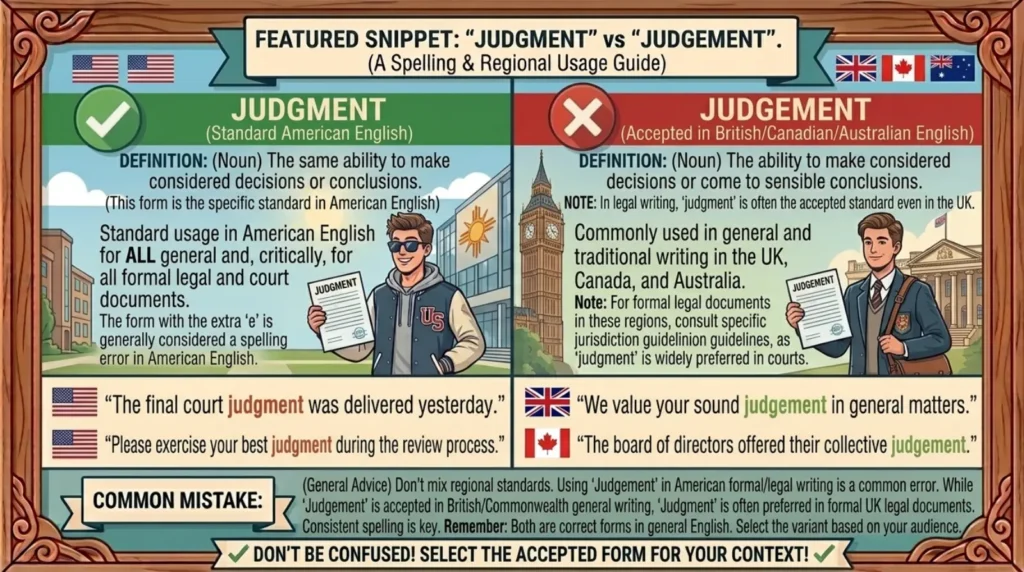
Expert Insights
Professional editors recommend consistency.
Many respected dictionaries accept both spellings in British English.
However, modern publishers increasingly choose judgment.
If your audience includes readers from different countries, judgment is usually the safer choice.
Legal professionals also favor judgment.
Using one spelling throughout your document improves trust and readability.
FAQs:
Is judgement correct in the UK?
Yes. British English accepts both judgment and judgement.
Which spelling is more common today?
Judgment is more common in modern publishing and international writing.
Is judgment American or British?
It is standard in American English. It is also accepted in British English.
Which spelling do UK courts use?
UK legal writing usually prefers judgment.
Do both words have the same meaning?
Yes. They both mean an opinion, decision, or legal ruling.
Should students use judgment or judgement?
Follow your school’s style guide. If there is no rule, judgment is a safe choice.
Why does judgement have an extra “e”?
It reflects an older British spelling tradition.
Which spelling is best for SEO?
Use judgment if you target a global audience. Include judgement naturally for UK searches.
Featured Snippet Answer
Judgment and judgement both mean an opinion, decision, or legal ruling. American English uses judgment almost exclusively. British English accepts both spellings, but judgment is preferred in legal writing and is becoming more common in modern UK publishing.
Internal Linking Suggestions
Link this article to related grammar guides such as:
- Judgment vs Judgement in Legal English
- American vs British Spelling Differences
- Adviser or Advisor
- Practice or Practise
- Licence or License
- Toward or Towards
- Travelling or Traveling
- Program or Programme
Conclusion
Understanding judgment or judgement UK is easier than it first appears. Both spellings share the same meaning and are accepted in British English. However, judgment is the standard form in American English and is also widely preferred in UK legal writing and modern publishing. Judgement remains an acceptable traditional British spelling, especially in informal or stylistic contexts. The most important rule is consistency. Choose the spelling that matches your audience and style guide, then use it throughout your writing. For most international, academic, business, and legal content, judgment is the safest and most widely recognized choice. Using the correct spelling improves clarity, professionalism, and reader trust.

Emma Collins is a language writer and grammar enthusiast specializing in English vocabulary, spelling comparisons, and word usage guides. She creates easy-to-understand content that helps readers improve their writing, communication, and language skills with confidence.