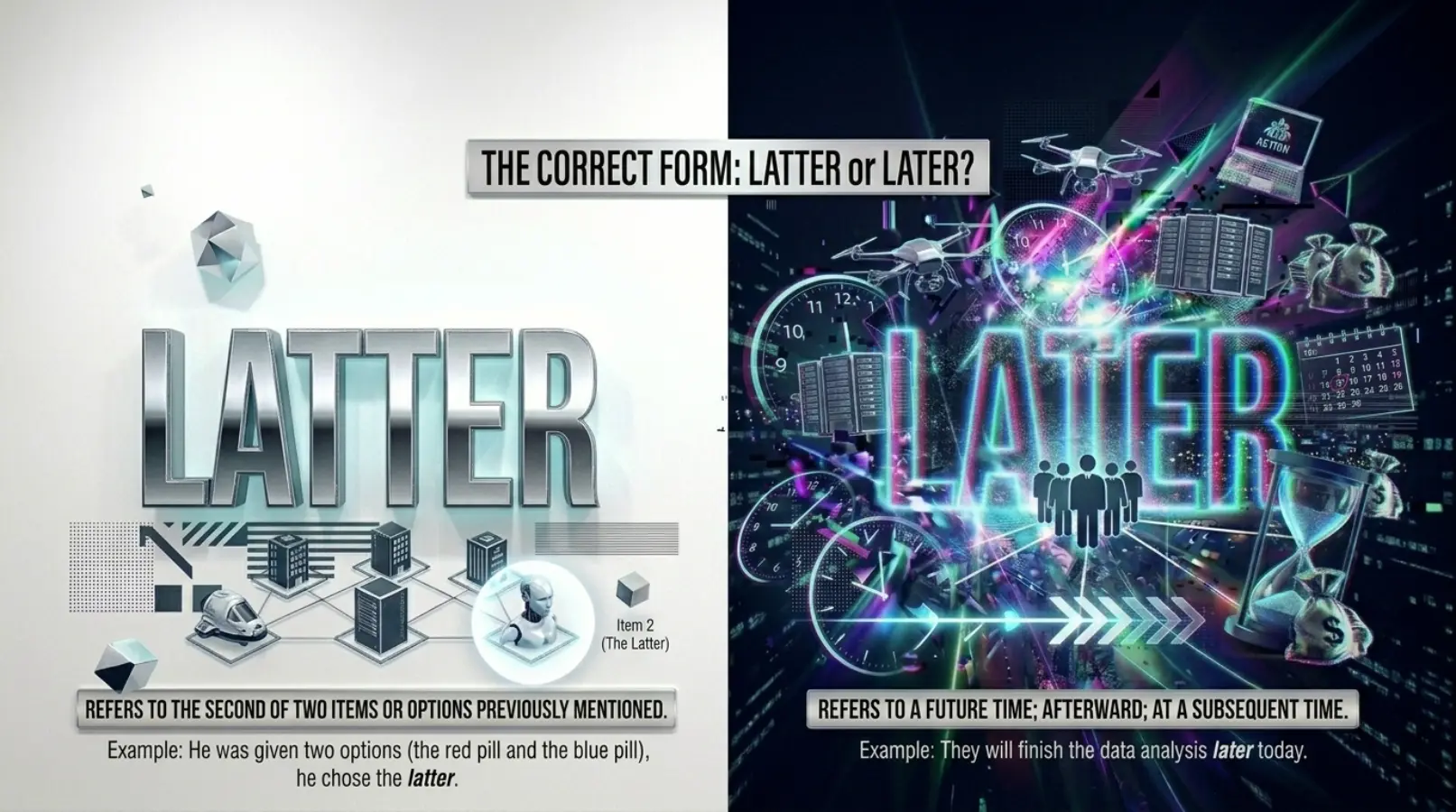
Latter or later is a common grammar question that confuses many English learners. These two words look alike, but they have different meanings. Using the wrong one can change your sentence or make it unclear.
The good news is that the difference is easy to learn. Once you know when to use each word, you will write and speak with more confidence.
In this guide, you will learn the meaning of latter and later in simple English. You will also see comparison tables, real-life examples, common mistakes, memory tips, and expert advice. By the end, you will know exactly which word fits your sentence.
Quick Summary Box
- Latter means the second of two people or things.
- Later means after some time or at a future time.
- Use latter only when comparing two items.
- Use later when talking about time.
- Remember: Latter = second. Later = time.
- Although they look similar, they are never interchangeable.
What Does “Latter” Mean?
Latter refers to the second of two people, ideas, or things already mentioned.
It helps avoid repeating the same word again.
Examples
- I like coffee and tea. I prefer the latter.
- We visited Paris and Rome. The latter was warmer.
- You can choose cake or ice cream. I’ll take the latter.
Simple Definition
Latter = the second of two choices.
What Does “Later” Mean?
Later means after now, after some time, or toward the future.
It tells us when something happens.
Examples
- I’ll call you later.
- We can finish the work later.
- She arrived later than expected.
- See you later.
Simple Definition
Later = after some time.

Latter or Later: Key Differences
| Feature | Latter | Later |
|---|---|---|
| Meaning | The second of two | After some time |
| Refers to | Choice or comparison | Time |
| Part of Speech | Adjective or noun | Adverb, adjective, or adjective comparative |
| Used With | Two people or things | Events and time |
| Example | I prefer the latter. | I’ll finish later. |
When Should You Use “Latter”?
Use latter when talking about two options already mentioned.
Correct Examples
- Between pizza and pasta, I chose the latter.
- Sarah and Emma came. The latter stayed longer.
- We discussed travel and business. The latter seemed more exciting.
Easy Rule
If there are only two choices, you may use latter.
When Should You Use “Later”?
Use later whenever you talk about time.
Correct Examples
- I’ll visit you later today.
- Let’s discuss this later.
- She called me two hours later.
- We’ll meet again later this week.
Easy Rule
If your sentence answers “When?”, use later.
Real-Life Examples of Latter and Later
At School
Teacher: We have math and science today.
Student: I enjoy the latter more.
At Work
Let’s continue this meeting later.
Shopping
I compared two laptops.
The latter had better battery life.
Friends
I’ll text you later tonight.
Travel
We visited London and Edinburgh.
The latter had beautiful castles.
Common Mistakes People Make
Many learners confuse these words because they look almost the same.
Incorrect
❌ I’ll call you latter.
✅ I’ll call you later.
Incorrect
❌ I like apples and oranges. I prefer the later.
✅ I like apples and oranges. I prefer the latter.
Incorrect
❌ See you latter.
✅ See you later.
Easy Tricks to Remember the Difference
Here are simple memory tricks.
Trick 1
Later = Time Later
Both relate to time.
Trick 2
Latter = Last Mentioned
Latter refers to the last item mentioned when only two exist.
Trick 3
Ask yourself:
“Am I talking about time?”
- Yes → Later
- No, I mean the second choice → Latter
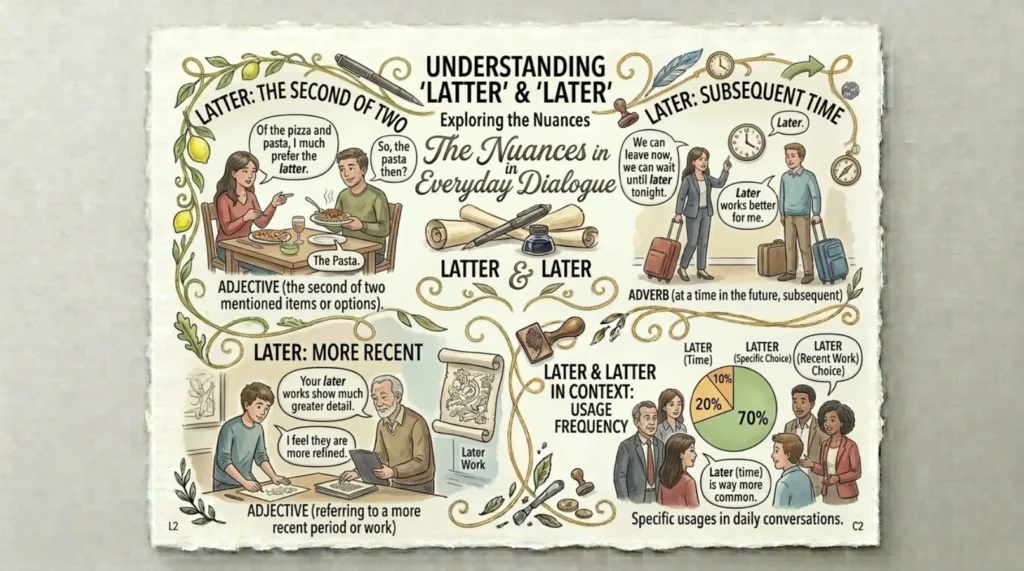
Latter and Later in Everyday Conversations
People use later every day.
Examples
- Talk to you later.
- I’ll eat later.
- We can leave later.
- See you later.
- Call me later.
People use latter less often because it appears mainly in comparisons.
Examples
- Between tea and coffee, I prefer the latter.
- Of the two plans, the latter seems easier.
Synonyms and Related Words
Synonyms of Latter
- Second
- Last mentioned
- Final (in two choices)
- Second option
Synonyms of Later
- Afterwards
- Subsequently
- Eventually
- Afterward
- Next
- In the future
LSI and Semantic Keywords
- latter meaning
- later meaning
- latter vs later
- difference between latter and later
- when to use latter
- when to use later
- latter definition
- later definition
- grammar difference
- English grammar guide
- confusing English words
- latter examples
- later examples
- proper word usage
Expert Insights: Why This Difference Matters
Small grammar mistakes can affect your writing.
Using latter correctly shows you understand comparisons.
Using later correctly makes your timeline clear.
Professional writers, teachers, and editors pay attention to these details. Correct usage improves essays, emails, reports, and business communication.
The easiest rule is simple:
- Latter = second choice
- Later = future time
Master this rule once, and you will avoid one of the most common English mistakes.
Common Grammar Rules
Remember these important rules.
- Use latter only after mentioning two things.
- Never use latter for time.
- Use later whenever discussing the future.
- “See you later” is always correct.
- “The latter” usually replaces the second noun already mentioned.
Practice Sentences
Choose the correct word.
- I’ll see you _____.
- ✅ Later
- We discussed books and movies. I preferred the _____.
- ✅ Latter
- Let’s finish this _____.
- ✅ Later
- Between blue and green, I chose the _____.
- ✅ Latter
- She arrived ten minutes _____.
- ✅ Later
FAQs:
Is it “latter” or “later”?
It depends on the meaning. Use latter for the second of two choices. Use later for time.
Can “latter” mean after some time?
No. Only later refers to time.
Can I say “see you latter”?
No.
The correct phrase is “See you later.”
What does “the latter” mean?
It means the second of two people or things already mentioned.
Which word is more common?
Later is much more common because people often talk about time.
Can “later” be an adjective?
Yes.
Example:
- We caught a later train.
Is “the latter” formal?
Yes. It appears more often in formal writing, articles, and academic English, but people also use it in everyday speech.
How can I remember the difference?
Think:
- Later = Time
- Latter = Second Choice
Featured Snippet: Latter vs Later
| Word | Meaning | Example |
|---|---|---|
| Latter | The second of two things mentioned | I like apples and oranges. I prefer the latter. |
| Later | After some time or in the future | I’ll call you later. |
Quick Answer: Use latter for the second of two choices. Use later when talking about time.
Internal Linking Suggestions
To strengthen your site’s topical authority, consider linking this article to related grammar guides, such as:
- Then or Than
- Further or Farther
- Affect or Effect
- Accept or Except
- Its or It’s
- Who or Whom
- Lay or Lie
- Less or Fewer
Conclusion
Understanding latter or later becomes easy once you know what each word means. Latter points to the second of two people or things already mentioned. Later refers to time and means after now or at a future moment. Although these words look similar, they serve completely different purposes. Remember the simple rule: latter equals the second choice, while later equals time. Practice with everyday sentences, and the difference will soon feel natural. Whether you’re writing emails, school assignments, blog posts, or business messages, using the correct word improves clarity and professionalism. Keep this guide handy whenever you need a quick reminder, and you’ll avoid one of the most common English grammar mistakes.

Emma Collins is a language writer and grammar enthusiast specializing in English vocabulary, spelling comparisons, and word usage guides. She creates easy-to-understand content that helps readers improve their writing, communication, and language skills with confidence.