
Layed vs laid is a common grammar question that confuses many English learners and native speakers alike. At first glance, both words seem correct. However, only one is accepted in standard English.
Knowing the correct word helps you write better emails, school assignments, blogs, and social media posts. It also improves your grammar and makes your writing more professional.
In this guide, you will learn the difference between layed and laid using simple words and real-life examples. We will explain when to use laid, why layed is usually incorrect, and easy tricks to remember the right spelling. By the end, you will never wonder which word to use again.
Quick Summary Box
- ✅ Laid is the correct past tense and past participle of lay.
- ❌ Layed is not a standard English word.
- Lay means to put something down.
- Laid always refers to placing something somewhere.
- Remember: Lay → Laid, not Layed.
What Does “Lay” Mean?
The verb lay means to put or place something down carefully.
It always needs an object.
Examples
- Please lay the book on the table.
- Lay your phone beside your laptop.
- Lay the baby in the crib gently.
You are placing something somewhere.
What Does “Laid” Mean?
Laid is both the past tense and past participle of lay.
You use laid when the action already happened.
Examples
- She laid the keys on the desk.
- They laid fresh flowers at the memorial.
- I laid my bag near the door.
Every sentence shows that something was placed somewhere.
Is “Layed” a Real Word?
In modern English, layed is not the correct past tense of lay.
Most dictionaries and grammar guides consider it incorrect for everyday writing.
Incorrect
- ❌ I layed my phone on the table.
Correct
- ✅ I laid my phone on the table.
There is one rare exception.
In some technical industries, especially when discussing cable installation, people sometimes use layed informally. However, professional writing still prefers laid in almost every situation.
Layed vs Laid Comparison Table
| Feature | Laid | Layed |
|---|---|---|
| Standard English | ✅ Yes | ❌ No |
| Past tense of “lay” | ✅ Yes | ❌ No |
| Accepted in dictionaries | ✅ Yes | Rare or nonstandard |
| Used in school writing | ✅ Yes | ❌ No |
| Used in business writing | ✅ Yes | ❌ No |
| Recommended spelling | ✅ Always | ❌ Avoid |
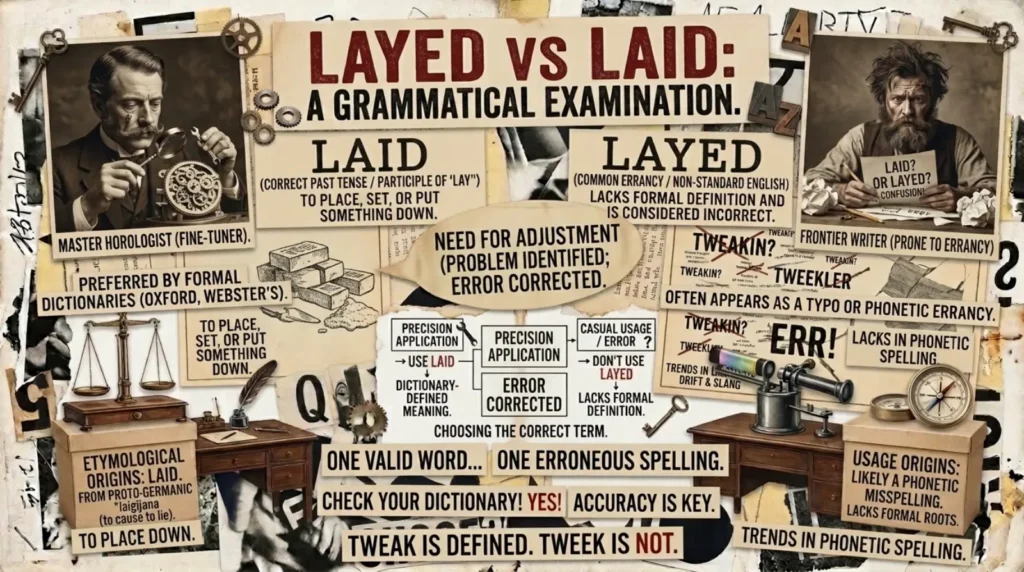
Layed vs Laid Explained in Simple Words
Think about the base verb first.
Present tense:
- Lay the book here.
Past tense:
- I laid the book here yesterday.
Never add -ed to lay.
English uses an irregular form.
Just remember:
| Verb Form | Word |
|---|---|
| Present | Lay |
| Past | Laid |
| Past Participle | Laid |
| Present Participle | Laying |
Why Do People Write “Layed”?
Many people think every verb forms its past tense by adding -ed.
Examples include:
- Play → Played
- Stay → Stayed
- Clean → Cleaned
So they assume:
- Lay → Layed
However, lay is an irregular verb.
Its past tense changed over time.
That is why English uses laid instead.
Real-Life Examples of Laid
Here are common examples you may hear every day.
Home
- Mom laid dinner on the table.
- I laid my jacket on the chair.
School
- The teacher laid the books on each desk.
- Students laid their bags beside the wall.
Work
- She laid the documents on my desk.
- We laid the plans out before the meeting.
Travel
- They laid towels on the beach chairs.
- He laid the map on the hood of the car.
Common Mistakes People Make
Mistake 1
❌ I layed my wallet on the counter.
✅ I laid my wallet on the counter.
Mistake 2
❌ She has layed the table.
✅ She has laid the table.
Mistake 3
❌ They layed new flooring yesterday.
✅ They laid new flooring yesterday.
Mistake 4
❌ We have layed the foundation.
✅ We have laid the foundation.
Lay vs Lie: Don’t Mix Them Up
Many learners confuse lay and lie.
| Verb | Meaning | Past Tense |
|---|---|---|
| Lay | Put something down | Laid |
| Lie | Rest or recline | Lay |
Examples
Lay
- I lay the book down.
- Yesterday I laid the book down.
Lie
- I lie on the sofa.
- Yesterday I lay on the sofa.
Notice how lay belongs to lie in the past tense.
This causes confusion.
Easy Trick to Remember Laid
Try this memory tip:
Lay → Laid
Think:
“I laid it down.”
Never think:
“I layed it down.”
You can also remember this sentence:
The hen laid an egg.
Nobody says:
The hen layed an egg.
This simple example helps many learners remember the correct form.
When Should You Use “Laid”?
Use laid whenever someone or something placed an object somewhere.
Examples
- She laid the baby in bed.
- We laid the cards on the table.
- He laid the phone beside the keyboard.
- They laid fresh grass in the yard.
- The workers laid bricks all day.
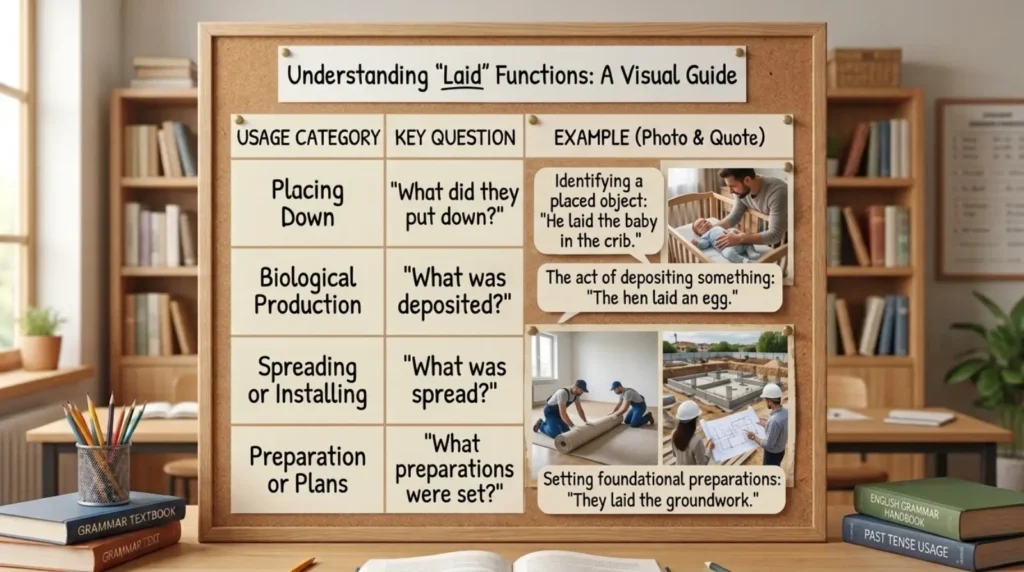
Everyday Sentences Using Laid
Here are more natural examples.
- I laid my clothes on the bed.
- Dad laid the tools in the garage.
- She laid the notebook beside me.
- We laid blankets on the grass.
- The waiter laid the menu on our table.
- The artist laid the paint carefully.
- He laid his hand on my shoulder.
- They laid a path through the garden.
- She laid fresh flowers on the grave.
- I laid everything out before leaving.
Synonyms and Related Words
Synonyms for “Lay”
- Place
- Put
- Set
- Position
- Arrange
- Spread
- Deposit
- Rest
- Install
- Locate
Related Grammar Keywords
- lay vs lie
- laid meaning
- lay past tense
- lay past participle
- laying meaning
- grammar mistakes
- English verbs
- irregular verbs
- correct spelling
- English grammar guide
Expert Insight
Grammar experts agree that laid is the standard past tense of lay.
Using the correct form improves readability and builds trust with readers.
Search engines also reward well-written, grammatically correct content. Good grammar improves user experience and reduces confusion.
If you write blogs, business emails, or academic papers, choosing laid instead of layed helps maintain credibility.
Common Grammar Rules to Remember
- Use lay in the present tense.
- Use laid in the past tense.
- Use laid after has, have, or had.
- Avoid layed in standard English.
- Check whether the verb needs an object.
Featured Snippet Answer
Is it “layed” or “laid”?
Laid is correct. It is the past tense and past participle of lay, meaning to put something down. Layed is not accepted in standard English and should usually be avoided.
Internal Linking Suggestions
To improve your grammar content cluster, consider linking this article to:
- Lay vs Lie Explained
- Laying vs Lying
- Past Tense of Lay
- Common Irregular Verbs in English
- Grammar Rules for Everyday Writing
- English Spelling Mistakes Guide
FAQs:
Is “layed” ever correct?
Generally, no. Standard English uses laid as the past tense of lay.
Why is “laid” correct?
Because lay is an irregular verb. Its past tense is laid, not layed.
Is “laid” the past participle too?
Yes. Both the past tense and past participle are laid.
What is the difference between lay and laid?
Lay is present tense. Laid is past tense and past participle.
Why do people say “layed”?
Many people assume every verb adds -ed in the past tense. However, lay is irregular.
Is “I laid down the book” correct?
Yes. It is grammatically correct.
Is “The hen laid eggs” correct?
Yes. That is the correct sentence.
Can I use “layed” in formal writing?
No. Use laid in academic, business, and professional writing.
Conclusion
Understanding layed vs laid is easier than it first appears. In standard English, laid is always the correct past tense and past participle of lay, while layed is considered incorrect in almost all situations. Learning this simple rule will improve your grammar and make your writing clearer and more professional. Whenever you describe placing something somewhere in the past, choose laid with confidence. Remember the simple pattern: Lay → Laid → Laid. Keep practicing with everyday examples, and the correct form will soon become natural. Small grammar improvements like this can make a big difference in your communication, whether you write emails, school papers, blog posts, or social media updates.

Michael Reed is a language content writer and word comparison researcher based in the United States. He studied English Language and Communication and focuses on grammar, spelling differences, and word usage. His work helps readers understand confusing English words through clear comparisons and practical explanations. Michael creates simple, reader-friendly content designed to improve everyday language skills.