
Truely or truly UK is a common spelling question for students, writers, and English learners. Many people wonder if British English uses truely instead of truly. The simple answer is no. Truly is the correct spelling in both UK and US English. Truely is always incorrect.
This small spelling mistake appears in emails, school work, blogs, and social media. Luckily, it is easy to avoid once you know the rule. In this guide, you will learn the meaning of truly, why people write truely, and how to remember the correct spelling. You will also find examples, grammar tips, a comparison table, FAQs, and expert advice to improve your English writing.
📌 Quick Summary Box (Featured Snippet)
- Correct UK spelling: Truly ✅
- Incorrect spelling: Truely ❌
- Used in British English: Truly
- Used in American English: Truly
- Meaning: In a truthful, honest, or genuine way
- Easy memory trick: Remove the e from true before adding -ly
What Does “Truly” Mean?
Truly is an adverb. It describes how something is done honestly, sincerely, or correctly.
Simple Definition
Truly means:
- Honestly
- Really
- Genuinely
- Sincerely
- Without doubt
Examples
- I truly appreciate your help.
- She truly loves her family.
- This is truly amazing.
- He was truly sorry.
- We truly enjoyed our holiday.
Is It Truely or Truly UK?
The correct spelling in the United Kingdom is truly.
Although British English sometimes keeps extra letters in words, this is not one of those cases.
| Word | UK English | US English | Correct? |
|---|---|---|---|
| Truly | ✅ Yes | ✅ Yes | Correct |
| Truely | ❌ No | ❌ No | Incorrect |
Answer: British English and American English both use truly.
Why Is “Truely” Incorrect?
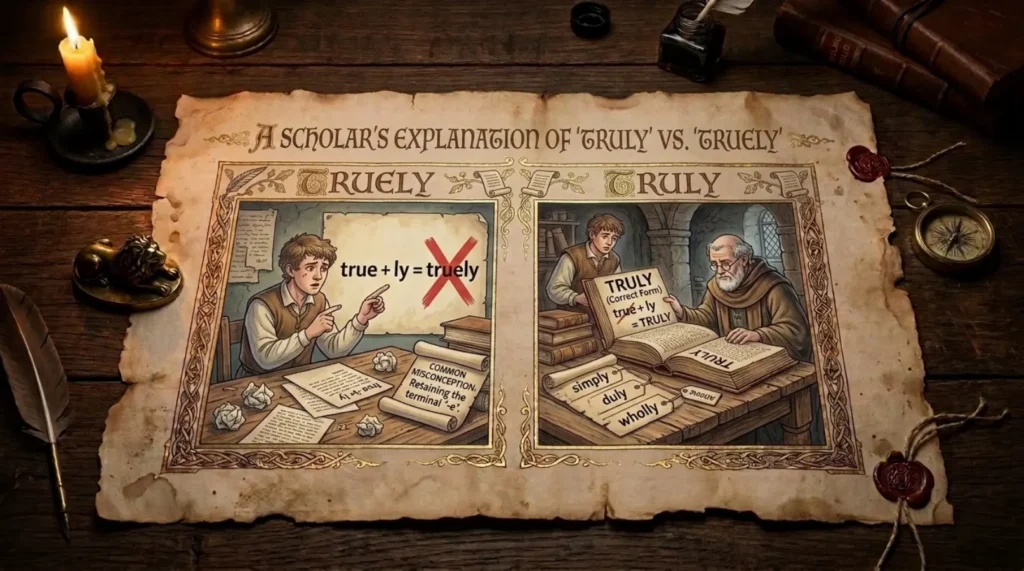
Many people believe adding -ly to true creates truely.
English grammar follows a different rule.
The final e disappears before adding -ly.
Pattern
- True → Truly ✅
- Due → Duly ✅
- Whole → Wholly ✅
The silent e is removed first.
Truely vs Truly Comparison Table
| Feature | Truly | Truely |
|---|---|---|
| Correct spelling | ✅ Yes | ❌ No |
| UK English | ✅ Yes | ❌ Never |
| US English | ✅ Yes | ❌ Never |
| Dictionary approved | ✅ Yes | ❌ No |
| Used in formal writing | ✅ Yes | ❌ No |
| Used in exams | ✅ Yes | ❌ Incorrect |
| Recommended by grammar experts | ✅ Yes | ❌ No |
Grammar Rule Behind “Truly”
Most words ending in e drop the final e before adding -ly.
Examples
| Adjective | Adverb |
|---|---|
| True | Truly |
| Due | Duly |
| Whole | Wholly |
| Noble | Nobly |
| Gentle | Gently |
This spelling rule explains why truely is incorrect.
Why Do People Spell It “Truely”?
Several reasons cause this mistake.
1. The Base Word Ends in “E”
People naturally keep the final letter.
2. Pronunciation
Both spellings sound almost identical.
3. Typing Habits
Many writers simply add -ly without checking spelling rules.
4. Autocorrect Doesn’t Always Catch It
Some apps may miss the error.
Real-Life Examples of Truly
Here are examples you may see every day.
At School
- I truly understand the lesson.
- Your answer is truly correct.
At Work
- We truly value our customers.
- Thank you for your truly excellent work.
In Emails
- I truly appreciate your quick response.
- Yours truly,
- We truly hope to hear from you soon.
On Social Media
- That movie was truly unforgettable.
- You truly inspired me today.
Common Mistakes with Truly
Avoid these errors.
❌ Wrong
- I truely love this book.
- She was truely happy.
- It is truely beautiful.
- Yours truely.
✅ Correct
- I truly love this book.
- She was truly happy.
- It is truly beautiful.
- Yours truly.
Easy Trick to Remember the Correct Spelling
Remember this simple rule:
True loses the “e” before adding “-ly.”
Think about this sentence:
True becomes truly, not truely.
You can also remember:
No “E,” Easy English.
Does the UK Spell Truly Differently?
No.
Some British spellings differ from American spellings.
Examples include:
| UK English | US English |
|---|---|
| Colour | Color |
| Favourite | Favorite |
| Centre | Center |
| Organise | Organize (sometimes) |
However, truly remains exactly the same in both versions.
Truly in Daily Life
You probably use truly more often than you realize.
Everyday Conversation
- I truly believe you.
- That was truly funny.
Business Writing
- We truly appreciate your business.
- Our team is truly committed.
Academic Writing
- The research truly changed our understanding.
- The results are truly significant.
Creative Writing
- She truly missed her hometown.
- It was truly magical.
Synonyms of Truly
Using synonyms improves your writing.
Common Synonyms
- Really
- Honestly
- Genuinely
- Sincerely
- Actually
- Certainly
- Indeed
- Definitely
- Authentically
- Faithfully
Example
Instead of:
- I truly appreciate it.
You could write:
- I sincerely appreciate it.
- I genuinely appreciate it.
Related Keywords (LSI & Semantic Keywords)
Use these naturally in your writing.
Primary Keyword
- truely or truly uk
Secondary Keywords
- truly spelling UK
- truely meaning
- truly meaning
- how to spell truly
- truly or truely
- British English spelling
- English spelling mistakes
- grammar guide
- common spelling errors
- correct English spelling
- truly definition
- truly examples
- UK grammar rules
- spelling rules in English
Expert Insight
Grammar experts agree that truly is the only accepted spelling.
Major dictionaries, educational institutions, and style guides all list truly as the correct form.
Using the correct spelling helps you:
- Build writing confidence
- Avoid grammar mistakes
- Improve academic work
- Write more professionally
- Increase credibility online
If you write blog posts or business content, correct spelling also improves reader trust and supports SEO quality signals.
Featured Snippet Answer
Is it truely or truly in UK English?
The correct spelling is “truly.” British English and American English both use “truly.” The spelling “truely” is incorrect because the final “e” in “true” is dropped before adding “-ly.”
FAQs:
Is truely correct in the UK?
No. Truly is the correct spelling in UK English.
Is truely ever acceptable?
No. Standard English does not accept truely.
Why does true become truly?
The final e is removed before adding -ly.
Is truly an adverb?
Yes. Truly is an adverb describing honesty or sincerity.
Do British dictionaries include truely?
No. They only recognize truly.
Is Yours Truly correct?
Yes. Yours truly is a standard closing in formal letters.
Does Microsoft Word mark truely as incorrect?
Yes. Most modern spell checkers identify truely as a spelling mistake.
How can I remember the correct spelling?
Remember:
True loses the “e” before adding “-ly.”
Common Real-Life Scenarios
Scenario 1
❌ Thank you truely.
✅ Thank you truly.
Scenario 2
❌ Yours truely,
✅ Yours truly,
Scenario 3
❌ I am truely grateful.
✅ I am truly grateful.
Internal Linking Suggestions
To improve your website’s SEO, consider linking this article to related grammar guides such as:
- Truly or Truely: Complete Spelling Guide
- Judgement or Judgment
- Grey or Gray
- Preventative or Preventive
- Lose or Loose
- Weather or Whether
- Principal or Principle
- Stationary or Stationery
Conclusion
Many people search for truely or truly UK because the spelling can seem confusing. Fortunately, the rule is simple. Truly is the only correct spelling in both British and American English. The word truely is a common mistake and should never appear in formal or informal writing. Remember that true drops its final e before adding -ly, giving us truly. Learning this small grammar rule will improve your writing, help you avoid spelling errors, and make your communication more professional. Whenever you are unsure, think of the simple rule: true loses the “e,” so the correct spelling is always truly.

Emma Collins is a language writer and grammar enthusiast specializing in English vocabulary, spelling comparisons, and word usage guides. She creates easy-to-understand content that helps readers improve their writing, communication, and language skills with confidence.