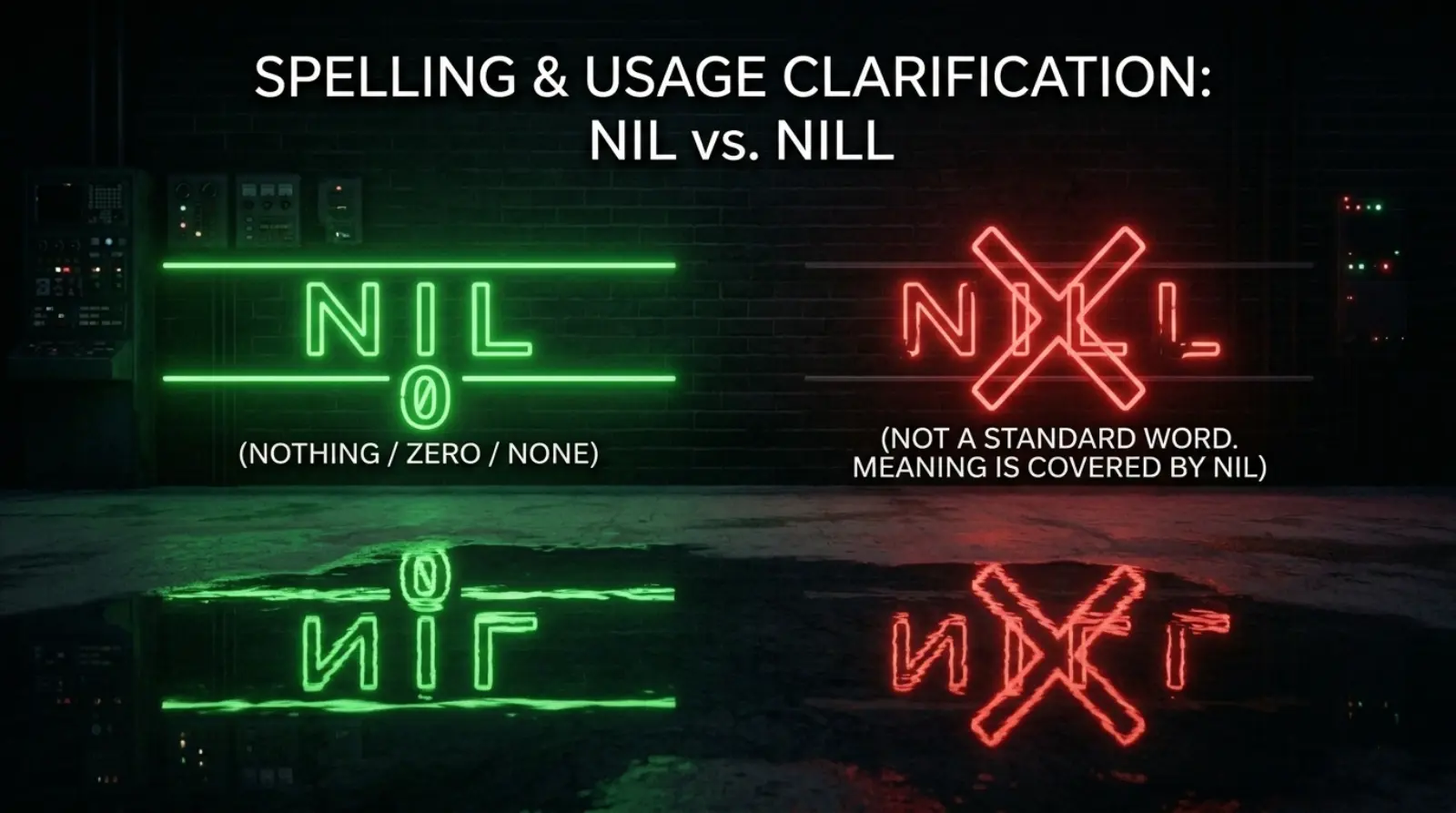
Nil vs nill is a common spelling question that confuses many English learners and writers. At first glance, both words look correct. However, only one spelling is accepted in standard English.
The word nil means nothing, zero, or no value. People use it in sports, business, forms, and everyday conversations. On the other hand, nill is usually a spelling mistake. Most dictionaries do not recognize it as the standard form.
Knowing the correct spelling helps you write with confidence. It also prevents errors in school, work, and online communication. This guide explains the difference in simple words. You will also find examples, grammar tips, common mistakes, and expert advice to help you remember the correct spelling forever.
Quick Summary
- Nil is the correct English word.
- Nill is usually a spelling mistake.
- Nil means zero, nothing, or no amount.
- Use nil in forms, sports, finance, and reports.
- Avoid writing nill unless referring to a rare surname or proper noun.
- Remember: One “L” is always correct.
Featured Snippet Answer
What is the difference between nil and nill?
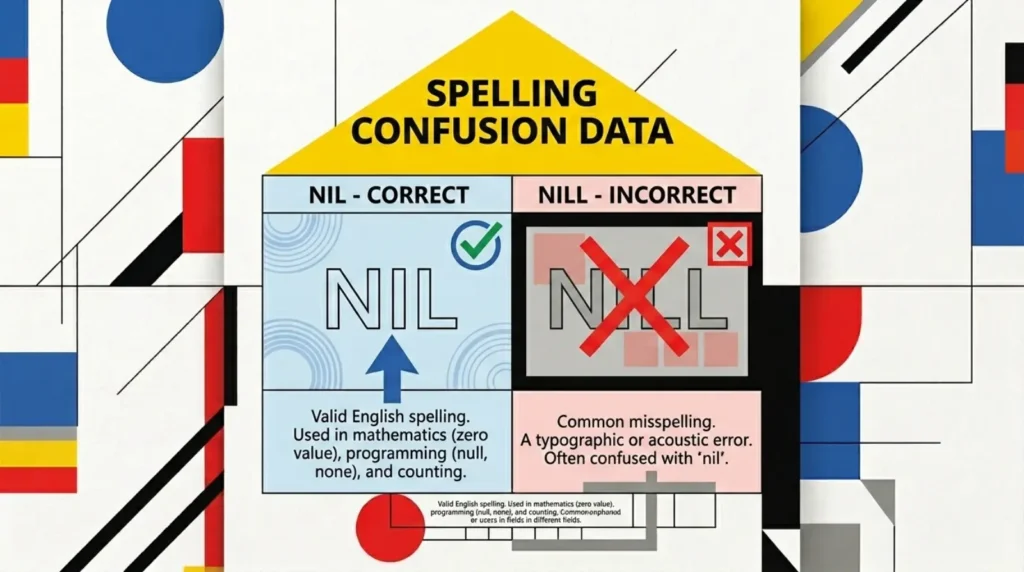
The difference is simple. Nil is the correct English spelling that means zero or nothing. Nill is generally an incorrect spelling and should not be used in normal writing.
What Does “Nil” Mean?
The word nil means:
- Zero
- Nothing
- No amount
- No value
It often replaces the number zero in specific situations.
Examples
- The football match ended 2–0, or two nil.
- My bank balance is nil.
- There was nil evidence against the suspect.
- The company reported nil profit this month.
- She had nil experience before starting the job.
What Does “Nill” Mean?
In modern English, nill is not the accepted spelling of the word.
Most people who write nill actually mean nil.
Very rarely, “Nill” may appear as:
- A family surname
- A place name
- An old or historical spelling
For everyday English, you should avoid using nill.
Nil vs Nill Comparison Table
| Feature | Nil | Nill |
|---|---|---|
| Correct spelling | ✅ Yes | ❌ No |
| Found in dictionaries | ✅ Yes | Rarely |
| Means zero | ✅ Yes | ❌ No |
| Used in sports | ✅ Yes | ❌ No |
| Used in business | ✅ Yes | ❌ No |
| Accepted in formal writing | ✅ Yes | ❌ No |
| Recommended spelling | ✅ Always | ❌ Avoid |
Why Do People Confuse Nil and Nill?
Several reasons cause this mistake.
1. Double-letter confusion
Many English words end with two Ls.
Examples:
- Fill
- Will
- Skill
Because of these words, people mistakenly write nill.
2. Typing errors
Fast typing often adds an extra letter.
3. Pronunciation
Both spellings sound almost identical.
4. Lack of grammar knowledge
Many people simply have never learned the correct spelling.
Real-Life Examples of “Nil”
Here are common situations where nil appears.
Sports
- Manchester won three nil.
- The final score was nil nil.
- Brazil defeated Spain one nil.
Job Applications
- Previous experience: Nil
- Criminal record: Nil
Banking
- Outstanding balance: Nil
- Interest earned: Nil
Medical Forms
- Allergies: Nil
- Current medication: Nil
Business Reports
- Losses were nil.
- Customer complaints were nil.
When Should You Use Nil?
Use nil whenever you mean:
Zero
Example:
The account balance is nil.
Nothing
Example:
There was nil chance of success.
No amount
Example:
Our profit was nil.
No evidence
Example:
Police found nil evidence.
Common Mistakes People Make
❌ Writing “nill”
Wrong:
I have nill experience.
Correct:
I have nil experience.
❌ Using “nil” as a verb
Wrong:
I nilled the report.
Correct:
I completed the report.
❌ Mixing it with “null”
Although both relate to “nothing,” they are different.
Nil means zero.
Null means invalid or without legal effect.
Nil in Everyday English
People use nil more often than they realize.
On Forms
- Dependents: Nil
- Medical conditions: Nil
At Work
- Nil expenses
- Nil inventory
- Nil defects
At School
- Homework completed: Nil
In Government Documents
- Tax due: Nil
- Income: Nil
Nil in Sports
Sports commentators frequently use nil instead of zero.
Examples:
- One nil
- Two nil
- Nil nil draw
Football uses nil more than any other sport.
Examples:
- Arsenal won four nil.
- Liverpool lost one nil.
Nil in Business and Finance
Companies often use nil in official reports.
Examples include:
- Nil revenue
- Nil tax
- Nil balance
- Nil expenses
- Nil debt
Using nil sounds more professional than writing “zero” in many documents.
Nil in Legal and Government Documents
Legal writing often includes nil.
Examples:
- Nil criminal record
- Nil assets
- Nil liabilities
Government forms also use the word because it is short and clear.
Synonyms of Nil
Here are words with similar meanings.
- Zero
- Nothing
- None
- No amount
- Empty
- Void
- No value
- Absent
- Blank
- Missing
Remember that the best synonym depends on the sentence.
Long-Tail Keywords Related to Nil vs Nill
These related search terms help explain the topic naturally.
- nil meaning
- nill meaning
- nil or nill
- correct spelling of nil
- nil definition
- nil in football
- nil examples
- is nill a word
- nil vs zero
- how to spell nil
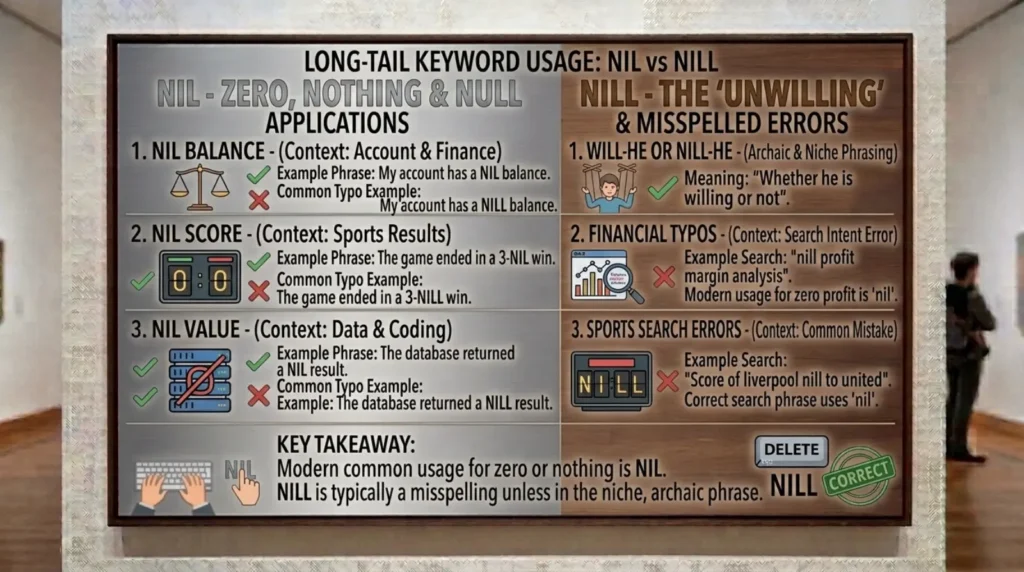
Tips to Remember the Correct Spelling
Remember these easy tricks.
Tip 1
Nil has one L.
Think:
Zero extra letters.
Tip 2
Official forms always use nil.
If you see a government document, notice the spelling.
Tip 3
Football scores use nil.
Example:
Three nil.
Never three nill.
Tip 4
Most dictionaries list nil, not nill.
Common Grammar Rules
Correct
- Nil balance
- Nil income
- Nil complaints
Incorrect
- Nill balance
- Nill experience
- Nill evidence
Expert Insight
Professional writers choose nil because it is the accepted English spelling. Using the correct word improves clarity and builds trust with readers. It also helps avoid grammar mistakes in formal documents, resumes, reports, and academic writing.
Editors, teachers, and employers expect standard spelling. Even a small spelling error can affect the quality of your writing. Learning simple differences like nil vs nill strengthens your English skills and makes your communication more professional.
Frequently Asked Questions
Is nill a real word?
Usually no. In standard English, nil is the correct spelling. “Nill” is generally considered a misspelling.
Which spelling is correct: nil or nill?
Nil is correct.
What does nil mean?
It means zero, nothing, or no amount.
Is nil used in football?
Yes. Football scores often use nil instead of zero.
Example:
Two nil.
Can I write nill in formal writing?
No. Use nil instead.
Is nil the same as zero?
Almost. Both represent nothing, but nil is more common in sports, forms, and official documents.
Why do people spell nil as nill?
They often add an extra “L” because many English words end with double letters.
Is nil commonly used today?
Yes. It appears in sports, legal documents, banking, business, and official forms.
Common Real-Life Scenarios
Scenario 1
Job Form
Work Experience:
Nil
✅ Correct
Scenario 2
Bank Statement
Outstanding Balance:
Nil
✅ Correct
Scenario 3
Football Match
Chelsea 2–0 Everton
Commentator:
Chelsea won two nil.
✅ Correct
Scenario 4
Medical Form
Known Allergies:
Nil
✅ Correct
Internal Linking Suggestions
To strengthen your website’s SEO, consider linking this article to related grammar and spelling guides, such as:
- Nil vs Zero
- None vs No One
- Affect vs Effect
- Bearable vs Bareable
- Preventive vs Preventative
- Other vs Others
- Youth vs Youths
- Chose vs Choose
- Business vs Bussiness
- Nosey vs Nosy
These related articles help readers learn more while improving your site’s internal linking structure.
Conclusion
Understanding nil vs nill is easier than it seems. Nil is the correct spelling and means zero, nothing, or no amount. It appears in sports, business reports, legal documents, banking, and everyday forms. In contrast, nill is usually just a spelling mistake and should not appear in standard English writing.
Using the correct spelling improves your grammar and makes your writing more professional. It also helps readers understand your message without confusion. Whenever you want to express zero or nothing, remember this simple rule: use “nil” with one “L.” Keeping this tip in mind will help you avoid a common mistake and write with greater confidence.

Emma Collins is a language writer and grammar enthusiast specializing in English vocabulary, spelling comparisons, and word usage guides. She creates easy-to-understand content that helps readers improve their writing, communication, and language skills with confidence.