
Nosy or nosey spelling is a common question for English learners and native speakers alike. Many people see both words online and wonder which one is correct.
The good news is that both spellings exist. However, one spelling is more common and widely accepted.
Understanding the difference helps you write with confidence. It also prevents mistakes in school, work, and everyday communication.
In this guide, you will learn the meaning of both words, their differences, real-life examples, common mistakes, and expert tips. By the end, you will know exactly when to use nosy and when nosey may be acceptable.
Quick Summary Box
- Nosy is the most common and preferred spelling.
- Nosey is an alternative spelling.
- Both words mean overly curious about other people’s affairs.
- Most dictionaries list nosy as the standard form.
- Use nosy in formal writing.
- Use nosey only if following a style guide that accepts it.
- Remember: Nosy = Preferred. Nosey = Variant.
What Does Nosy Mean?
The word nosy describes a person who wants to know too much about other people’s private matters.
A nosy person often asks personal questions or listens to conversations that do not concern them.
Simple Definition
Nosy means:
Too interested in other people’s personal business.
Example Sentences
- My neighbor is very nosy.
- She asked several nosy questions.
- Don’t be nosy about their finances.
- The child became nosy about the surprise party.
What Does Nosey Mean?
Nosey has the same meaning as nosy.
It describes someone who interferes in other people’s affairs or asks too many personal questions.
Most modern dictionaries treat nosey as an alternative spelling.
Example Sentences
- He can be a little nosey sometimes.
- Stop being so nosey about my plans.
- The nosey customer wanted every detail.
Although correct, this spelling appears less often than nosy.
Nosy or Nosey Spelling: Which Is Correct?
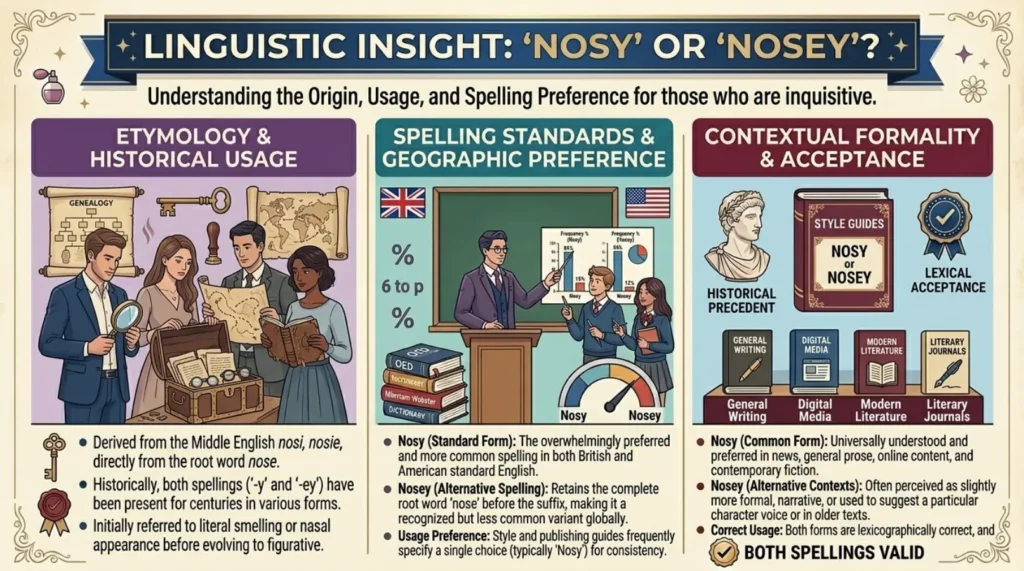
Both spellings are correct.
However, nosy is the preferred spelling in modern English.
Most style guides, dictionaries, teachers, and editors recommend using nosy.
Quick Answer
If you are unsure, choose nosy.
It is more common in:
- Academic writing
- Business communication
- Professional content
- News articles
- Educational materials
Nosy vs Nosey Comparison Table
| Feature | Nosy | Nosey |
|---|---|---|
| Meaning | Overly curious | Overly curious |
| Correct Spelling | Yes | Yes |
| Most Common Form | Yes | No |
| Preferred by Editors | Yes | Sometimes |
| Used in Formal Writing | Yes | Less often |
| Dictionary Accepted | Yes | Yes |
| Recommended Choice | Yes | Alternative |
Why Do People Get Confused?
Many English words come from body parts.
Since the word relates to “nose,” many people assume nosey must be correct.
The confusion grows because both spellings appear online.
People often see:
- Nosy neighbor
- Nosey neighbor
- Nosy questions
- Nosey questions
Since both forms exist, writers often wonder which one to choose.
The History Behind Nosy and Nosey
The word developed from the noun nose.
Historically, people used the expression “sticking your nose into other people’s business.”
Over time, this idea evolved into the adjective nosy.
Some writers kept the connection to the word “nose” and spelled it nosey.
Eventually, nosy became the dominant spelling.
Today, both forms survive, but nosy appears far more frequently.
Real-Life Examples of Nosy and Nosey
At School
- A nosy student keeps asking about another student’s grades.
- A nosey classmate wants to know everyone’s test scores.
At Work
- A nosy coworker asks about salaries.
- A nosey employee constantly checks other people’s projects.
In Families
- A nosy relative asks personal relationship questions.
- A nosey family member wants every detail of your plans.
Online
- A nosy social media user follows every update.
- A nosey commenter asks private questions.
Common Mistakes People Make
1. Thinking Nosey Is the Only Correct Form
Many people believe nosey is correct because it contains the word “nose.”
That is not true.
2. Using Different Spellings in the Same Article
Consistency matters.
Choose one spelling and stick with it.
3. Using Nosey in Formal Writing
Editors usually prefer nosy.
4. Assuming the Meanings Differ
Both spellings have the same meaning.
There is no difference in definition.
How to Remember the Correct Spelling
Here are simple tricks.
Trick 1: Choose the Shorter Word
Nosy is shorter and more common.
Trick 2: Think of Modern Dictionaries
Most dictionaries list nosy first.
Trick 3: Use This Rule
When in doubt, write “nosy.”
This rule works almost every time.
How Nosy Is Used in Daily Life
You hear the word often in conversations.
Everyday Examples
- Don’t be nosy.
- My neighbor is nosy.
- Stop asking nosy questions.
- That reporter seems nosy.
- The children became nosy about the gift.
The word usually carries a slightly negative meaning.
It suggests someone is crossing personal boundaries.

Synonyms for Nosy
Using related words improves writing variety.
Common Synonyms
- Curious
- Inquisitive
- Intrusive
- Meddlesome
- Prying
- Snoopy
- Interfering
- Busybody
Example
Instead of:
- She is nosy.
You could write:
- She is intrusive.
- She is meddlesome.
- She is a busybody.
Related Words and LSI Keywords
Search engines associate these terms with the topic:
- nosy meaning
- nosey meaning
- nosy vs nosey
- correct spelling of nosy
- nosey or nosy difference
- how to spell nosy
- nosy neighbor meaning
- curious person synonym
- intrusive behavior
- meddlesome person
Using these naturally helps SEO.
Expert Insights: Why Correct Spelling Matters
Correct spelling improves clarity and credibility.
Readers trust content that follows accepted language standards.
Professional writers, editors, and teachers generally recommend nosy because it is the dominant spelling in modern English.
Choosing the standard form also helps maintain consistency across articles, emails, reports, and academic work.
If your goal is professional communication, nosy remains the safest choice.
Frequently Asked Questions
Is nosy or nosey the correct spelling?
Both are correct, but nosy is the preferred spelling.
Which spelling is more common?
Nosy is much more common in modern English.
Do nosy and nosey have different meanings?
No. Both words mean overly curious about other people’s affairs.
Should I use nosy in formal writing?
Yes. Most editors and style guides prefer nosy.
Is nosey wrong?
No. It is an accepted alternative spelling.
Why is the word connected to the nose?
The term comes from the idea of sticking your nose into someone else’s business.
What is a nosy person?
A nosy person asks too many personal questions or interferes in private matters.
What is another word for nosy?
Common alternatives include curious, intrusive, meddlesome, prying, and snoopy.
Internal Linking Suggestions
Link this article to related topics such as:
- Commonly confused English words
- Grammar and spelling guides
- Curious vs intrusive behavior
- Everyday vocabulary mistakes
- English writing tips
These internal links can improve user engagement and SEO performance.
Conclusion
The debate over nosy or nosey spelling is simpler than many people think. Both spellings are accepted and share the same meaning. However, nosy is the standard and preferred version in modern English.
Most dictionaries, editors, and style guides recommend using nosy, especially in formal writing. While nosey remains an accepted alternative, it appears less often in professional content.
The easiest rule is simple: when you are unsure, choose nosy. It is the safer option and the one most readers expect to see.
By understanding this difference, you can write more confidently and avoid a common spelling mistake.

Michael Reed is a language content writer and word comparison researcher based in the United States. He studied English Language and Communication and focuses on grammar, spelling differences, and word usage. His work helps readers understand confusing English words through clear comparisons and practical explanations. Michael creates simple, reader-friendly content designed to improve everyday language skills.