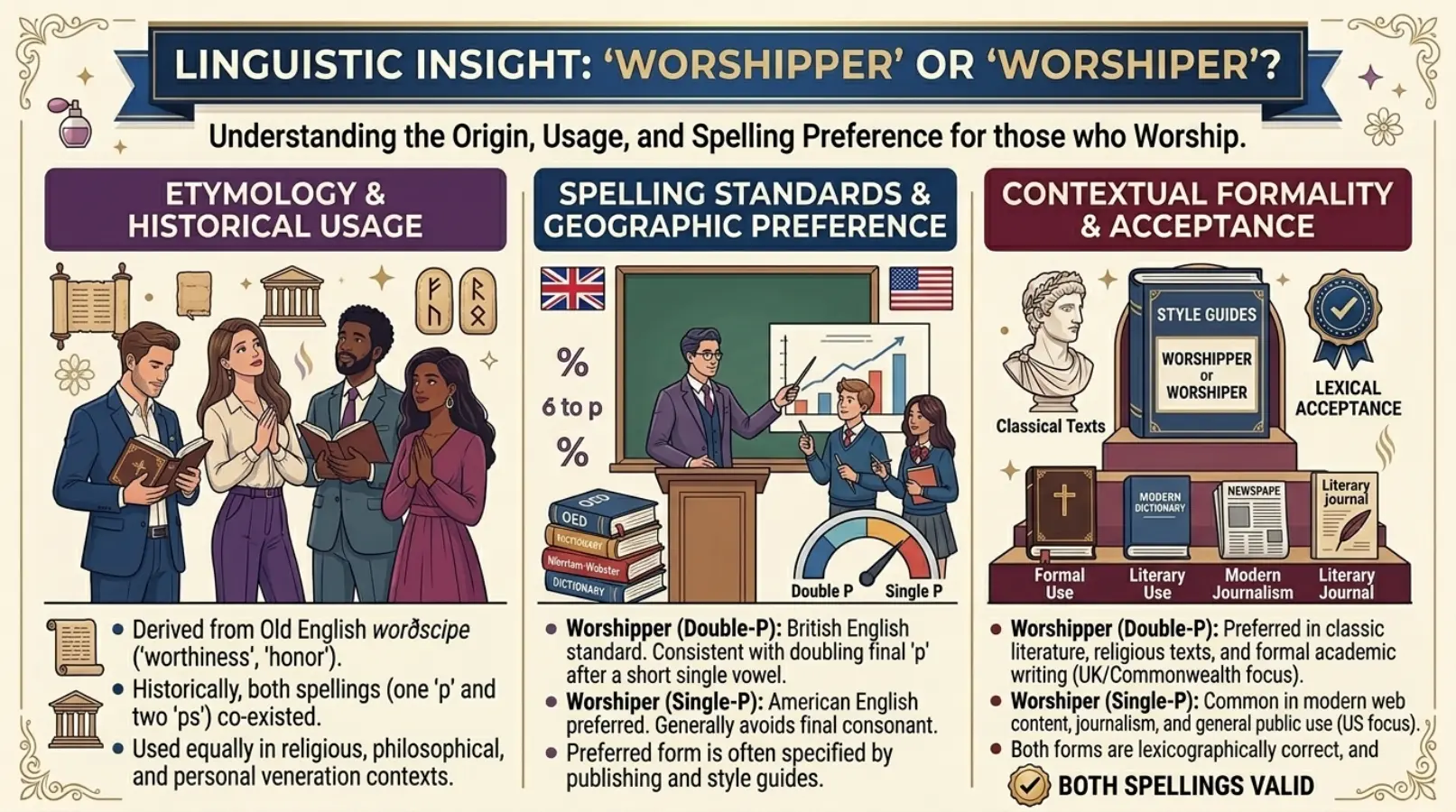
Worshipper or worshiper is a common spelling question that confuses many English writers. Both words refer to a person who worships or shows devotion to a god, religion, or belief. However, their spelling differs depending on the type of English you use.
English contains many words with different spellings across regions. This often creates uncertainty when writing. The good news is that both spellings are correct. The choice depends on whether you follow American English or British English.
In this guide, you will learn the difference between worshipper and worshiper, when to use each spelling, and how to avoid common mistakes. You will also find examples, a comparison table, expert tips, and answers to common questions.
Quick Summary Box
- Worshipper and worshiper have the same meaning.
- Both words mean a person who worships.
- Worshipper is preferred in British English.
- Worshiper is preferred in American English.
- Neither spelling is wrong.
- Use one style consistently in your writing.
- Choose the spelling that matches your audience.
What Does Worshipper or Worshiper Mean?
The words worshipper and worshiper describe a person who worships a deity, religious figure, or sacred belief.
Simple Definition
Worshipper/Worshiper: A person who shows devotion, respect, or religious reverence.
Example
- The worshipper prayed quietly in the temple.
- Every worshiper joined the morning service.
Both sentences are correct. The spelling simply changes by region.
Worshipper vs Worshiper: What’s the Difference?
There is no difference in meaning or pronunciation.
The only difference is spelling preference.
| Feature | Worshipper | Worshiper |
|---|---|---|
| Meaning | A person who worships | A person who worships |
| Pronunciation | Same | Same |
| British English | Preferred | Less common |
| American English | Less common | Preferred |
| Correct Usage | Yes | Yes |
Quick Answer
- Use worshipper for British English.
- Use worshiper for American English.
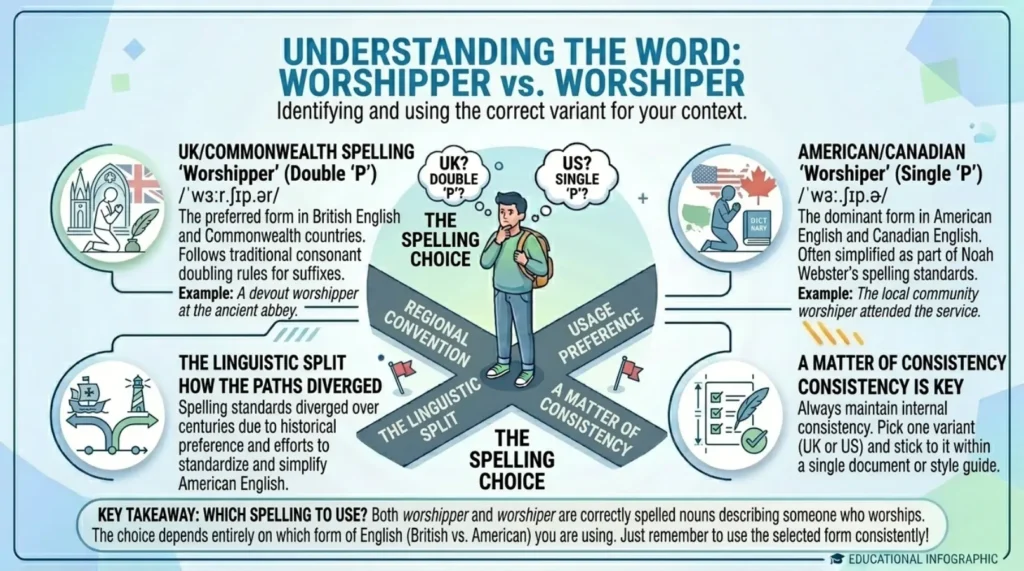
Why Are There Two Spellings?
English developed differently in different countries.
British English often doubles the final consonant before adding a suffix.
American English often simplifies spellings.
This pattern appears in many words.
Examples
| British English | American English |
|---|---|
| Traveller | Traveler |
| Jewellery | Jewelry |
| Counsellor | Counselor |
| Worshipper | Worshiper |
Because of these spelling traditions, both versions remain accepted today.
Which Spelling Is More Common?
The answer depends on location.
In the United Kingdom
People usually write worshipper.
In the United States
People usually write worshiper.
In Other Countries
Countries that follow British spelling often use worshipper.
Examples include:
- United Kingdom
- Australia
- New Zealand
- South Africa
Countries influenced by American English often prefer worshiper.
How to Use Worshipper in a Sentence
Use worshipper when writing for a British audience.
Examples
- The worshipper entered the church quietly.
- Each worshipper received a prayer book.
- A devoted worshipper attended every service.
- The worshipper bowed respectfully.
These examples follow British spelling conventions.
How to Use Worshiper in a Sentence
Use worshiper when writing for an American audience.
Examples
- The worshiper arrived early for prayer.
- Every worshiper listened carefully.
- The worshiper thanked the pastor.
- A faithful worshiper attended weekly services.
These examples follow American spelling conventions.
Real-Life Examples of Worshipper and Worshiper
Seeing words in context helps understanding.
British English Example
“The worshipper lit a candle before leaving the cathedral.”
American English Example
“The worshiper joined the community prayer gathering.”
Online Content Example
A UK church website may write:
- “Visitors and worshippers are welcome.”
A US church website may write:
- “Visitors and worshipers are welcome.”
Both statements are correct.
Common Mistakes People Make
Many writers become confused because both spellings appear online.
Mistake 1: Mixing Spellings
❌ The worshipper joined other worshipers.
✅ The worshipper joined other worshippers.
✅ The worshiper joined other worshipers.
Choose one style and keep it consistent.
Mistake 2: Assuming One Is Wrong
Many people think one spelling is incorrect.
In reality, both are accepted English spellings.
Mistake 3: Ignoring Audience Location
Always consider where your readers live.
A British audience expects British spelling.
An American audience expects American spelling.
Easy Trick to Remember the Difference
Use this simple memory tip.
Remember:
British English likes double letters.
Examples:
- Traveller
- Counsellor
- Worshipper
American English often prefers simpler spelling.
Examples:
- Traveler
- Counselor
- Worshiper
This trick helps you choose the correct version quickly.
Worshipper or Worshiper in Daily Writing
You may encounter these words in many situations.
Religious Articles
- Worshipper (UK)
- Worshiper (US)
Church Websites
Different countries use different spellings.
Academic Papers
Follow the style guide required by your institution.
Business Writing
Match your audience’s regional English.
Consistency matters more than the specific spelling chosen.
Synonyms and Related Words
Using related terms improves writing variety and SEO relevance.
Synonyms
- Believer
- Devotee
- Follower
- Disciple
- Congregant
- Adherent
- Faithful person
Related Terms
- Worship
- Prayer
- Religion
- Devotion
- Spirituality
- Faith
- Churchgoer
- Religious follower
These words naturally support content about worshippers and worshipers.
Expert Insight: Why Correct Spelling Matters
Correct spelling builds trust with readers.
When content matches local language standards, it feels more professional.
Search engines also value clear, high-quality writing.
Writers, bloggers, businesses, and educators should follow the spelling style their audience expects.
Using the right regional spelling improves user experience and strengthens credibility.
For international audiences, choose one version and stay consistent throughout the entire article.
When Should You Use Worshipper?
Use worshipper when:
- Writing for UK readers
- Following British English rules
- Publishing on British websites
- Following British style guides
Example
“The worshipper remained silent during the ceremony.”
When Should You Use Worshiper?
Use worshiper when:
- Writing for US readers
- Following American English rules
- Publishing on American websites
- Following American style guides
Example
“The worshiper attended the service every Sunday.”
FAQs
Is worshipper or worshiper correct?
Both spellings are correct. The choice depends on regional English.
Which spelling is used in the UK?
British English typically uses worshipper.
Which spelling is used in the US?
American English typically uses worshiper.
Do worshipper and worshiper mean the same thing?
Yes. Both words describe a person who worships.
Is one spelling more formal?
No. Both are equally correct and formal.
Can I use either spelling in a blog post?
Yes, but stay consistent throughout the article.
Why does worshipper have a double “p”?
British spelling often doubles consonants before adding suffixes.
Does pronunciation change?
No. Both words are pronounced the same way.
Internal Linking Suggestions
To improve SEO, link this article to related topics such as:
- Worship vs Prayer
- Disciple vs Apostle
- Faithful vs Loyal
- Religious Terms Explained
- Common British and American Spelling Differences
- Traveler or Traveller
- Counselor or Counsellor
These related articles help increase user engagement and topical authority.
Conclusion
The answer to worshipper or worshiper is simple: both spellings are correct. They share the same meaning and pronunciation. The only difference is regional preference. British English usually uses worshipper, while American English prefers worshiper.
When writing, think about your audience first. If your readers are in the UK, use worshipper. If they are in the US, use worshiper. Most importantly, remain consistent throughout your content.
Understanding this small spelling difference helps improve clarity, professionalism, and reader trust. The next time you see worshipper or worshiper, you will know exactly why both versions exist and when to use each one.

James Carter is a comparison writer and research specialist with over 10 years of experience in digital publishing. With a background in business communication and consumer research, he creates detailed comparison articles, buying guides, and reviews that help readers make informed decisions with confidence. “Every comparison should help readers make better decisions. My goal is to turn complex information into clear, practical guidance that people can trust.” — James Carter